The Liver and Gallbladder Flush

The full protocol for clearing the liver's thousand silted ducts, and the profound, whole-body healing that arrives once the bile runs free again.

X邮件

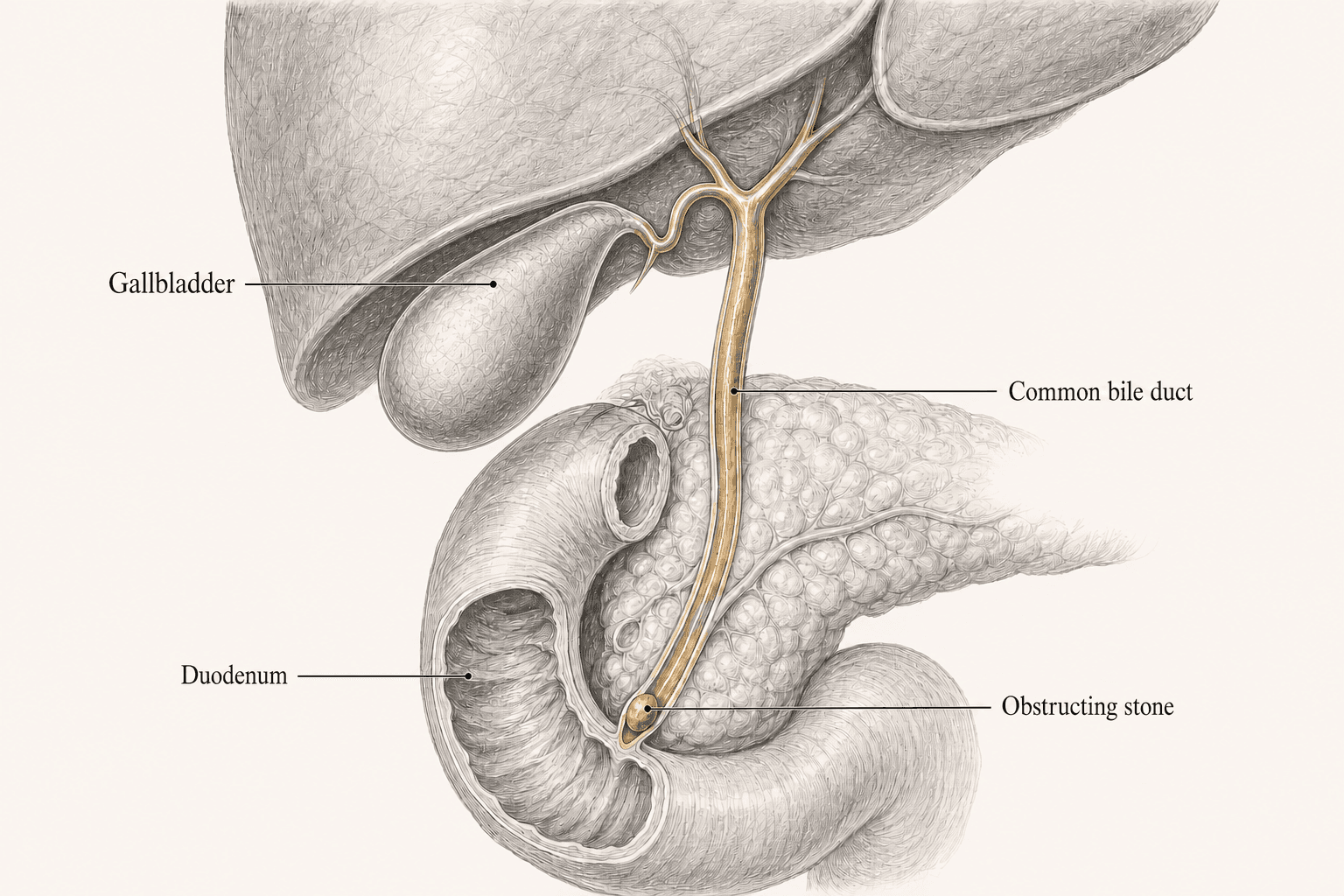
The liver runs somewhere over five hundred distinct jobs: it builds cholesterol and hormones, stores and releases fuel, filters every drop of blood the gut sends up, and manufactures about a liter of bile a day. Every one of those jobs depends on an internal plumbing system of bile ducts so fine and so numerous that anatomists call the liver's interior the biliary tree. There is a single observation about that tree that changes how you read your own health: in most adults it is partially blocked, silently, for years, and almost nobody is looking.

The flush in this essay is the answer to that blockage. It was mapped in its modern form by Andreas Moritz, the Ayurvedic practitioner who spent three decades refining it, and it has since been run, by careful people keeping careful records, hundreds of thousands of times. What follows is the protocol laid out the way it has to be run, the reasoning first, then the steps to the clock and the milliliter, because the flush is one of those interventions where the details are not decoration. In the casework, the details are the whole difference between a profound result and a wasted night.

The thesis: stones the scans do not see

Conventional medicine recognizes gallstones in the gallbladder. They show up on ultrasound because the classic gallbladder stone is calcified, dense enough to bounce sound. The claim here is bolder, and once you have flushed it is undeniable: long before the gallbladder ever fills with hard stones, the liver itself silts up with hundreds, often thousands, of soft ones.

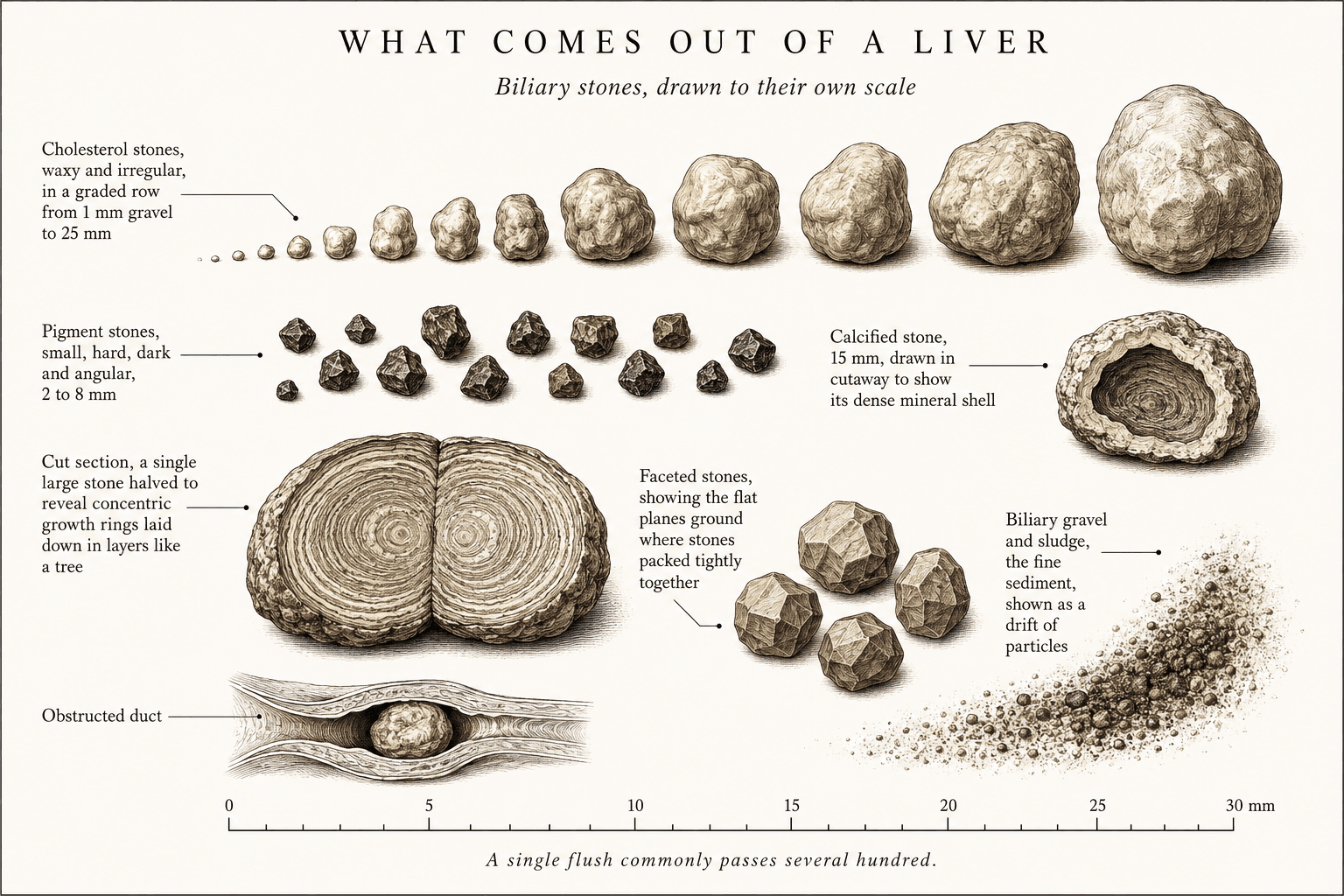
These are not the hard pebbles a surgeon shows you in a jar. They are soft, waxy, pea-green to tan clots of hardened bile, mostly cholesterol, that form silently inside the liver's ducts the way scale forms inside old pipes. Because they are not calcified, they are invisible to the imaging that defines the official picture, which is the whole reason this congestion goes unnamed while it quietly steals years of vitality. The liver, remarkably uncomplaining as organs go, compensates and keeps working, at sixty percent, then forty, then less.

What suffers first is bile. is not a digestive garnish. It is how the body digests fat, how it excretes cholesterol, how it carries processed toxins out of circulation, how it keeps the upper gut alkaline and moving, and part of how it keeps unwelcome organisms from colonizing the small intestine. Choke the ducts and every one of those functions dims at once.

One organ, one obstruction, a hundred downstream complaints. The complaints are not a hundred diseases. They are one plumbing problem wearing a hundred masks.

This is why the otherwise strange catalogue of things that resolve over a series of flushes hangs together so cleanly: bloating and intolerance of fatty meals, constipation, dull skin and acne, allergies, hay fever, recurring headaches, shoulder and upper-back pain along the liver's referred lines, low morning energy, irritability. Especially irritability.

In nearly every traditional physiology the liver is the seat of anger, and the old systems were not wrong: a congested liver makes a congested temper, and a cleared one lets it go.

The hundred masks

Here is the part that turns the flush from a remedy into a key. Map the body the way the book does, system by system, and the same root keeps surfacing under different names. Bile touches digestion, circulation, immunity, hormones, the nervous system, the skin, the joints, the mood. When the ducts silt up, every one of those systems loses its cleanest export channel at once, and what looks like a dozen unrelated diagnoses turns out to be one congestion expressing itself in a dozen places. The book traces the following to chronic biliary congestion, and almost no one, reading honestly, fails to find themselves somewhere on it.

Digestion and gut. Chronic bloating and gas, intolerance of fatty foods, nausea, constipation, diarrhea, irritable bowel syndrome, Crohn's disease, ulcerative colitis, diverticulosis, hemorrhoids, anal fistula, clay-colored or floating stools, bad breath and a coated tongue, hiatal hernia, gastritis, stomach and duodenal ulcers, appendicitis, fatty liver, hepatitis, cirrhosis, and pancreatitis.

Heart and circulation. High cholesterol and triglycerides, hardening of the arteries, high blood pressure, low blood pressure, coronary heart disease and heart attack, an enlarged heart, poor circulation with cold hands and feet, varicose and spider veins, an enlarged spleen, congested lymph, and fluid retention in the legs.

Lungs and immunity. Asthma, chronic bronchitis, frequent colds and flu, sinus congestion, hay fever and seasonal allergies, food sensitivities, swollen lymph nodes, and the lowered, never-quite-well immunity behind recurrent infection.

Brain, nerves and mood. Depression, anxiety, irritability and a short fuse, brain fog and poor concentration, failing memory, chronic headaches and migraines, dizziness and fainting spells, insomnia and broken sleep, numbness and tingling in the limbs, and the slow mental dulling the book links to a body drowning in its own unexported toxins.

Hormones, metabolism and weight. Type 2 diabetes and unstable blood sugar, hypoglycemia, thyroid trouble, stubborn weight gain and obesity, chronic fatigue and flat morning energy, hormonal imbalance, PMS, painful or irregular periods, menopausal misery, infertility, ovarian cysts and fibroids, an enlarged prostate, and lost libido.

Skin. Acne, eczema, psoriasis, rosacea, a dull or sallow complexion, brown liver spots, vitiligo, chronic itching, early wrinkling, and the dark circles and puffiness under the eyes that track a tired liver almost perfectly.

Bones, joints and muscles. Osteoarthritis and rheumatoid arthritis, gout, frozen shoulder and stiff neck, chronic shoulder and upper-back pain, lower-back pain and sciatica, stiff and aching joints, osteoporosis, scoliosis, muscle weakness, knee trouble, and fibromyalgia.

Kidneys and water. A tendency to kidney stones, urinary tract infections, bladder trouble, and the puffy, water-logged heaviness of poor fluid clearance.

The whole body. Chronic fatigue, premature aging, low vitality, body odor, relentless sugar and food cravings, a cold-sensitive constitution, and the diffuse, untreatable feeling of being just never quite well that sends people from specialist to specialist with no name to show for it.

The list is long on purpose, and its length is the whole argument: a single obstructed organ, sitting upstream of every other, does not produce one tidy symptom. It produces this, the hundred masks, and clearing the tree is what lets the masks come off together. The book pushes the same logic further still, to the gravest degenerative conditions medicine treats as separate fates, on the reasoning that an organ this central, left congested for decades, eventually shows its hand in the most serious diagnoses too. Wherever you sit on the list, the invitation is the same: clear the root and watch how much of the rest was only ever the root in disguise.

Why the ducts silt up

The causes read like a description of the default modern life. Overeating, and above all eating heavily late at night, when the liver wants to be cleaning rather than processing. Processed fats and refined food that distort the cholesterol-to-bile-salt ratio until cholesterol crystallizes out of solution. Chronic under-hydration, which thickens bile exactly the way it thickens blood. Rushed meals, stress eating, and the sympathetic nervous tone that squeezes the biliary tree shut, because bile flow is a rest-and-digest function and the modern day has very little rest in it.

Once the first soft stones form, the process feeds itself. Stones obstruct flow, slower flow means more stagnation, stagnant bile grows more stones. Waiting does not fix it. The tree has to be flushed, mechanically, deliberately, and more than once.

The flush, step by step

What follows is the protocol in its standard adult form. It has two parts: six days of preparation, then the flush night and morning. The preparation is not optional. Nearly every disappointing flush traces straight back to skipped preparation.

Days 1 to 6: softening

  • One liter of apple juice, every day, for six days. Sipped slowly between meals, never with food, never cold. The working agent is , which over six days soaks into the stones and softens them so they can deform and pass through ducts narrower than they are. This is the step that makes the flush gentle; hard stones in narrow ducts are how a careless flush turns into a painful one.
  • Eat warm, eat light, eat early. Room-temperature and warm food and drink only; ice-cold drinks chill and contract the bile ducts. Keep animal protein, dairy, and fried food low for the whole week, and finish dinner by early evening each night. The liver should arrive at day six with as little backlog as possible.
  • Clear the colon before the flush. A on or just before day six, so the flush night meets no traffic downstream. The full mechanics of colon work are in the parasite cleanse essay; the two protocols share a foundation.
  • Time it with the calendar, not the mood. Pick a flush day whose following morning is free, a Saturday works. Tradition also times the flush to the lunar cycle where possible: between full moon and new moon, ideally near the new moon, and never on the full moon itself, when the body holds fluid and releases least willingly. It is not mandatory, only conducive.

Day 6: the runway

  • Breakfast: hot cereal cooked in water, oatmeal is the standard, no milk, no butter, no oil, no sugar. Fat is the enemy today; the point is to let zero fire before tonight, so the gallbladder sits full and loaded.
  • Lunch by 1:30 pm: plain rice with steamed vegetables, lightly salted, again zero fat.
  • After 2:00 pm: nothing but water. This rule is absolute. Food in the stomach at 10 pm converts the flush into a night of nausea; the 2 pm cutoff is the single most-broken and most important rule in the protocol.
  • Mix the Epsom salt water: 4 level tablespoons of Epsom salts (magnesium sulfate) in 720 ml of water, divided into four servings of 180 ml each. Refrigerating it improves the taste; a squeeze of lemon in each glass helps it down. This is the one cold drink the protocol permits.

The night

  • 6:00 pm. First Epsom dose, 180 ml. begins dilating the bile ducts and opening the sphincter where the biliary tree empties into the gut. Wide ducts are the second half of painlessness; soft stones are the first.
  • 8:00 pm. Second Epsom dose. Expect watery bowel movements from here on; that is the road being cleared.
  • 9:30 pm. If there has been no bowel movement by now and no colon cleanse in the last 24 hours, take a warm-water enema to open the road manually.
  • 9:45 pm. Build the drink. Squeeze grapefruit, removing the pulp, until you have 180 ml of fresh grapefruit juice, and combine it with 125 ml of light extra-virgin olive oil in a jar. (Fresh lemon plus orange substitutes for grapefruit if needed.) Screw the lid on and shake hard until the mixture is watery and uniform. Visit the bathroom one last time.
  • 10:00 pm. Drink it standing, at the bedside, in one go if you can manage it, within five minutes regardless. Then lie down immediately, this is the step no one should soften, lights out, flat on the back with the head propped on a pillow, or on the right side with the knees drawn up. Hold completely still for twenty minutes with the attention resting on the liver. Many feel the movement directly: a quiet, painless procession under the right ribs. The gallbladder, hit with the largest fat bolus it has seen in years on a fully primed system, contracts to its maximum. The day's pressurized bile blasts the softened stones out of the tree, down the open ducts, into the intestine. Then sleep.

The morning

  • 6:00 to 6:30 am (not earlier). Third Epsom dose. Drowsiness and mild nausea on waking are normal and lift through the morning. Go back to bed or sit upright and rest.
  • 8:00 to 8:30 am. Fourth and final Epsom dose.
  • 10:00 to 10:30 am. Re-entry. Fresh-pressed fruit juice first; whole fruit half an hour later; a light, plain solid meal after another hour. Eat gently for the rest of the day, and by dinner or the next morning the body feels not just normal but noticeably lighter.

The morning bowel movements carry the result: pea-green and tan stones, floating, because cholesterol floats, from gravel-sized grains to occasionally the size of a walnut, along with bile-stained chaff. Count them, loosely, flush after flush. The number matters for one reason only: it tells you when you are done.

The series

A single flush is an introduction, not a result. The flush is run every three to four weeks until two consecutive flushes produce no stones at all. For a typical adult carrying decades of accumulation, expect eight to twelve flushes to empty the tree, sometimes more. Two rules govern the series:

  1. Do not stop halfway. Each flush pulls stones forward from the deep rear of the liver toward the exit ducts. Abandoning the series leaves that mobilized debris parked at the front of the tree, which reliably reproduces the original symptoms and then some. Begin the series intending to finish it.
  2. Colon cleanse within three days after every flush, without exception, for the reasons above. Run a once during any long series, to support the second filter while the first is being emptied.

Once clean, maintenance is one or two flushes a year, and the prep-week habits, warm food, early dinners, real hydration, do most of the work of keeping the tree clear between them.

Who waits

Time the flush around strength, not through weakness. Wait if acutely ill, do not flush during pregnancy or menstruation, and anyone severely depleted should rebuild first; the sequencing for the chronically ill runs colon, kidneys, strength, then liver. Diabetics adjust the apple-juice step with the malic-acid alternatives. People with known calcified gallbladder stones prepare more carefully and for longer, softening more before asking anything to move. The flush is forceful by design; the rule is to bring a prepared body to it.

The soap myth, answered

One claim circulates wherever the flush is discussed: that the green stones are nothing but soap, fatty acids saponified from the olive oil overnight in the gut, never extracted from any liver.footnoteThe soap claim is usually traced to a 2005 letter in The Lancet describing one patient's flush residue assayed as fatty-acid soap. It is a single sample from one fraction of one night, and it cannot account for the calcified stones, the dark pigment gravel, the stones passed by people with no gallbladder, or the durable symptom relief that the full series delivers. A real phenomenon does not stop being real because one part of it can be explained away. It is worth answering directly, because answered directly it falls apart. Some of what passes is indeed saponified oil; the flush uses a quarter glass of oil and the gut does chemistry on it, and no honest account pretends otherwise. But soap formation takes hours, and flushers routinely pass the first wave of stones in the early-morning movements, ahead of the oil's transit. The stones vary, flush to flush, in a way a fixed soap reaction never could: waxy green ones, soft tan ones, dark pigment gravel, and occasionally old calcified stones that no overnight chemistry can build. People whose gallbladders were surgically removed still pass them, which leaves exactly one organ upstream to supply them. And the stones smell of bile, putrid in a way fresh soap is not. The decisive point is the simplest one: the symptom relief tracks the stones. Run the series, watch the stones come, and the bloating, the dull skin, the heavy mornings, and the short temper leave with them; reach two clean flushes and the relief stays. Whatever name a laboratory wants to give the green material, the tree that produced it is clear, and the body reports the difference in a language no assay can argue with.

Judge the flush by the only measure that matters: run the series to two clean flushes, then ask the body for its verdict.

The arc

The first flush is the strange one, the one nobody quite believes until the morning. By the third and fourth, the pattern assembles in full: fatty meals stop announcing themselves, the skin clears the way it does when the gut terrain and the bile flow are both handled, mornings arrive with energy that does not need coaxing, and the short temper that the old physiologies assigned to the liver quietly loses its trigger. The endpoint is nothing exotic and all the more profound for it: a liver doing all of its five hundred jobs at full flow, which a body then translates into the ordinary miracle of feeling well.

Sources

  1. The Amazing Liver and Gallbladder Flush, Moritz, A.
  2. Timeless Secrets of Health and Rejuvenation, Moritz, A.
  3. Magnesium sulfate and sphincter of Oddi motility, Various (clinical pharmacology literature)
  4. Cholecystokinin and gallbladder contraction in response to dietary fat, Various (gastrointestinal physiology reviews)
  5. Malic acid as a solubilizing and chelating agent, Various (food chemistry literature)
发表
阅读
11 分钟
出处
5