
The Parasite Cleanse
A thirty-day protocol that empties the gut of its parasites and their biofilm, killing the bad without touching the good.
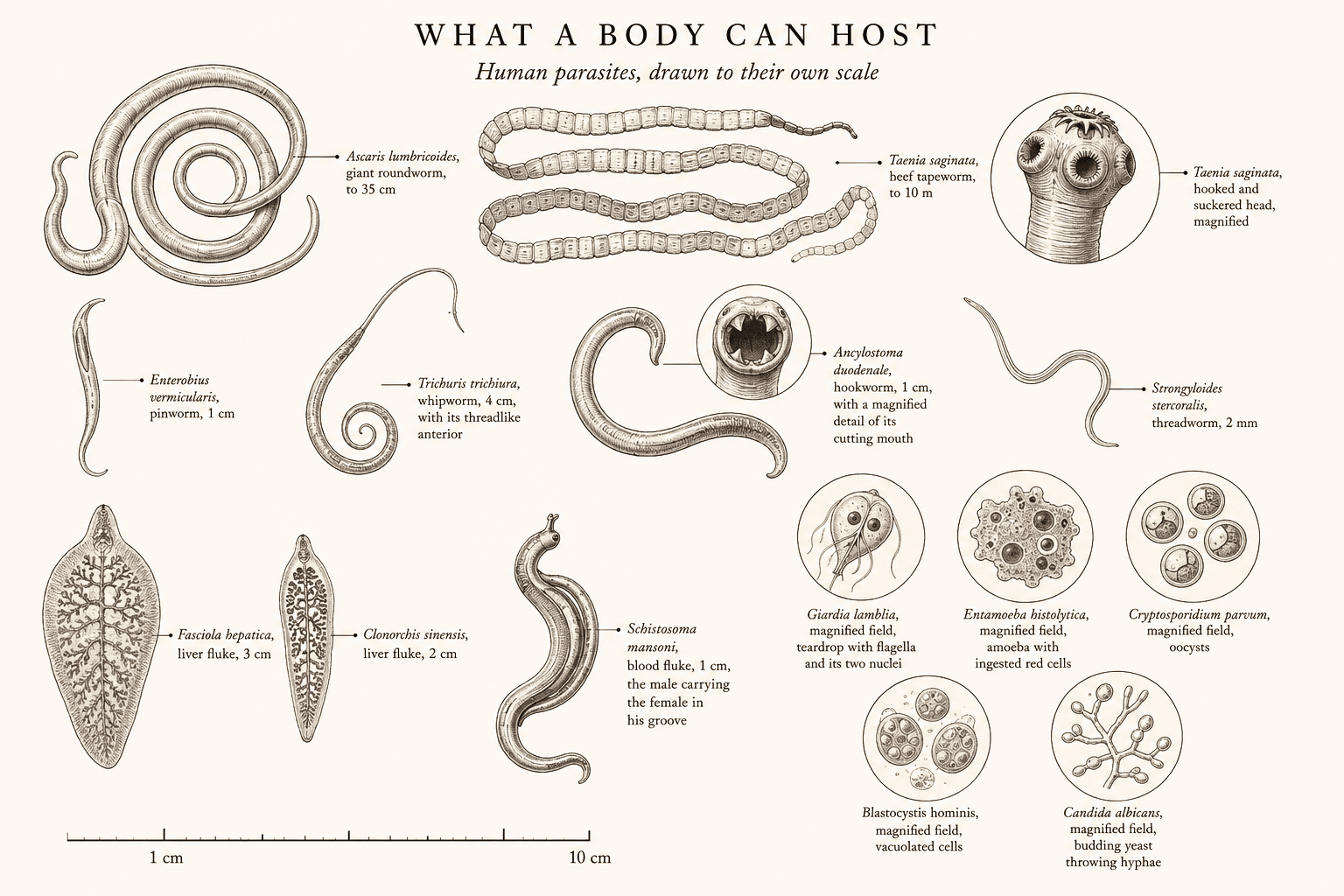
Something other than you is living in your gut, and the odds it is something you would not want there sit between fifteen and forty percent. That is the range Western clinical surveys return for parasitic or protozoal colonisation in adults, depending on the population studied and how sensitive the assay is.
In a large share of those adults it is doing real damage: the autoimmune disease nobody can find a trigger for, the anaemia that returns however much iron you take, the gut no PPI has ever fixed, and years of inflammation written off as stress because nothing on the panel explains it.
Mainstream Western medicine still files parasites under tropical travel. They are not a tropical problem. They are a resident one.
The thirty-day protocol below evicts that load without nuking the good flora. It is one of the cheapest, highest-leverage interventions an adult can run on their own body, and the gap between people who have run it and people who have not is wider than almost any other single variable worth tracking.
Garlic does the work of an antibiotic on the pathogens, without doing the harm of an antibiotic to the good bacteria.
What you get back
A short, concrete list. Each item shows in the mirror inside two cycles.
- Cleaner, faster bowel movements. Transit time drops from twenty-four hours to twelve or under. Stools form, regularise, stop carrying the old residue.
- Energy that holds through the afternoon. The chronic low-grade inflammation a coated, colonised colon broadcasts is what most adults are calling "tired." Take the broadcast out and the baseline lifts.
- Cognitive clarity. Brain fog has multiple causes, but a leaking gut wall flooding the bloodstream with microbial debris is one of the more common ones. Seal the wall and the fog lifts.
- Mood stability. Roughly ninety percent of the body's serotonin is made in the gut. The microbes that make it need a clean field to work in.
- Skin clears. What the bowel cannot excrete the skin tries to. Fix the bowel and the skin stops compensating.
- Sleep deepens. A colon that finishes its work by evening stops waking the nervous system at three in the morning.
- Autoimmune markers settle. Many patterns that show up as autoimmune are downstream of a permeable gut and a chronically alarmed immune system. Repair the wall, calm the alarm.
What returns to you is a faculty most adults have lost the use of: a gut that does its job quietly and on time.
The colon as terrain
The gut is the body's interface with the world. Every gram of food, every drop of water, every microbe that hitches a ride, every environmental toxin passes through a single twenty-five-foot tube before the body decides what to absorb and what to send out the other end. That decision sets more of the body's downstream chemistry than almost any other single variable.
The colon itself is roughly five feet of muscular tube. Its job is to pull the last water and minerals out of what you ate, to house a fifty-trillion-cell microbial community, and to move waste out within twelve to twenty-four hours of when you swallowed it. When it works, things move through quickly, stools are formed and regular, and the microbes inside produce a steady stream of useful chemistry: that feed the cells of the colon wall, B vitamins, vitamin K2, and the raw materials the brain uses to make its neurotransmitters.
That is the baseline. Three things break it.
What breaks it
Stagnation and the mucoid plaque
The lining of the gut produces a slick coat of mucus to protect itself from digestive acids and the abrasive bits of whatever you ate. In a healthy gut this coat is constantly shed and replaced, sloughed off with each wave of muscular contraction and remade from below. In a gut starved of fibre, short on water, slow to move, and chronically exposed to processed food, the coat builds up instead of clearing. It hardens into a rubbery layer that sticks to the colon wall and will not come off on its own.
Dr. Richard Anderson, the clinician most associated with documenting this in modern terms, watched clients pass long sheets of dark green to black rubbery material during sustained cleanses. A colon coated in old mucus, fibrin, and food debris cannot absorb nutrients well, cannot move waste out cleanly, and cannot house a balanced microbial community. The layer physically sits between the food and the surface the gut uses to absorb anything, the . And it makes a comfortable home for the wrong organisms to set up shop.
A second load presses on the same system. The gut handles whole foods, whole plants, whole animals, fermented grains, cleanly, because their structures are the ones its enzymes evolved to take apart. is harder work: stripped of the fibre that keeps things moving, dense, slow to clear.
When transit is sluggish and fibre is low, that poorly digested residue lingers instead of leaving. It catches in the mucus coat, dries and hardens alongside it, adds to the load. A modern colon therefore often carries two overlapping residues: the natural mucoid plaque, and a layer of old, stale, undigested food that processed eating leaves behind when the bowel runs slow.
The first thing the body needs is for both to go.
Microbes out of balance
A healthy adult colon holds tens of trillions of microbes, from five hundred to a thousand species. The right ones, the strains the body has co-evolved with for as long as there have been bodies, produce the small fatty acids that feed the colon wall and the chemicals that keep the seams between gut cells tight.
When the balance tips, the wrong things move in. A common fungus overgrows. Gas-producing species take over. Single-celled parasites and larger worms colonise the tract, and this is more common than the mainstream picture suggests. The fifteen-to-forty-percent points here.
The wall starts leaking
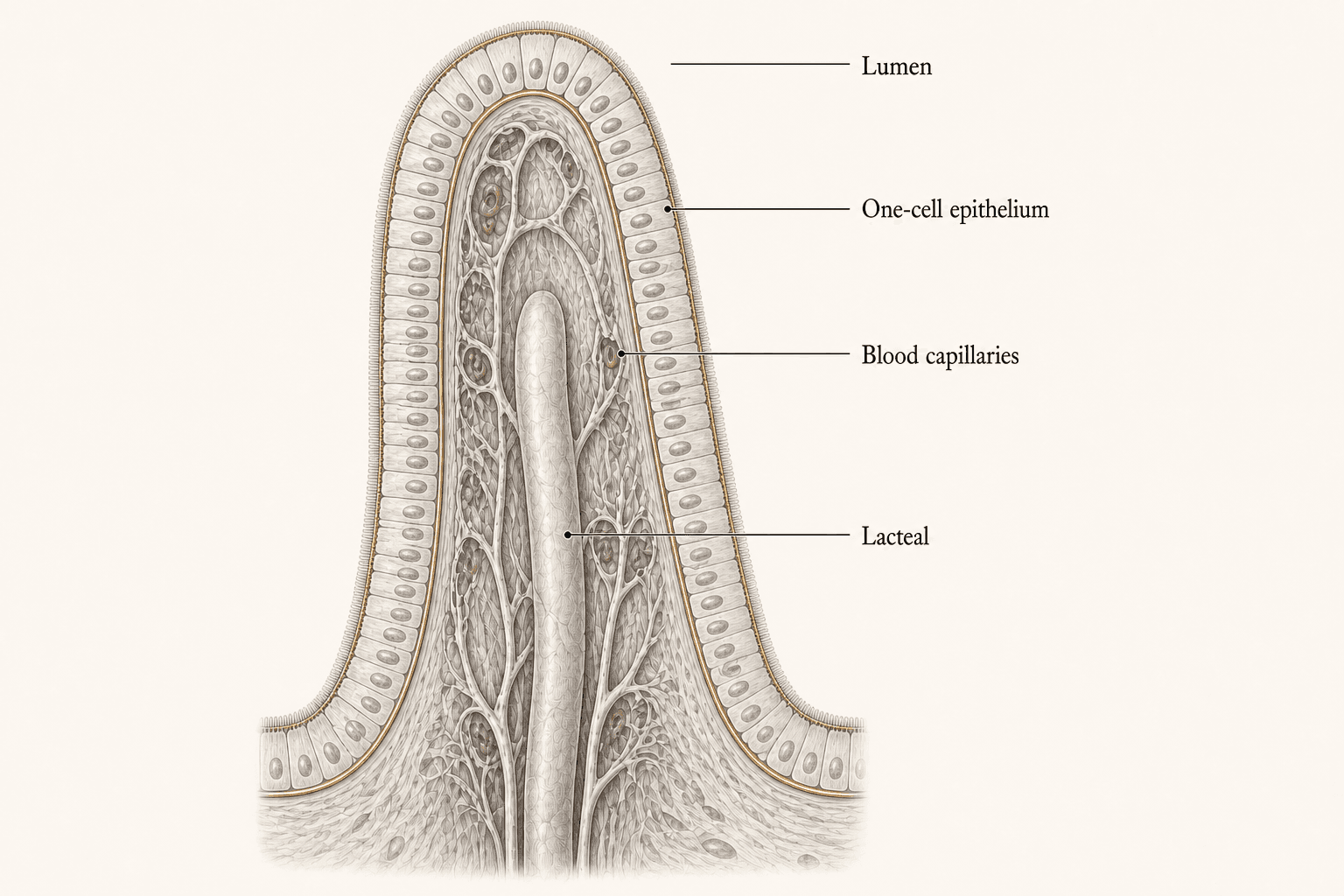
The third problem is the consequence of the first two. The barrier is one cell thick: a single row of cells stands between what you swallow and the blood behind it. A gut wall inflamed for years gets leaky, the seams between those cells open, and partly digested food and microbial debris cross into the bloodstream when they should not. The body reads this as a chronic injury and answers with chronic inflammation. The result is the familiar constellation: tiredness that does not lift, brain fog, mood problems, the autoimmune patterns so many chronically ill adults are now living inside.
What the protocol must do
A serious gut cleanse has to do four things, in order. If any of the four is wrong, the others do not land.
- Break up the stagnation. Soften the old mucus layer and get it moving, so the rest of the protocol can reach the gut wall behind it.
- Kill the pathogens. Take out the parasites, the fungal overgrowth, and the opportunistic bacteria, selectively, leaving the good bacteria alone.
- Move it out. Keep the gut moving fast enough that the dead organisms and dislodged debris leave the body, rather than getting reabsorbed back through the gut wall in the .
- Reseed and repair. Repopulate the good bacteria and rebuild the gut lining once the field is clean.
The bile has to be running before anything is killed
Underneath all four sits a condition almost nobody lists, because bile gets filed as a digestive aid. It is the body's own antiparasitic, and it is the current that carries the kill out of the body.
are detergents in the strict chemical sense. Fat-soluble on one face, water-facing on the other, they assemble into micelles and pull lipid out of whatever membrane they meet. On dietary fat that reads as emulsification.
On an organism it reads as damage. Protozoal membranes, the outer tegument of a worm, and the lipid layer that carries a helminth egg intact through stomach acid are all built from the material bile dissolves. A duodenum taking strong, concentrated, continuous bile is chemically hostile ground. The reason a healthy small intestine stays thinly populated while the colon houses fifty trillion organisms is in large part bile doing that work every hour, unprompted, for a lifetime.
Bile is also the exit.
The kidney takes the small water-soluble conjugates; the bulky ones, and the fat-soluble load bound to glutathione and glucuronic acid, leave in bile, and so does everything this protocol kills: dead organisms, their debris, the dislodged plaque, the metals the garlic bound. All of it rides bile down the duct into the duodenum and out along the length of the bowel. Bile acids reaching the colon also pull water into the lumen and drive the muscle, so the fluid that carries the load is part of what moves it. Kill without flow and the kill has nowhere to go. It sits high in the small intestine, against the thinnest and most absorptive wall in the body, and the enterohepatic loop hands it back to the blood the liver has just finished cleaning.
A congested liver and a silted biliary tree mean bile that is thin, slow and insufficient. The duodenum loses its chemical defence at the exact moment the herbs are driving organisms into it, transit slackens, and the loop turns the protocol against itself. This is why a person can run a technically perfect kill, every agent at the right dose at the right hour for thirty days, and finish it feeling poisoned rather than clean.
The killing was never the part that failed. The exit was shut.
So the liver and gallbladder flush is not an adjacent protocol for later. It belongs upstream of this one, or running alongside it.
Clearing the ducts restores the volume and concentration of bile arriving in the duodenum, which restores the chemical defence and the carriage in the same stroke, and the liver and gallbladder flush sets out the six-day preparation and the flush night in full. One practical note when the two run together: while the parasite load is still live, use the malic acid powder or the apple cider vinegar version of the six-day preparation rather than a litre of apple juice a day, which feeds the organisms this protocol is starving.
Here is the protocol.
1. Castor oil, the mechanical reset
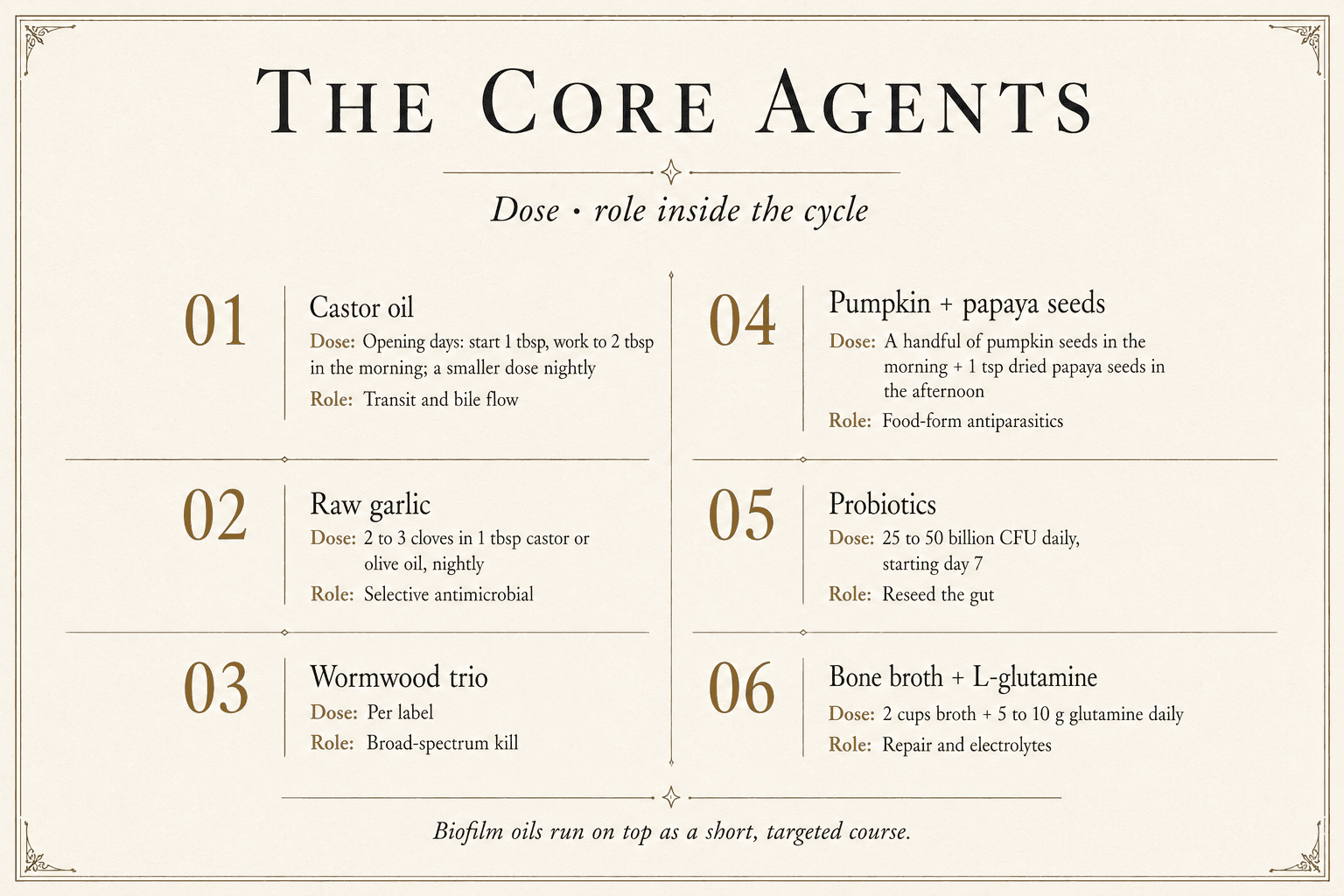
Castor oil is, mechanically and chemically, the most useful single thing in the cleanse. Two tablespoons of cold-pressed castor oil, taken on an empty stomach in the morning through the opening days, and a smaller dose at night before bed throughout, does work no other agent does.
The active ingredient is . Once the body splits it out of the oil, it docks onto receptors in the muscle of the gut wall and tells that muscle to contract harder and more often. footnoteTunaru, S.; Althoff, T. F.; Nüsing, R. M.; Diener, M.; Offermanns, S. (2012). PNAS. "Castor oil induces laxation and uterus contraction via ricinoleic acid activating prostaglandin EP3 receptors." This was the paper that finally pinned down the molecular handshake, castor oil had been used as a laxative for a hundred years before anyone could say which receptor it was hitting. The same receptor mediates the laxative effect on the bowel and the contractile effect on the uterus, which is why castor oil is contraindicated in pregnancy. The exact molecular mechanism, binding of ricinoleic acid to the , was only worked out in 2012.
The effects cascade:
- Things move. The gut muscle contracts harder. Transit time drops from twenty-four hours to twelve hours or under, often nearer six at full dose.
- The liver dumps. The gallbladder releases stored bile into the small intestine, and that bile carries with it the day's , the heavy metals and processed toxins the liver has been binding up.
- The mucus layer softens. The oil itself, as a fat, softens and partly dissolves the old rubbery mucus layer along the gut wall.
The push of castor oil married to the antimicrobial agents that come next is the whole game. Without the push, the dead organisms sit in the bowel long enough to be reabsorbed through the wall and you end up sicker than you started. With it, they leave before they can re-enter the bloodstream. This is the difference between a cleanse that works and a cleanse that hurts you.
On dose: start with one tablespoon and work up to the two. At full dose castor oil is cathartic: you will have multiple bowel movements within four to eight hours. Plan accordingly.
2. Eat high-water-content food, drop the GMO and processed load
What you eat during the cleanse matters more than in ordinary life, because the cleanse is asking the colon to release decades of accumulated mucus, processed-food residue, and microbial debris.
Two rules carry most of the work.
First, high-water-content food at every meal. Fresh fruit, raw and cooked vegetables, and well-sourced animal flesh (roughly seventy percent water by mass) carry their hydration into the colon with them. Water reaching the gut wall through food, rather than as a bolus you drink between meals, is what and lets the rest of the protocol pry it loose. The opposite approach, dry crackers, bread, dried snacks, chips, pulls water out of the bowel and locks the old layer in place. Make the menu wet. The deeper case for living, water-rich raw food, and the fruit and juice cleanses built on it, is Biophotons and the Light in Living Food.
A working list for the duration: fresh fruit (cucumber, watermelon, citrus, berries, apples, pears, grapes), most vegetables raw or lightly steamed (greens, tomatoes, peppers, courgettes, cucumber, celery, radish), and clean animal protein cooked simply (fish, eggs, lamb, beef, poultry). Bone broth at one meal a day stacks both the hydration and the gut-healing collagen and amino acids. Soups, stews, and salads carry more water per bite than anything dry.
Second, drop the GMO and ultra-processed foods entirely for the duration. These are the inputs producing the stale, undigested residue described above. Continuing to add to the load while trying to release it is wasted work. Drop refined seed oils (canola, soybean, sunflower, corn), conventional grain-based snacks (most of which now carry glyphosate residues), packaged foods with ingredient lists that read like a chemistry catalogue, sugary drinks, and anything with a barcode and a shelf life measured in months.
The practical reframe: eat what would have existed on a continent five hundred years ago. Fresh produce in season, animal meat from animals that ate plants, traditional ferments, water. The body recognises these inputs and digests them cleanly. Nothing is left to accumulate.
3. Raw garlic, the selective antimicrobial
If castor oil is the mechanical lever, garlic is the chemical one. Two to three cloves of raw garlic, chopped into rough pieces, not crushed and not minced to paste, swallowed in a tablespoon of castor oil or olive oil at night before bed.
The active compound is , which the clove only produces when its cells are physically broken open. Allicin is one of the most potent natural antimicrobials known, and it is selective. It hits the bad and spares the good. That property is what separates it from the pharmaceutical antibiotics it would otherwise resemble.
How the selectivity works. Allicin attacks , and the parts it attacks are the ones pathogenic organisms depend on most. The fungi, the parasites, the opportunistic bacteria that should not be there get hit; the good bacteria the body has co-evolved with carry backup biochemistry that lets them shrug it off at the same dose.
The 2012 Filocamo paper made this concrete: garlic extract at concentrations high enough to suppress pathogenic E. coli and Candida still left the beneficial Lactobacillus populations intact. Follow-up work in living animals has confirmed the gap.
Beyond the direct kill, allicin also:
- Pulls heavy metals out. Binds mercury, lead, and cadmium, and routes them through the liver for excretion. footnoteCha, C. W. (1987). Tohoku Journal of Experimental Medicine. "A study on the effect of garlic to the heavy metal poisoning of rat." First clean demonstration of allicin's chelation profile; the work has been replicated several times since. The mechanism is the same -SH binding that drives the antimicrobial effect, heavy metals have similar affinity for those sulfur sites, and once bound they ride out of the body on garlic's coattails.
- Fires up the liver's detox enzymes. The liver's get upregulated, which moves the dead-organism debris out faster.
- Strengthens the gut's frontline immunity. Raises , the antibody the gut secretes onto its own surface, which makes it harder for surviving pathogens to set up shop again.
Timing matters. Taken at night, on an empty digestive tract, with castor oil as the prokinetic vehicle, garlic works on the pathogens during the slow-moving overnight phase and the dead material clears with the first bowel movement of the morning. Taken during the day with food, digestion dilutes the allicin and you get a fraction of the effect.
On form: it has to be raw, and it has to be chopped, not crushed. This is where most people get it wrong. The familiar kitchen rule, crush the clove and let it sit, is built for cooking, where the point is to form every molecule of allicin up front before the heat goes on. Swallowed for a cleanse, that same crush works against you. A clove pulped to paste dumps its whole allicin load at once, high in the gut, where most of it is absorbed or broken down long before it reaches the lower bowel, the mucoid plaque, and the late-stage parasites that are the entire point of the protocol.
It burns going down for the same reason, the raw allicin hitting the mouth, throat, and stomach lining in one hot wave.
Chop the cloves into rough pieces instead and swallow them with the oil. Coarse pieces are not digested quickly. They travel mostly intact and surrender their allicin slowly, the enzyme working through them over hours as they break apart, so the antimicrobial is still being released in the later stages of the gut, exactly where the mucus-dissolving and parasite-clearing work has to happen.
That slow metering is also why it does not burn: there is no single concentrated hit. Chop too fine and you slide back toward the crush, spent early and gone before it reaches the ground that matters.
Cooked garlic loses most of its allicin within five minutes of heat above 60°C, and a whole clove swallowed without a single cut never breaks enough cells to start the chemistry at all. Aged garlic extract is a different molecule (less allicin, more ), useful for cardiovascular support, wrong tool for this job.
4. The traditional anti-parasitic herbs, wormwood, black walnut, cloves
The , wormwood plus green-hull black walnut plus cloves, is the most-replicated traditional herbal anti-parasitic stack on record. Each one does a different job:
- . Kills the adult worms and the single-celled parasites. The active piece is , the same molecule now used as a malaria treatment; it sets off destructive chemistry inside parasitic cells that mammalian cells do not undergo.
- . Targets the larvae and eggs the adult worms produce, the life stages the adult-killing agents miss. The combination closes the loop.
- . Kill the eggs. Without this leg, killing the adults and larvae just triggers a new generation from surviving eggs.
The three are dosed together because parasites have life-cycle stages and you need every stage hit. Tincture form is the most bioavailable; standardised capsules are the easiest to dose consistently.
Wormwood should not be used in pregnancy or at high sustained doses (the thujone is neurotoxic at concentration). Stay within the labelled dose.
5. The biofilm breakers, neem, black seed, and the antiparasitic oils
Everything to this point kills what it can reach. The organisms that have been in you longest do not let themselves be reached. They wall themselves in.
A is the fortress a parasite builds when it intends to stay. The organisms anchor to the gut wall, secrete a slime of sugars, proteins, and DNA, and seal themselves inside it. The matrix is the entire defence. Nothing the body sends at the colony gets through it, and what is sealed inside falls dormant and drops out of the immune system's view. This is why a dug-in parasite load survives the garlic, survives the herbs, survives course after course of prescription drugs, and returns the moment the pressure lifts. You are not failing to kill the organisms. You are failing to reach them.
The one class of molecule that dissolves that wall is the , the small, fat-loving aromatic compounds a plant builds to defend itself. They are oily enough and small enough to treat the fatty matrix as a road, not a barrier. They collapse the curtain, break up the chemical chatter that holds the colony together, and expose the organisms that were hiding, to the rest of this protocol and to the body's own defences. The full mechanism, and the dosing discipline it demands, belongs to The Magic of Terpenes, and nobody should run this layer without that chemistry in hand. These are pharmaceutical-strength molecules. A little goes a long way, and a careless dose does real harm. One rule governs all of them: drops, never spoonfuls, always carried in fat, in short deliberate courses, never neat and never daily forever.
Within that rule, the oils that carry this phase:
- . The bitter Ayurvedic standby, antiparasitic and antifungal across a wide range of organisms. Taken in small amounts and short courses. Potent enough that the dose discipline is not optional, and off-limits in pregnancy.
- . The gentlest of the group, and the one that doubles as daily support. A teaspoon a day. Its thymoquinone is antiparasitic and antimicrobial, and it steadies the immune system while the rest of the protocol does the killing.
- Tea tree, oregano, and clove oils. The terpene-rich essential oils, the direct biofilm dissolvers. dissolve the matrix and rupture the organisms behind it. A few drops dissolved directly in a carrier oil, castor or coconut, worked up slowly from a single drop. Oregano and clove are the strongest and the most punishing if overdone; tea tree is the broad workhorse.
- . The forgotten anthelmintic, almost pure pine terpene, and one of the most effective biofilm dissolvers in the traditional cabinet. Only ever the pure gum spirits, never the hardware-store solvent, which is a different and poisonous thing. A quarter teaspoon with a little fat, infrequently, is the traditional sweep.
Run this layer alongside the herbs and the garlic, not in place of them. The kill agents take down what is exposed; the oils take down the wall that was hiding the rest. Together they finish a job neither half does alone.
6. Pumpkin seeds and papaya seeds, the food-as-medicine layer
Raw pumpkin seeds and dried papaya seeds are the food-form anti-parasitics. A handful of pumpkin seeds in the morning, a teaspoon of dried papaya seeds ground over salad in the afternoon. They are gentle, well-tolerated, and they sit on top of the herbal stack without adding any pharmaceutical load.
paralyse the worm-stage parasites so they cannot hang on. The compounds in papaya seeds hit several of the species the herbs target. And pumpkin seeds are dense with zinc, about fifteen to twenty milligrams per quarter cup, which the liver needs for the that is now running hot.
7. The reseed, probiotics and fermented foods
Once the cleanse is running and the bowel is clearing, the good bacteria go back in. The cleanest way is through fermented foods: raw sauerkraut, kimchi, milk kefir, water kefir, traditional yoghurt. A daily serving from two of these alongside the cleanse delivers live cultures and gives the bowel the fibre those cultures need to take up residence.
Capsule probiotics fill a complementary role, especially multi-strain Lactobacillus / Bifidobacterium blends combined with . The spore-formers survive stomach acid in a way the live cultures do not, and they reach the colon viable. Dose: twenty-five to fifty billion CFU daily, on an empty stomach an hour before meals.
The reseeding starts on day seven of the cleanse and continues for at least sixty days after the herbal phase ends. Rebuilding the microbiome is slow work; the fast part is the killing.
8. Mineral and electrolyte support
A vigorous cleanse strips minerals, particularly magnesium, potassium, and sodium, as the bowel speeds up and elimination increases. The full mineral stack from the essential minerals protocol runs alongside the cleanse, with two additions:
- Bone broth, daily. Two cups of long-cooked bone broth a day. Supplies , the amino acids the gut lining uses to rebuild itself, along with the electrolytes the cleanse is depleting.
- , 5 to 10 grams daily. The preferred fuel of the cells of the gut wall; rebuilds the absorptive surface and tightens the seams between cells during the repair phase.
The arc
Run the full thirty days. That is what it takes to catch every stage of the worm, egg, larva, adult, and the next generation that hatches inside the first cycle.
A first cleanse, for an adult with years of accumulated stagnation, runs thirty days, then a five-day pause, then a second thirty-day cycle. The thirty-day length is not arbitrary: worm lifecycles run egg, larva, adult on roughly that timeline, and a shorter cleanse only kills the stage that happens to be exposed when the herbs hit. The first cycle clears the bulk of the old material and the active organisms; the second cycle catches the next round of eggs that hatched after the first cycle ended, and the secondary releases the first cycle dislodged but did not quite finish.
Expect to feel worse before you feel better. The first three to seven days, what is sometimes called , are the body absorbing the chemistry of dying organisms faster than the liver and bowel can clear it. Headaches, tiredness, joint stiffness, mood drops, even mild flu-like symptoms are normal. The castor oil and minerals shorten it. So does bile. A liver whose ducts were cleared before the herbs started gives that debris a wide channel out on the first pass, and the phase runs shorter and milder for it.
Add the missing pump from the first day. Walk, move every major joint, breathe low into the diaphragm, and use a short sauna when hydration and energy are steady. The kill-load has to leave the tissue as fast as the herbs create it, and The Missing Pump gives the complete movement, sauna, and recovery sequence.
The bowel changes first, inside two weeks, and sleep and skin follow it. The cognitive markers come up around week four, last, because they are downstream of everything else.
For ongoing maintenance: a fourteen-day cleanse twice a year keeps the field clean once the first major cleanse has done its work. A daily raw clove of garlic, the high-water-content diet, and a baseline of ferments stay in the protocol long-term, regardless.
Empty the bowel; protect the good bacteria; rebuild the wall. In that order.
With the parasites cleared and the field clean, the same selectivity that let garlic spare the good flora opens a larger question. The plants that kill what does not belong carry a whole class of volatile defensive compounds, the aromatic oils that make wormwood bitter, clove pungent, garlic sharp. Those terpenes are the next instrument in the clearing, and they reach further than the gut.
Sources
- Cleanse & Purify Thyself, . https://openlibrary.org/works/OL4512545W
- Allicin Bioavailability and Bioequivalence from Garlic Supplements and Garlic Foods, . https://pmc.ncbi.nlm.nih.gov/articles/PMC6073756/
- Antimicrobial Properties of Allicin from Garlic, . https://pubmed.ncbi.nlm.nih.gov/10594976/
- Effect of Garlic Powder on the Growth of Commensal Bacteria from the Gastrointestinal Tract, . https://pubmed.ncbi.nlm.nih.gov/22480662/
- Castor Oil Induces Laxation and Uterus Contraction via Ricinoleic Acid Activating Prostaglandin EP3 Receptors, . https://www.pnas.org/doi/10.1073/pnas.1201627109
- Effectiveness of Dried Carica Papaya Seeds against Human Intestinal Parasitosis: A Pilot Study, . https://pubmed.ncbi.nlm.nih.gov/17472487/
- Herbal Parasite Cleanse: Parasite Chart for Adults, . https://drclark.org/en-us/cleanses/herbal-parasite-cleanse/parasite-chart-for-adults
- The Cure for All Diseases, . https://drclarkstore.com/collections/all/products/the-cure-for-all-diseases
- Bowel Transit Time, . https://www.youtube.com/watch?v=iTd2GOiNMoU
Next in the series
The Incorruptible Body · The ClearingThe Magic of TerpenesThe plant molecules that dissolve the biofilm fortress, and still work in the places antibiotics have started to fail.
- Published
- Reading
- 18 min
- Sources
- 9