
The Missing Pump
Blood has a heart. Lymph has movement. How muscle, breath, daily motion, and sauna keep the body's drains open when a cleanse begins to move the load.
Blood has a heart. Three billion beats across a long life, each one throwing a wave of red fluid through a closed circuit and bringing it home again. The pump is so loud and so obviously alive that medicine built an entire language around it.
Beside that river runs another, almost as extensive and almost entirely ignored. It begins as hair-fine channels in the wet spaces between the cells, gathering what the capillaries leak along with proteins, broken tissue, microbial debris, and part of the chemical load the body is trying to carry away. It is the drainage system beneath the circulatory system, the second river that keeps the first from flooding every tissue it feeds.
This river has no heart.
It has thousands of pumps and no central engine that will run whether you participate or not. Skeletal muscle squeezes it, the diaphragm changes pressure with every deep breath, the feet strike the ground, the intestines contract, the arteries pulse, and the skin stretches over moving joints. The lymphatic system turns all of those forces into forward flow. It is a distributed pump built into movement itself.
That is why movement stops being optional the moment a cleanse begins to move a real load. Loosen the metals, kill what is living in the tissue, pull the old residue off the gut wall, and something that was stored, sealed, or alive yesterday is circulating today. Mobilization has begun, and mobilization is not detoxification. The body is not clear when the load moves. It is clear when the load leaves.
Sit still inside that release and the drains lose their largest source of power. Cleanse culture has a name for what follows, die-off, and treats it as proof the protocol is working. It is proof of the opposite. Release has outrun clearance, and bravado will not fix that. Throughput will.
This is the missing pump: your muscles, your breath, your daily movement, and the deliberate heat of the sauna. A cleanse is an opening operation. Movement and heat are how you keep the opened system flowing.
Every cleanse has two halves. The loud half loosens the load. The quiet half carries it out of the body.
The river beneath the river
Every cell lives in a thin internal sea called . Blood delivers oxygen and nutrients to the edge of it, the cells take what they need and release what they have used, and most of the fluid returns directly to the venous side. The remainder, along with proteins and particles too large for the blood capillary wall, enters the lymphatic capillaries.
Those capillaries are built like one-way doors. Their endothelial cells overlap, so when pressure rises in the tissue the overlaps pull open and admit whatever is suspended there, and when pressure rises inside the vessel the flaps press shut and the load cannot wash backward. The smallest channels merge into collecting vessels that carry the fluid through hundreds of lymph nodes, where immune cells inspect it before it returns to blood. The network is drainage, transport, and surveillance at once, which is why a stagnant one changes both the chemistry and the immune traffic of the space every cell lives in.
There is a direction to all of it. From the wet space around the cells, through the nodes, upward through the trunk, into the thoracic duct, back into the blood beneath the left collarbone, then onward to the liver, kidneys, bowel, lungs, and skin. Lymph does not destroy the load. It delivers it to the organs that can transform or expel it. Slow that delivery while a protocol is creating more debris, and the space between the cells becomes the waiting room.
No single pump, but thousands of pumps
The popular sentence says lymph has no pump. That is close enough to be useful and wrong enough to hide the most beautiful part of the system. Lymph has no single central pump. It has a distributed chain of them spread across the entire body.
The intrinsic unit is the , the segment of a collecting vessel between two valves. Smooth muscle wraps its wall. As fluid fills the chamber and stretches it, the muscle contracts, the valve behind closes, the valve ahead opens, and the load moves one chamber forward. Then the next chamber does the same. A collecting lymph vessel is a chain of tiny hearts, each one passing fluid to the next.footnoteZawieja, D. C. (2009). "Contractile physiology of lymphatics." Lymphatic Research and Biology 7(2):87-96. Collecting lymphatics use intrinsic rhythmic contractions of lymphatic muscle together with valves, while surrounding tissues provide external cycles of compression and expansion.
That rhythm is not the whole story. The part of the network that matters most during a cleanse has almost no muscle of its own: the first lymphatic capillaries, the ones drinking directly from the space around the cells, depend on changing pressure in the tissue around them to open, fill, and compress. Something outside has to move.
Skeletal muscle is the largest of those outside forces. Every calf contraction during a step squeezes the vessels threaded through and around it, and the valves make the squeeze directional. Breathing is the second. The diaphragm drops during a deep inhalation, lowering pressure in the chest while raising it in the abdomen, and that difference draws lymph upward toward the thoracic duct; on the exhale the pressures reverse and the valves hold the gain. The gut adds peristalsis, the arteries add their pulse, and walking adds skin tension, tendon loading, joint motion, and the repeated strike of the foot against the ground.footnoteSchmid-Schonbein, G. W. (1990). "Microlymphatics and lymph flow." Physiological Reviews 70(4):987-1028. The review maps the forces that fill and compress lymphatics, including skeletal muscle contraction, walking, running, massage, respiration, diaphragm motion, intestinal motility, arterial pulsation, and intrinsic smooth-muscle propulsion.
That architecture explains the plainest observation there is: the body feels clearer after a walk and heavier after a day in a chair.
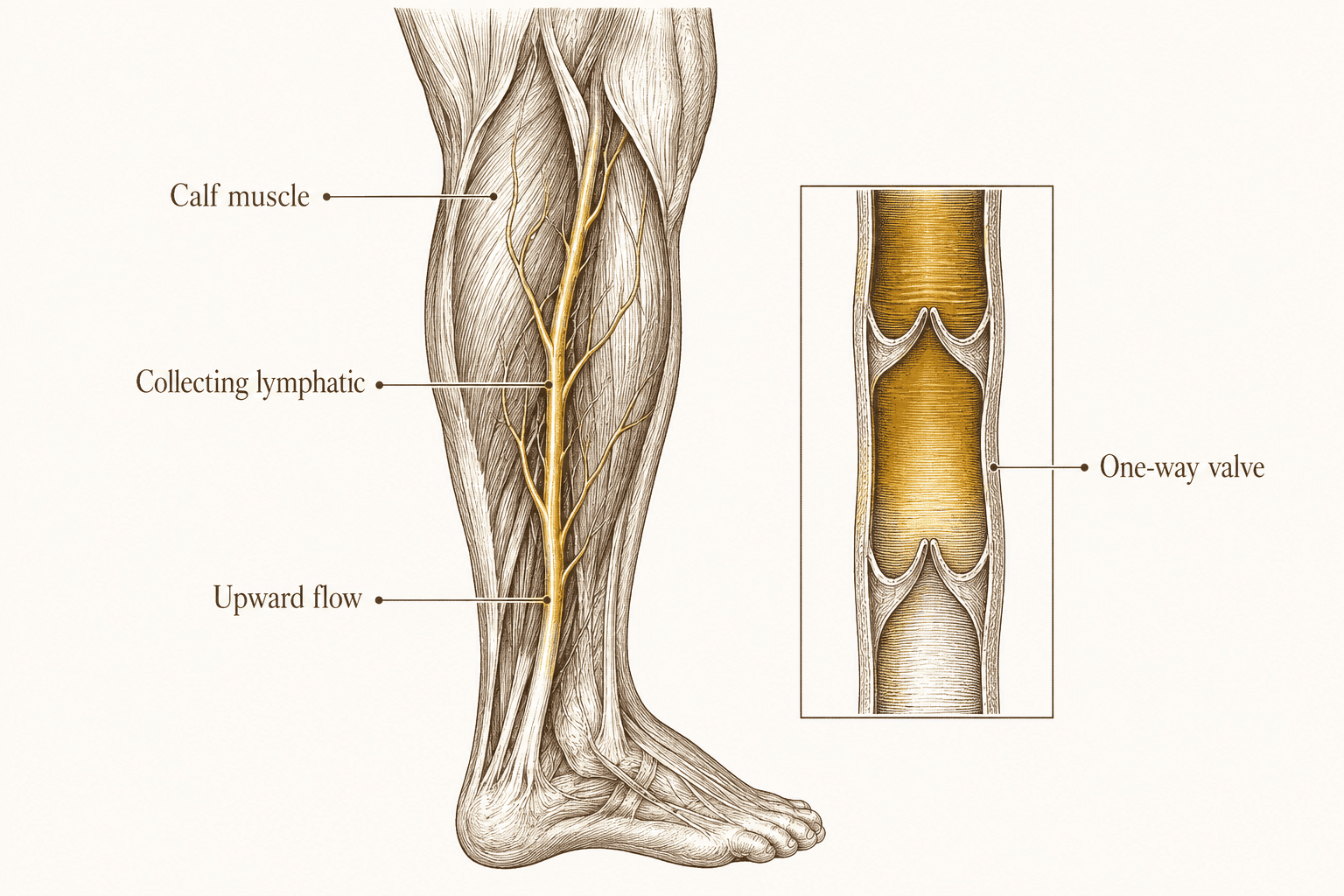
The heart pumps blood from one room. Lymph is pumped by the whole house.
Movement is drainage made visible
Once you see the anatomy, daily movement stops looking like fitness and starts looking like sanitation. The most useful movement during a cleanse is the one that creates the most rhythmic compression, not the most fatigue.
Walking wins because it recruits so much of the system at once: feet, calves, thighs, swinging arms, a rotating trunk, a deepening breath, and the abdominal contents shifting against the diaphragm, thousands of times, without the inflammatory cost of a punishing session.
Rebounding turns the same principle vertical. A mini-trampoline alternates acceleration, lightness, and landing pressure through the body, and the valves turn that oscillation into a series of small forward gains. The feet can stay on the mat while the knees pulse. Height is not the point. Repetition is.
Mobility work reaches the places a straight walk does not. Shoulder circles compress the vessels around the armpit nodes, neck turns and lateral bends move the crowded return routes above the collarbones, cat-cow motion changes abdominal and thoracic pressure, hip circles work the deep channels around the groin, and calf raises use one of the strongest peripheral pumps in the body.
Then there is the pump most adults never use. We breathe high in the chest: the shoulders rise, the upper ribs lift, the diaphragm barely travels, and one of the body's largest pressure pumps works at a fraction of its range. A full diaphragmatic breath presses gently into the abdominal organs while lowering the pressure above them, and five minutes of it moves fluid through the deepest trunk channels without taking a step.
Hard training has its place, but an aggressive cleanse is not the time to stack muscular damage on top of a high chemical clearance load. Correct movement leaves you warmer, looser, and more awake than when you began. It does not leave you flattened on the floor.
Mobilization is only half the operation
Every serious cleanse contains a mobilizer. Chelators and binders loosen and capture stored metal, an antimicrobial course kills organisms and breaks up the old terrain around them, and a fast releases what was held in fat as the body burns through its reserves. All of it does one thing: it takes material that was fixed in fat, tissue, mucus, or a chemical bond and puts it back into traffic.
Elimination is the second half, and it belongs to other organs. The liver transforms fat-soluble compounds and pushes them into bile, the gallbladder releases that bile into the gut, and the bowel carries it out before it can be reabsorbed. The kidneys filter water-soluble material into urine, the lungs release volatile compounds, and the skin sends water, salts, and a measurable toxic-element load into sweat. Between the cells and all of those organs runs the lymph.
So the clean protocol has a sequence: loosen, bind, transport, transform, and excrete. Skip binders and a loosened metal relocates. Let the bowel stall and bile-bound waste comes back through the liver instead of leaving. Stop moving and the transport layer loses its largest external pump. Sweat hard without replacing water and minerals and the exit begins consuming the very resources clearance needs. That is how a person runs an effective mobilizing protocol and feels progressively worse.
More mobilizer does not mean more clearance, and a harder kill does not mean a cleaner body. The correct dose is the one the bowel, kidneys, liver, lymph, and skin can finish. Judge power by how steadily the body clears, never by how violently it reacts.
Die-off is a throughput warning
Kill a large microbial population and the body inherits the remains: cell-wall fragments, proteins, inflammatory compounds, and the broken matrix those organisms lived in, all entering the same clearing system already handling the ordinary work of life. Loosen stored metal and the carrier molecules, liver, bile, bowel, kidneys, and tissue fluid inherit that load. Open fat stores in a fast and what was held in them re-enters traffic too.
The early result can feel like defeat: fatigue, a heavy head, brain fog, drowsiness, body aches, joint stiffness, irritability, skin eruptions, changing stool, stronger urine, and a body odor that seems to have come from someone else. Rings feel tighter. The face looks puffier on waking. Energy falls after long periods of sitting. There is no single laboratory number for any of it, only a pattern, and the pattern is release arriving faster than clearance.
The smell is the sign most often mistaken for illness. Sweat leaves the gland as mostly water and electrolytes, then reaches a skin ecosystem that transforms what arrives, so stronger body odor during a protocol means the skin is participating in a changed chemical load. Shower after sweating, wash the textiles carrying yesterday's output, and keep the other exits moving.
Low energy carries a similar message. Liver conjugation consumes nutrients and reducing power, kidney filtration depends on blood volume, lymphatic return depends on motion, and heat adds a cardiovascular demand. Ask all of that to work harder while food, water, salt, or sleep have been cut too far, and the body slows you down. Restore the carrying system rather than stacking more mobilizers.
Neurological symptoms deserve more respect than the rest. Mild, brief fog can travel with a cleanse; escalating tingling, tremor, or unusual weakness is not a badge. Stop the heat and the mobilizing agents, cool down, rehydrate, and assess, because a body can be overloaded by the protocol and it can also be dehydrated, short on sodium, reacting to a supplement, or fighting an infection. Mastery means knowing when the pattern has left the ordinary lane.
Otherwise the response is mechanical. Lower the mobilizing pressure until the symptoms settle, restore water and minerals, keep the bowel moving daily, run the movement and breathing steps below, add heat only when hydration and energy are steady, and sleep, because the clearing organs need energy more than the protocol needs bravado. Die-off tells you the front of the line is moving faster than the back. Widen the back, then continue at the dose the exits can complete.
Sauna opens the skin
The skin is the body's largest contact surface, and sweat is one of its physical exits. Put a person in heat and the skin's blood vessels widen, blood is redirected toward the surface, and eccrine glands draw fluid from that circulation and release it through millions of pores. Sodium, chloride, potassium, urea, lactate, and trace elements travel out with the water, and among those trace elements are metals the body has no use for.
The Blood, Urine, and Sweat study measured toxic elements across all three fluids in the same people and found different elements leaving by different routes. Some were present in sweat when they were not detectable in serum at all.footnoteGenuis, S. J., Birkholz, D., Rodushkin, I., and Beesoon, S. (2011). "Blood, urine, and sweat (BUS) study: monitoring and elimination of bioaccumulated toxic elements." Archives of Environmental Contamination and Toxicology 61(2):344-357. Blood, urine, and sweat carried distinct toxic-element profiles, and multiple elements appeared preferentially in perspiration. A systematic review then gathered the human evidence for arsenic, cadmium, lead, and mercury: sweat in more heavily exposed people often carried concentrations above plasma or urine, cadmium concentrated strongly, and dermal excretion of some metals matched or exceeded daily urinary excretion.footnoteSears, M. E., Kerr, K. J., and Bray, R. I. (2012). "Arsenic, cadmium, lead, and mercury in sweat: a systematic review." Journal of Environmental and Public Health 2012:184745. The review synthesized 24 records and found clinically meaningful dermal excretion, especially in people carrying higher exposure or body burden. The skin is an elimination surface rather than a wrapper, and sweat is a real road out for part of the metal load.
Sauna turns that road into a deliberate practice. The heat produces a sustained sweat without asking the muscles for another hard training session, which makes it most useful on the day the body needs circulation but cannot afford the tissue damage of hard exercise. It is a vascular event rather than passive sitting: heart rate rises, peripheral vessels open, and a thirty-minute exposure has been shown to reduce arterial stiffness and blood pressure during recovery.footnoteLaukkanen, T. et al. (2018). "Acute effects of sauna bathing on cardiovascular function." Journal of Human Hypertension 32:129-138. A 30-minute sauna session increased circulation to the skin and produced measurable changes in arterial stiffness and blood pressure through recovery.
The sauna does not start detoxification. It gives a body already moving its load another door, and it works only as one exit inside a complete system. Binders catch the load in the gut and the bowel carries it out. Glutathione, selenium, sulfur, and the B vitamins transform and transport it. Walking supplies the thousands of muscle compressions that move lymph across the body. Sauna adds the skin. The order matters: move first, sweat second, wash third, replace fourth.
The daily sequence
A protocol works when it can be repeated. What follows is simple enough to run during a cleanse and complete enough to keep every transport route open. There is no virtue in waiting for symptoms before moving: the missing pump should be running from the first day, because daily movement is preventive clearance.
1. Water, minerals, breath
Begin with water, before caffeine, before the sauna, before another mobilizer, and take it with mineral support rather than alone. Sodium holds circulating volume, potassium supports the electrical work of cells, magnesium supports muscle and bowel function. Replace what the exits are using, without the sugar load of a sports drink.
Then breathe. Hand below the navel, inhale through the nose until the lower abdomen expands, let the side ribs widen, feel the breath fill the back of the waist, exhale slowly and fully. Five minutes of it, in for about four counts and out for six, starts the central pressure pump before the day adds noise. No breath holds; the work is pressure change, not strain. Follow with two or three minutes of joint movement: neck turns, shoulder circles, spinal flexion, hip circles, ankle rolls, calf raises.
2. Walk before you sit
Take a twenty to thirty minute walk early, brisk enough to deepen the breath and warm the skin, easy enough to breathe through the nose for most of it. Let the arms swing, use the whole foot, and walk again after meals.
If energy is low, reduce intensity before frequency: a slow ten-minute walk repeated three times keeps the pump alive better than one heroic hour followed by the rest of the day in bed. At a desk, stand and move for two or three minutes each hour, ten calf raises, ten easy squats, a shoulder roll, a forward fold, six deep breaths. The long uninterrupted block of sitting is the thing being broken.
3. Keep the bowel ahead of the release
Before adding sauna, confirm that the bowel is moving. The liver sends conjugated waste into bile and bile empties into the gut, so a bowel that has stopped is a closed exit downstream of an active chemical plant. Use whatever support the cleanse specifies, fibre, magnesium citrate, binders, or high-water foods. One complete bowel movement a day is the floor during active release, and if it has stalled, fix the stall before increasing the antimicrobial, the chelator, the fast, or the heat.
4. A second movement pulse
Later in the day, ten minutes of rebounding, mobility work, deep squats, hanging, crawling, swimming, easy cycling, tai chi, yoga, or a light resistance circuit, all below exhaustion. This is the second sweep, not the main training session. Think calves, hips, ribs, shoulders, and breath. If fatigue is pronounced, five minutes of gentle bouncing with the feet planted and ten deep breaths keeps continuity.
5. Enter the sauna resourced, then replace what it took
Do not enter the heat thirsty, dizzy, depleted, or straight after hard training. Walk and breathe first, drink first, replace minerals first. Start with a duration you can complete cleanly, which for a new user may be five to ten minutes. Sessions lengthen as heat tolerance develops, but duration is never the trophy: a steady sweat, a clear head, a controlled heart rate, and clean recovery are the target. Stand up gradually when leaving, because heat widens the blood vessels and a sudden rise can drop pressure enough to make the room move.
Cool down in fresh air, then shower the sweat away in cool or lukewarm water, washing the scalp and the folds of the skin where it collects. Put on clean clothes rather than returning the output through a soaked shirt, and wash the textiles carrying yesterday's output. Then drink again, replace electrolytes, and eat enough protein and sulfur-bearing food to support glutathione when the protocol allows food.
6. Downshift, then measure the morning
Rest is the final phase. The body finishes chemical work when the nervous system is not being driven from one demand to the next, so a calm evening walk, a second five minutes of breathing, and sleep at a consistent hour complete the cycle.
Then measure. Energy, mental clarity, urine colour, resting pulse, body weight, bowel movement, and the way you feel on standing tell you whether yesterday's load was inside your capacity. If body weight fell sharply overnight, the urine is dark, the resting pulse is unusually high, or standing makes you dizzy, restore fluid and minerals and shorten the next heat exposure. A strong practice produces a stronger morning.
The line between a reaction and a warning
Mild fatigue, a temporary headache, stronger odor, brief fog, and an achy day sit inside the expected lane of release. They should ease when the dose is reduced, the exits are supported, and the body is rested, and they should trend toward resolution rather than accumulate day after day. Past that lane the rules change, and they are not negotiable.
Stop the sauna immediately for dizziness, nausea, a pounding headache, chills in the heat, painful cramps, unusual weakness, a racing or irregular heartbeat, blurred vision, or the feeling that you may faint. Move to a cool place. Lie or sit safely. Cool the body. Replace fluid and electrolytes if you are awake and able to drink. Do not return to the heat that day.
Confusion, fainting, seizure, chest pain, trouble breathing, inability to walk normally, one-sided weakness, slurred speech, persistent vomiting, very dark urine, or sharply reduced urine are outside the ordinary cleanse lane. They require urgent medical assessment. Heat illness can progress quickly, and confusion is a particularly serious sign.footnoteU.S. Centers for Disease Control and Prevention, NIOSH. "Heat-related illnesses." Confusion, altered mental status, loss of consciousness, seizure, and very high body temperature are heat-stroke emergencies; dark urine with weakness or muscle pain can signal muscle breakdown and requires immediate care.
The same discipline applies before the first session. Unstable chest pain, a recent heart attack, severe aortic stenosis, uncontrolled fainting, acute fever, intoxication, or an inability to regulate fluid safely are reasons not to enter the sauna without medical direction. Heat deliberately changes circulation, blood pressure, and fluid balance, and respecting those changes is the craft.footnoteHannuksela, M. L., and Ellahham, S. (2001). "Benefits and risks of sauna bathing." The American Journal of Medicine 110(2):118-126. The review describes the acute circulatory effects of sauna and identifies unstable angina, recent myocardial infarction, and severe aortic stenosis among its contraindications.
Heavy-metal poisoning deserves its own line. Nutritional support, movement, binders, and sauna strengthen the body's exits. A serious measured exposure, progressive neurological symptoms, kidney injury, or a need for pharmaceutical chelation belongs with a clinician experienced in the specific metal. The art is not surrendering the protocol. It is matching the strength of the tool to the size of the load.
The system, assembled
The lymphatic system runs on its own contractions, its one-way valves, its immune stations, and a body-wide set of external pumps. It listens to motion, breath, pressure, stretch, pulse, and heat. The way you live supplies part of the energy it uses.
Walking supplies thousands of muscular compressions. Rebounding supplies rhythm. Mobility reaches the crowded bends. Diaphragmatic breathing drives the central pressure change. Sauna opens the skin. Water and minerals keep the carrier fluid available. The bowel keeps the final gate open. Sleep pays for the work.
Run those pieces together and die-off changes character. It stops being an ordeal to endure and becomes a flow problem to solve. Slow the release when it outruns you, widen the exits, keep the lymph moving, and continue from a stronger baseline.
The body does not need more violence. It needs the whole sequence completed. The heart will keep pumping the blood without being asked. The second river waits for your participation.
The missing pump was never missing. It was waiting for you to move.
But the metals were never the only load riding that river. There is a second kind, not a dead weight the body stored but a living one feeding off it, organisms that have taken up residence in the gut and the tissues and quietly spend the energy you are fighting to restore. The drains are open now. Next, the parasite cleanse, and the second thing the clearing has to subtract.
Sources
- Microlymphatics and Lymph Flow, . https://pubmed.ncbi.nlm.nih.gov/2217560/
- Contractile Physiology of Lymphatics, . https://pubmed.ncbi.nlm.nih.gov/19534632/
- Hydrodynamic Regulation of Lymphatic Transport and the Impact of Aging, . https://pubmed.ncbi.nlm.nih.gov/20226639/
- Blood, Urine, and Sweat (BUS) Study, . https://pubmed.ncbi.nlm.nih.gov/21057782/
- Arsenic, Cadmium, Lead, and Mercury in Sweat: A Systematic Review, . https://pubmed.ncbi.nlm.nih.gov/22505948/
- Benefits and Risks of Sauna Bathing, . https://pubmed.ncbi.nlm.nih.gov/11165553/
- Acute Effects of Sauna Bathing on Cardiovascular Function, . https://pubmed.ncbi.nlm.nih.gov/29269746/
- Heat-Related Illnesses, . https://www.cdc.gov/niosh/heat-stress/about/illnesses.html
- Far-Infrared Sauna and Far-Infrared Heating-Pad Detox Therapy, . https://drsircus.com/detox/far-infrared-sauna-and-far-infrared-heating-pad-detox-therapy/
Next in the series
The Incorruptible Body · The ClearingThe Parasite CleanseA thirty-day protocol that empties the gut of its parasites and their biofilm, killing the bad without touching the good.
- Published
- Reading
- 15 min
- Sources
- 9