
The Magic of Terpenes
The plant molecules that dissolve the biofilm fortress, and still work in the places antibiotics have started to fail.
A plant cannot run from the thing that wants to eat it. Rooted in one spot for its entire life, exposed to every fungus, bacterium, insect, and grazing animal that finds it, it survives by chemistry alone, and across four hundred million years of unbroken biological warfare it has refined some of the most effective antimicrobial weapons on the planet. You meet them every day and never name them.
They are what you smell when you crush a pine needle, peel an orange, or walk through a forest after rain. They are the terpenes, the largest and most ancient family of molecules a plant builds to stay alive, and the reason almost nobody uses them as medicine has nothing to do with whether they work.
The best of them do a thing the most expensive modern antibiotics cannot: they dissolve the wall a chronic infection hides behind. They clear stubborn infections that round after round of prescriptions could not touch, and once you understand the chemistry it stops being surprising.
What a terpene actually is
Strip the romance away and a terpene is a simple idea repeated. The plant takes a five-carbon building block called isoprene and snaps copies together like a child building with the same brick over and over. Two isoprene units make a , the light, volatile, intensely smelling molecules that make up most of an essential oil.
Three units make a heavier , slower and deeper, the molecules that carry much of the medicine in frankincense and myrrh. Add oxygen and you get a terpenoid, an alcohol or a ketone or an aldehyde hung off the carbon skeleton, and the oxygen is usually where the biological action sharpens.
That is the whole architecture. A handful of bricks, assembled into perhaps thirty thousand distinct molecules across the plant kingdom, each one tuned by a species over an evolutionary history to do one job: repel this insect, poison that fungus, signal to a pollinator, seal a wound in the bark. Distill the volatile fraction of a plant by steam and collect the oil that floats off, and you are harvesting that defensive chemistry in concentrated form. An essential oil is not an extract in the loose sense. It is the plant's immune system, decanted.
In a citrus fruit you can see where that chemistry is kept: a ring of oil glands packed just under the skin, which is why the scent arrives when you break the peel and not when you bite the flesh.
Two physical facts about terpenes explain almost everything that follows.
The first is that they are , fat-loving and water-fearing. Every living cell, yours and the microbe's alike, is wrapped in a membrane made of fat. A water-soluble drug has to find a specific door through that wall. A terpene does not knock. It dissolves straight into the fatty membrane the way oil disappears into oil, and once inside it disrupts the careful order the cell depends on. This is the root of the medicine, and most modern pharmacology cannot easily reproduce it, because most drugs are built to be water-soluble so the body can transport and excrete them.
The second is that they are volatile. They evaporate at body temperature, which is why you can smell them, and an inhaled terpene reaches the lungs, the sinuses, and the bloodstream within seconds, crossing into the brain almost as fast. The plant built a delivery system into the molecule.
An essential oil is not an extract in the loose sense. It is the plant's immune system, decanted.
The wall antibiotics keep hitting
To understand why these old molecules suddenly matter again, look at what is happening to the new ones.
The World Health Organization is blunt: antimicrobial resistance is one of the top global public health threats, driven by the overuse and misuse of the antibiotics that defined twentieth-century medicine. Resistance in Klebsiella pneumoniae to last-resort carbapenems has spread to every region of the planet. Resistance in E. coli to the front-line drugs for urinary infection is now so widespread that in many countries the standard treatment fails in more than half of patients. The arithmetic at the far end is grim: if nothing changes, the projection most often cited puts deaths from resistant infection at around ten million a year by 2050, more than currently die of cancer.footnoteWorld Health Organization, antimicrobial resistance fact sheet, and the O'Neill Review on Antimicrobial Resistance (2016), which produced the ten-million-by-2050 projection.
The pharmaceutical pipeline, meanwhile, has thinned to almost nothing, because a drug a patient takes for ten days and never needs again is a poor return on a billion-dollar development program.
There is a deeper reason the antibiotics are losing, and it is the reason terpenes are interesting. It is called biofilm.
You were taught to picture bacteria as free-floating single cells, drifting in the bloodstream, killed one by one as the antibiotic finds them. That picture describes the acute infection, the kind that arrives fast and either kills you or is killed. It does not describe the chronic infection, the one that lingers for months or years, flares and settles and flares again, and shrugs off course after course of antibiotics. The chronic infection is almost always a biofilm.
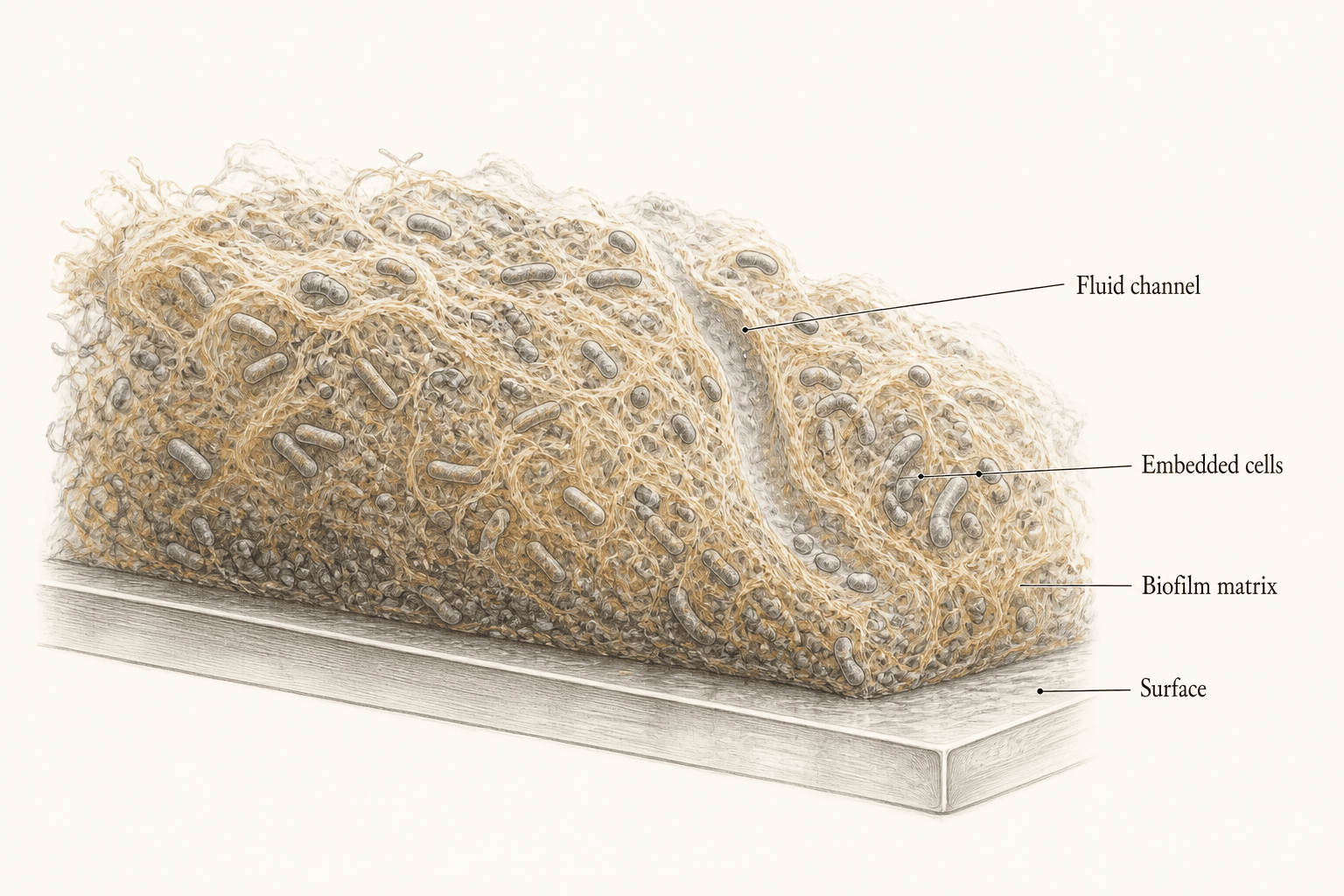
A is what microbes build when they stop being individuals and become a city. They anchor to a surface, a tooth, a catheter, a joint implant, a heart valve, the lining of a sinus, the bed of a chronic wound, the wall of the gut, and they secrete a slime, a matrix of sugars and proteins and DNA, and they wall themselves inside it. The matrix is the whole trick.
It is a physical shield drugs cannot fully penetrate. The organisms deep inside go dormant, and most antibiotics can only kill cells that are actively dividing, so the dormant core survives every course and reseeds the colony the moment the drug is withdrawn. The cells trade chemical signals through the matrix, a conversation called , and use it to coordinate their defence and crank up their virulence.
A landmark 1999 paper in Science put the scale of it plainly: organisms in biofilms can be up to a thousand times more resistant to antibiotics than the same cells floating free, and a majority of all chronic and recurrent infections in humans involve a biofilm.footnoteCosterton, J. W.; Stewart, P. S.; Greenberg, E. P. (1999). "Bacterial Biofilms, a Common Cause of Persistent Infections." Science. The widely cited figure that biofilms are implicated in roughly two-thirds of human infections originates with the US National Institutes of Health.
A thousandfold. That is not a margin a stronger dose closes. The biofilm is a different kind of target, and it is where the chemistry of a small, fat-soluble, membrane-dissolving molecule stops looking like folklore and starts looking like the answer.
The parasites that build fortresses
It is not only bacteria that build these fortresses. Many of the parasites and fungi that colonise the human gut do exactly the same thing, and it is the single biggest reason they are so hard to clear.
Consider what a parasite is up against. It has to survive inside a host whose entire immune system is built to find and destroy it. The solution evolution keeps arriving at is the same one the bacteria found: hide inside a wall.
The organism, or the bacterial community sheltering it, lays down a biofilm matrix and disappears behind it, and from that point the immune system is laying siege to a fortress it cannot breach.
The list of biofilm-forming or biofilm-sheltering gut organisms reads like the roster of every chronic gut infection conventional medicine struggles with:
- , one of the most common intestinal parasites on earth, lives inside the mucosal biofilm of the small intestine and forms protective aggregates of its own, which is why giardiasis recurs so reliably after a course of the standard drug.
- Blastocystis hominis and Entamoeba histolytica, two protozoa behind a huge fraction of chronic loose stool, bloating, and gut inflammation, are both studied for their biofilm behaviour and their association with the gut biofilm community.
- Cryptosporidium, a waterborne protozoan, persists inside the biofilms that line water systems and the gut, part of why it is so stubbornly chlorine-tolerant and so hard to clear in the immunocompromised.
- Trichomonas, a protozoan of the urogenital tract, is biofilm-associated, which tracks with how recurrent and treatment-resistant those infections become.
- , the yeast at the centre of most gut-overgrowth pictures, is one of the most aggressive biofilm builders in the body, and its biofilms are far more drug-resistant than free yeast.
- Helminths, the larger worms, create niches in the gut where bacterial biofilms form around them, a layered fortress of worm plus microbial matrix.
In every case the matrix does the same job it does around a bacterial colony. The large cells of the immune response, the that engulf and destroy invaders, are too big to push through and cannot reach what hides inside. The body knows something is wrong, it stays low-grade inflamed and exhausted, but it cannot find a target to finish. That is the lived experience of chronic parasitic infection: a war the body is fighting and cannot win, because the enemy is walled in.
This is exactly the problem a biofilm-dissolving terpene is built to solve. A small, fat-soluble molecule like pinene or terpinen-4-ol does the one thing the immune system and the antibiotics cannot: it dissolves the wall. It penetrates the fatty matrix, collapses the curtain, breaks up the quorum-sensing chatter that holds the colony together, and exposes the organisms that were hiding to the body's own defences and to whatever else is in the protocol. You stop besieging the fortress and start dismantling it. For the gut parasites in particular, where an oral oil reaches the colonised tissue directly, this is one of the most practical interventions there is, and it pairs naturally with the rest of a proper parasite cleanse.footnoteThe biofilm behaviour of intestinal protozoa and yeasts is an active and fast-growing research area; Giardia, Blastocystis, Entamoeba, Cryptosporidium, and Candida have all been characterised as biofilm-forming or biofilm-associated, and in several of these the biofilm is directly implicated in drug tolerance and recurrence. The clinical use of biofilm-disrupting agents alongside antimicrobials follows from that mechanism.
Why a terpene gets through
The antibiotic struggles against the biofilm because it is a relatively large, water-soluble molecule trying to diffuse through a dense, partly fatty matrix to reach cells that have stopped dividing. The terpene faces none of those constraints. It is small. It is lipophilic, so the fatty parts of the matrix are a road for it, not a wall. And its mechanism does not require the cell to be dividing, because it does not interfere with cell division. It dissolves into the membrane and ruptures the organism's ability to hold itself together, leaking ions and contents until the cell fails. A dormant cell has a membrane too, and the terpene does not care whether that cell is awake.
The laboratory work has accumulated for two decades. Tea tree oil acts against Staphylococcus aureus not only in its free-floating form but in the biofilm and the dormant stationary phase, the two states that defeat conventional drugs, and the strains tested have included methicillin-resistant S. aureus, MRSA itself.footnoteKwiecinski, J.; Eick, S.; Wojcik, K. (2009). "Effects of tea tree (Melaleuca alternifolia) oil on Staphylococcus aureus in biofilms and stationary growth phase." International Journal of Antimicrobial Agents. The study found activity against biofilm-embedded and stationary-phase S. aureus, the phenotypes most tolerant of antibiotics.
Beyond killing cells, sub-lethal concentrations of terpenes interfere with quorum sensing, jamming the chemical conversation the colony needs to build and maintain its matrix in the first place. The terpene does both things the antibiotic cannot: it penetrates the shield, and it disrupts the signalling that builds the shield.
This work spans the dish and the animal models, consistent and reproducible. None of it has been carried into a large human trial, and the reason has nothing to do with whether the molecules work.
Tea tree, the case study
If you want the whole argument in a single oil, study tea tree.
It is distilled from Melaleuca alternifolia, a paperbark tree native to the wetlands of New South Wales. The Bundjalung people of the Australian east coast used the crushed leaves on wounds and infections for longer than written record. Australian soldiers carried it as a field antiseptic through the Second World War. Then penicillin arrived, the miracle that made everything botanical look quaint, and tea tree was filed away as a relic. The relic is now being pulled back off the shelf, because the miracle is wearing thin.
The active core of tea tree oil is a monoterpene alcohol called , usually a third to a half of the oil by weight, and the quality of a tea tree oil is essentially the quality of its terpinen-4-ol fraction. The definitive scientific review, by Carson, Hammer, and Riley in Clinical Microbiology Reviews, catalogues the spectrum: broad antibacterial activity, antifungal activity, antiviral activity, and anti-inflammatory action, with terpinen-4-ol doing most of the work.footnoteCarson, C. F.; Hammer, K. A.; Riley, T. V. (2006). "Melaleuca alternifolia (Tea Tree) Oil, a Review of Antimicrobial and Other Medicinal Properties." Clinical Microbiology Reviews 19(1):50-62. The single most thorough review of the oil, and the place to start for the primary literature rather than the marketing. Look at what the individual papers found.
On bacteria. Effective against Staphylococcus aureus including resistant strains, Streptococcus, and Escherichia coli, the same E. coli the WHO singles out for spreading resistance to front-line drugs, and active against the biofilm and dormant states where antibiotics fail.
On fungi. Tea tree oil and its components are active against a wide range of fungi, and crucially against Candida species that have grown resistant to the standard antifungal drugs fluconazole and itraconazole.footnoteHammer, K. A.; Carson, C. F.; Riley, T. V. (2003). "Antifungal activity of the components of Melaleuca alternifolia (tea tree) oil." Journal of Applied Microbiology. Activity was demonstrated against fluconazole-resistant and itraconazole-resistant yeasts. Given that candida is one of the worst biofilm builders in the gut, an oil that hits both the yeast and its matrix is a genuinely useful thing to have.
On viruses. Tea tree oil has a documented inhibitory effect on influenza A replication, appearing to block the virus from fusing with and entering the host cell, and it does this at doses well below any that would trouble your own cells.footnoteGarozzo, A. et al. (2011). "Activity of Melaleuca alternifolia (tea tree) oil on Influenza virus A/PR/8, study on the mechanism of action." Antiviral Research. The inhibition occurred at concentrations below those toxic to the host cells, and appeared to act at the viral envelope and entry stage. It also has activity against the herpes simplex viruses.
On tumour cells. Terpinen-4-ol and whole tea tree oil impair the growth of human melanoma cells in culture, and they appear more effective against the drug-resistant variants of those cells, the opposite of the usual pattern.footnoteCalcabrini, A. et al. (2004), on terpinen-4-ol and tea tree oil against M14 human melanoma cells, and subsequent work on antiproliferative effects in lung cancer lines. Terpinen-4-ol impaired the growth of the cells and was more effective against the drug-resistant variants.
Can you take it internally? Yes, and people have for the better part of a century. The cases of tea tree toxicity on record are without exception cases of someone swallowing the neat oil by the mouthful, a child getting into the cupboard, an adult drinking a bottle or more straight. They tell you the obvious thing, that you do not drink a concentrated oil like a beverage, and they tell you nothing about a couple of drops taken properly with fat. A 2014 study asking specifically whether tea tree oil damages the genetic material of mammalian cells found that it does not. The molecule is not the danger. The mouthful is. Use a quality oil in dark glass, take it with fat, keep the course short rather than running it daily forever, and it does its work.
The molecule is not the danger. The mouthful is. The dose is the whole of the craft.
Turpentine, the forgotten medicine
Turpentine deserves its own section, because for most of the history of Western medicine it was not a paint solvent, it was a drug, and a respected one.
It is, chemically, almost pure terpene: steam-distilled from pine resin, dominated by alpha-pinene and beta-pinene, the same monoterpenes the forest exhales. It runs through the old pharmacopoeias as an anthelmintic to expel intestinal worms, a remedy for respiratory congestion, a urinary antiseptic, a dressing for wounds. That record is empirical pharmacology, written down over centuries by people who watched it work, and the molecule behind it, pinene, has exactly the small, lipophilic, biofilm-dissolving chemistry we have been tracking. For the gut, where it reaches the colonised tissue directly and goes after the matrix that shelters the worms and the yeast, it is one of the most effective biofilm dissolvers in the traditional medicine cabinet, which is precisely why it keeps being rediscovered by people tired of being told their chronic infection is incurable.
One distinction carries the whole of the practical safety, and it is about the substance rather than the dose: use one hundred percent pure gum spirits of turpentine, steam-distilled from pine resin and nothing else, never the hardware-store solvent, which is cut with petroleum distillates and is a different and genuinely harmful substance. With the pure gum spirits the tradition is straightforward: a quarter teaspoon or thereabouts, taken with a little sugar or a spoon of fat to carry it, in short courses. Taken that way it is gentle, and it goes after exactly the chronic, dug-in, biofilm-anchored infections that have outlasted everything else. It is one of the most useful things in the cabinet.
Pure gum spirits has a second use, and it is prevention. Almost everyone carries a quiet parasite load they never notice, and the gut biofilms that shelter it build up slowly over years. A small dose, taken now and then as a preventive sweep, keeps those biofilms from ever taking hold and stops the parasite load from establishing in the first place. That is the use for anyone who would rather stay clean and well than wait until something has already dug in.
The pharmacy the wise men carried
Long before any of this had a mechanism, the people who built the first civilisations knew the aromatic oils were the strongest medicines they had, and they treated them as treasure. This is the oldest pharmacology on earth, and it agrees completely with the chemistry.
Of the three gifts the Magi are said to have laid before the infant Christ, two were medicine. Gold was the symbol, the tribute owed to a king. Frankincense and myrrh were, in the ancient world, among the most valuable substances a person could own, worth their weight against gold precisely because they healed, and they were carried across deserts at enormous cost for that reason. The gift was wealth, kingship, and the finest medicine of the age.
is the dried resin of the Boswellia tree, and its medicine runs along two tracks. The volatile oil is heavy in alpha-pinene and limonene, the same antimicrobial monoterpenes we have been discussing. The resin itself yields a class of molecules called , and one of them, with the unlovely name AKBA, is a specific inhibitor of 5-lipoxygenase, the enzyme that manufactures the leukotrienes that drive inflammation.footnoteAmmon, H. P. T. (2006). "Boswellic acids in chronic inflammatory diseases." Planta Medica. AKBA (acetyl-11-keto-beta-boswellic acid) is a non-redox inhibitor of 5-lipoxygenase, a mechanism distinct from the COX inhibition of aspirin and ibuprofen. Boswellia extracts have been studied in arthritis, inflammatory bowel disease, and asthma. That is a real and distinct anti-inflammatory mechanism, and frankincense extracts have been studied seriously in arthritis, in inflammatory bowel disease, in asthma, and for antitumour activity. The civilisation that burned it in every temple was medicating the room.
is the resin of the Commiphora tree, and its signature is analgesia. In 1996, researchers publishing in Nature isolated the molecule responsible, a sesquiterpene named furanoeudesma-1,3-diene, and showed it acts on the opioid receptors in the brain, a plant molecule speaking the body's own language of pain relief.footnoteDolara, P. et al. (1996). "Analgesic effects of myrrh." Nature 379:29. The active sesquiterpene furanoeudesma-1,3-diene was shown to interact with opioid receptors, providing a mechanism for myrrh's millennia-old use as a painkiller and wound dressing. Myrrh is also antimicrobial, which is why for thousands of years it dressed wounds and embalmed the dead, holding decay at bay. The ancient Egyptians, the original master aromatherapists, used it in both medicine and mummification for the same single reason: it stopped things from rotting.
This is the thread that runs from Boswellia to the petri dish. The aromatic oils appear hundreds of times across the oldest texts we have. The holy anointing oil of Exodus is a precise formula of myrrh, cinnamon, calamus, and cassia in olive oil; spikenard and hyssop and cedarwood recur through scripture; and every one of those plants is, we now know, a terpene-rich antimicrobial and anti-inflammatory agent. The ancients did not have the word terpene. They had something arguably better: a few thousand years of careful observation, and the good sense to treat these oils as the precious medicines they are. We took a detour through the antibiotic century and are only now circling back to what they knew.
The secret, and why it stayed one
Internal and medicinal use of pure essential oils is the most underexploited tool in medicine, and not because the molecules fail. The mechanism is sound, the laboratory evidence is broad and reproducible, the historical record is long, and the molecules reach precisely the targets, the biofilms and the resistant organisms and the walled-in parasites, where our most expensive modern drugs are failing. The reason is economic, and almost embarrassingly simple.
You cannot patent a pine tree. You cannot patent limonene, or pinene, or terpinen-4-ol, because they are natural products that have existed for four hundred million years, and a molecule you cannot patent is a molecule no company will spend a billion dollars putting through human trials, because at the end anyone with a still could sell the same thing. The trials that would certify what the laboratory and the clinic already show, that these molecules kill the biofilm and clear the infection, are the trials nobody has a commercial reason to fund. So the late-stage trials never get run, by design, and their absence is then dressed up as proof that the molecules are unproven, when it is proof only that they are unpatentable.
That is the secret. Nothing so dramatic as a conspiracy, just the quiet, structural fact that our entire system for deciding what counts as medicine is built around what can be owned, and the plant's pharmacy cannot be owned. The knowledge did not disappear because it was disproven. It disappeared because there was no money in remembering it.
The gap in the evidence is a gap in the incentives, not a gap in the chemistry. You cannot patent a pine tree.
How to use them
The method first, because the method is what makes them work and what keeps them gentle.
Everything goes in with fat. A terpene is lipophilic, so it rides in fat to be absorbed broadly and gently rather than burning the tissue it touches. Never take a drop neat. Dissolve the drops directly into a carrier oil, castor or coconut, which protects the throat on the way down, or take them in another genuinely fatty vehicle, a spoonful of grass-fed butter, heavy cream, a fat-rich smoothie. The fat dilutes the concentration where it lands, protects the gut lining, and carries the molecule into circulation the way the body is built to absorb fats. Quality is not negotiable: use oils that name both the common and the Latin species, state the country of origin, report the key constituent fraction, and come in dark glass, the kind of oil worth trusting with the inside of your body, because that is the decision being made.
Start low and let your body set the pace. Begin with a drop or two, taken with fat, and pay attention to how you feel over the next day before going further. From there you work the dose up slowly, reading your body's reactions as you climb, until you reach the amount that does the work without overwhelming you. The mistake people make is starting high and fast, and there is no prize for it. Never take more than a teaspoon of any of these oils, ever, and a teaspoon is the ceiling, not a starting point.
One reaction matters before you start, because it is the main reason to climb slowly. When you begin killing a heavy microbial load and dissolving the biofilms that have sheltered it, all those dead organisms release their contents at once, a flood of that the liver and kidneys then have to clear. For a day or two you can feel worse rather than better: tired, headachy, foggy, achy, flu-like. That is the die-off, the Herxheimer reaction, and it means one thing only: the killing has outrun the clearing. It is not proof the dose is right. It is a reading on your throughput. It is also exactly why you start low and climb slowly. A gentle dose produces a die-off the body can keep up with; a reckless dose produces one it cannot. If the reaction hits hard, drop the dose back down, support the clearance with plenty of water and the rest of the cleanse, let the body catch up, then continue the climb. Reading that reaction is how you find your dose.
Clearance needs motion as much as it needs water. Walk, breathe low and deep, and use a controlled sauna while a course is running: that is the external pump that carries the released load out through lymph and sweat, and it is the difference between clearing a biofilm and relocating what was inside it. When the die-off stops easing and starts stacking, drop the terpene pressure until the exits catch up. The full sequence is in The Missing Pump.
Preventively, when nothing is wrong, tea tree oil keeps the terrain clean: climb to six or eight drops, dissolved in carrier oil, and hold there. At the first scratch in the throat or heaviness in the chest, take it again, and more often than not the thing never lands. Alongside it, every so often, a small dose of pure gum spirits of turpentine works as a preventive sweep, keeping the gut clear of the parasites and biofilms that quietly accumulate in anyone. That is the daily, low-key use, the oils as maintenance.
The other use is the one people come to these oils for: the chronic infection that will not clear, the gut that has been wrong for years, the candida or the parasite load that has survived every round of antibiotics and antifungals. This is where the biofilm story becomes the whole story. Here the oils dissolve the fortress, tea tree and the pine terpenes of turpentine breaking the matrix that has been hiding the organism from the immune system, taken in short, deliberate courses, with fat, alongside the rest of a proper cleanse. Infections that were called incurable resolve once the wall comes down and the body can finally reach what it was fighting. The oils do nothing mystical. They take the roof off the bunker, and the body does the rest.
The terpenes are patient medicine. They work at the level of terrain and biofilm and slow attrition, and the results show up over weeks, in the things that stop flaring. Used at the dose the chemistry allows and the history confirms, they are among the most effective and most neglected tools there are.
And every drop, every die-off, every dead colony flushed out of a broken biofilm ends up in the same place. Tea tree, turpentine, the resins of the wise men, all of them mobilise their kill-load and their endotoxins into one organ that has to filter it, neutralise it, and carry it out. That organ is the liver, and in most people it is already silted, congested, working at a fraction of its capacity before a single drop of oil is added. Clear the fortresses and you double the work asked of the body's chemical plant. The next move is to open the drain.
Sources
- Melaleuca alternifolia (Tea Tree) Oil: A Review of Antimicrobial and Other Medicinal Properties, . https://doi.org/10.1128/CMR.19.1.50-62.2006
- Effects of Tea Tree Oil on Staphylococcus aureus in Biofilms and Stationary Growth Phase, . https://doi.org/10.1016/j.ijantimicag.2008.08.028
- Activity of Melaleuca alternifolia (Tea Tree) Oil on Influenza Virus A/PR/8, . https://doi.org/10.1016/j.antiviral.2010.11.010
- Antifungal Activity of the Components of Melaleuca alternifolia (Tea Tree) Oil, . https://doi.org/10.1046/j.1365-2672.2003.02059.x
- Terpinen-4-ol, the Main Component of Melaleuca alternifolia (Tea Tree) Oil, Inhibits the In Vitro Growth of Human Melanoma Cells, . https://pubmed.ncbi.nlm.nih.gov/15009716/
- Analgesic Effects of Myrrh, . https://doi.org/10.1038/379029a0
- Boswellic Acids in Chronic Inflammatory Diseases, . https://doi.org/10.1055/s-2006-947227
- Unraveling the Interplay between Unicellular Parasites and Bacterial Biofilms, . https://doi.org/10.1080/21505594.2023.2289775
- Bacterial Biofilms: A Common Cause of Persistent Infections, . https://doi.org/10.1126/science.284.5418.1318
- Essential Oil Safety, . https://openlibrary.org/works/OL20991051W
- Antimicrobial Resistance, . https://www.who.int/news-room/fact-sheets/detail/antimicrobial-resistance
- The Essential Oil of Turpentine and Its Major Volatile Fraction: A Review, . https://pubmed.ncbi.nlm.nih.gov/20197260/
- Safety Assessment and Adverse Drug Reaction Reporting of Tea Tree Oil, . https://pubmed.ncbi.nlm.nih.gov/36420525/
- Turpentine Oil Poisoning, . https://medlineplus.gov/ency/article/002746.htm
Next in the series
The Incorruptible Body · The ClearingThe Liver and Gallbladder FlushThe full protocol for clearing the liver's thousand silted ducts, and the whole-body healing that arrives once the bile runs free again.
- Published
- Reading
- 19 min
- Sources
- 14