The Great Lock

Lust is the one drive willpower cannot beat, so the body ships a hardware lock for it. The three bandhas, the great lock, why injaculation is a trap, and why the conserved current needs a great work to hold it.

X邮件

There is exactly one drive in the human body that does not negotiate. You can talk hunger down, schedule it, eat in the afternoon instead of now. You can sit with boredom, ration anger, outlast fear. Every appetite the body carries can be reasoned with except one, and the one that cannot is the deepest, the oldest, wired closest to the survival of the species itself. Set your will directly against it and you lose, not sometimes but as a rule, because the act of resisting it requires you to hold the image of the thing in your mind, and to hold the image is to feed the fire. This is the drive that has wrecked kings and emptied monasteries and broken men who had conquered everything else they ever faced. Willpower meets it and breaks.

Willpower can manage every hunger but one. For the one it cannot, the body shipped a valve.

But the body did not leave us unarmed. It ships hardware locks built for exactly this, mechanical valves on a pressure vessel, three of them, sealable at will, and a way of throwing all three at once. I mapped the ascent gate by gate elsewhere, what rises through the spine when the deepest drive is conserved and turned upward, in the essay on sexual transmutation, and I treated the four great hungers as one current stalled at the floor in Sex, Power, Money, Fame. This essay is narrower and more physical. It is the engineering of the single gate everyone fails at, and the bodily mechanism that makes flight possible. The awe is real, but it arrives on the far side of the mechanism, never before it.

Lust is the one you flee, not fight

The radical claim first. Lust alone among the appetites cannot be beaten by force, because the will that contends with it must first render the image vividly in order to refuse it, and rendering inflames it. You cannot say no to a picture you are not looking at. To resist, you look; to look is to begin the loop. The first glance is biology and arrives unbidden. The second glance is the one you choose, and it is the second glance that opens the gate. Direct combat is a fight you lose by entering. The suppressed image rebounds, larger, the next quiet hour.

Scripture sorts the strategies in its grammar, and the verb choice is the entire argument. Against the devil you are told to STAND: resist him and he will flee from you, withstand in the evil day and having done all, stand. The Greek is the language of holding ground. But against lust you are told to FLEE, and the verb changes to the language of running: flee fornication, flee youthful lusts. The instruction is not to win the argument; it is to leave the room. The archetype is one image, Joseph in the house of Potiphar: she catches him by the garment, he leaves the garment in her hand, and he runs. He does not debate her. He does not test his resolve. He loses his coat and keeps his integrity, and the coat was the cheap price. The desert fathers, who fought this war professionally for centuries, named the demon of sexual fantasy and ranked it the hardest of all the wars, and their counsel was blunt: the fire does not respond to argument, so do not argue with it. Strike once with a word and turn the gaze away. Rise and flee.

You stand so the devil flees from you. You flee so that you do not fall. Lust is the only war won by retreat.

There is a reason to put this defect first. The four hungers were one current in the prior essay; this is the tactical exception that essay never isolated. A man not bleeding energy at the base is not spending his day in withdrawal and pursuit, and the charge that would have discharged downward is held as surplus. That surplus is what patience, honesty, and courage draw on; the appetite that protects itself with lies and grasps out of fear goes quiet when it is no longer starving. Lust is the keystone defect. Pull it and the arch of the other faults above it loses its load. You do not have to fight them one by one; you remove the pressure that was feeding them.

You cannot flee to nowhere

Here is where willpower abstinence breaks. Abstinence by force is a dam. I derived the hydraulic law in full elsewhere, the river that cannot rise ferments and bursts the weakest seam, so I will not rebuild it; the one line is enough. A dam with no spillway does not hold water. It only chooses where the flood breaks. To flee is not to stand still behind a wall. To flee is to move toward something. In the live instant of the urge the current must have somewhere up to go, or the flight is just a higher wall the pressure will eventually top.

Abstinence is a dam. A dam without a spillway does not hold water; it only chooses where the flood breaks. Flight needs a door, and the door is up.

To see how the door gets built you have to name the two currents in conflict. The lower body is governed by , a current whose native direction is down and out, the force behind elimination and reproduction. The upper body is governed by , a current that moves up and in. Conserving the charge is not enough, because a held charge still wants to fall. It has to be actively reversed and driven up the central channel of the spine. The locks are the mechanism that does this. They turn the bare prohibition, do not, into a destination, go here instead. Without them, flight has no door; with them, the door is at the base, in the second the urge arrives.

The three locks

A is a lock in the literal mechanical sense. The body is a pressure vessel, and on a held breath you seal its ports and redirect what moves through it. The classical claim is energetic, the control of prana and apana; the verifiable substrate is intra-abdominal, intrathoracic, and intracranial pressure plus the autonomic reflex arc. Both descriptions point at one event. The texts assign these to the third chapter of the Hatha Yoga Pradipika; I give chapter rather than verse on purpose, because the numbering shifts between editions and a single citation would be false precision. The locks are applied on , the held breath. What follows is genuinely instructive, which is also why the closing note on contraindications is not optional.

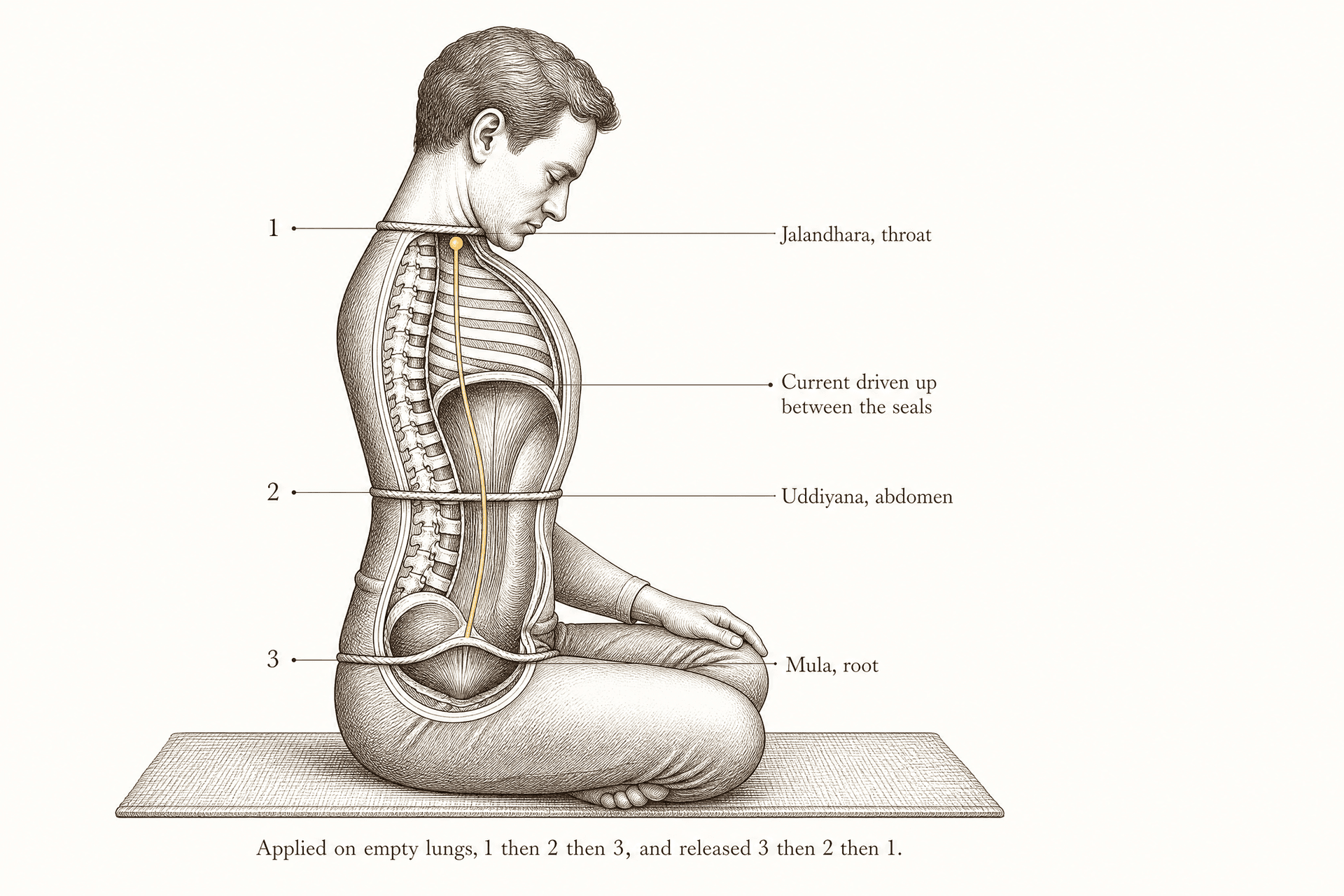
Mula Bandha, the root lock

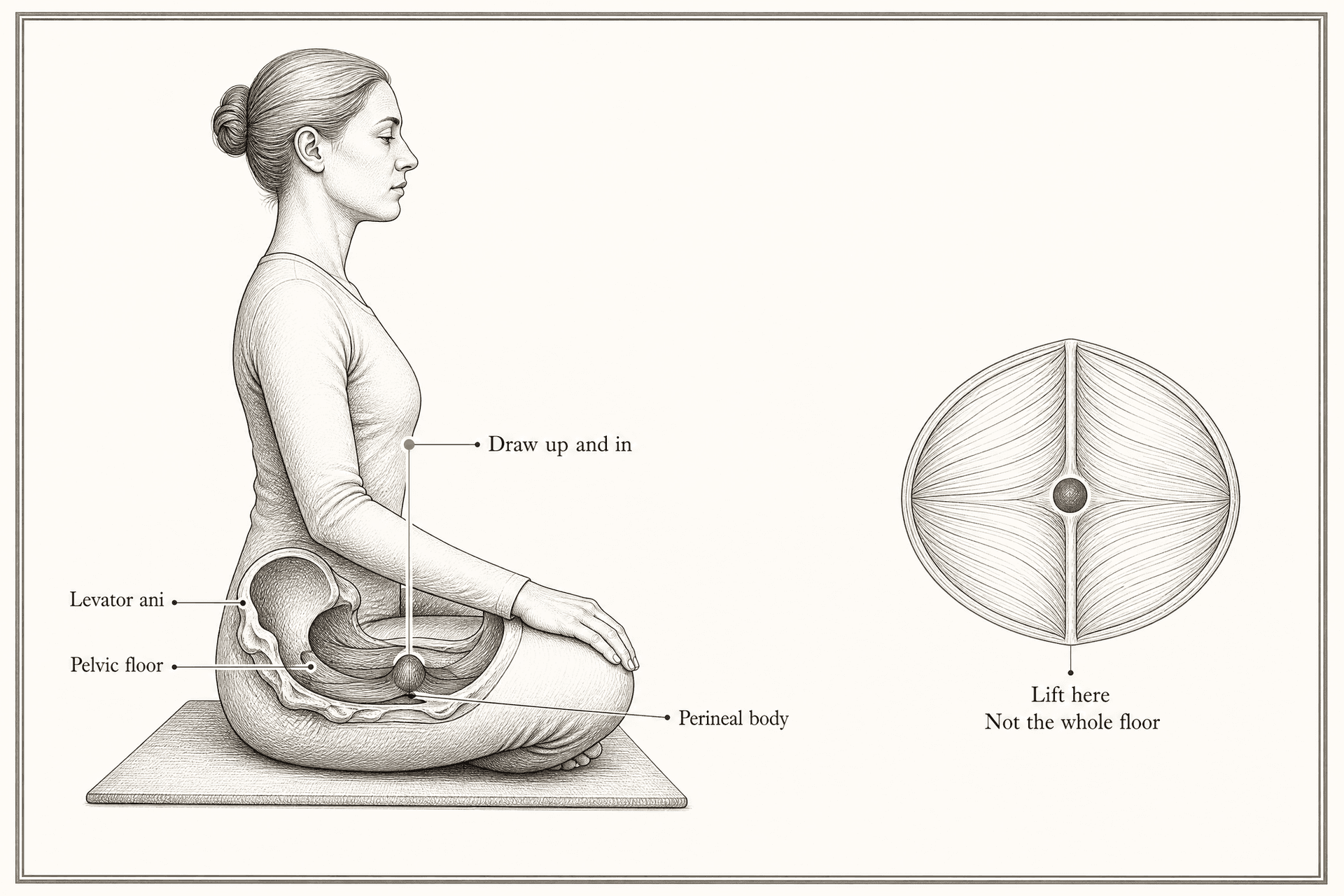
The target is precise and almost everyone gets it wrong on the first attempt. It is the perineal body, the central fibromuscular tendon of the floor of the pelvis, with the levator ani group and specifically the pubococcygeus. In a man it sits at the midpoint between the anus and the genitals; in a woman the traditional localization is the region of the posterior vaginal wall toward the cervix, which is the text's instruction and not a clinical certainty. It is not the anal sphincter, that is a different lock, and not the genital or urethral squeeze, that is another lock again. To find it, bring attention to that exact midpoint and draw it inward and upward in a subtle dome lift, not a gross clench of everything in the region. Iyengar treats the beginner's full-floor squeeze as an error to be unlearned; the lift you want is small, central, and specific.

You apply it in three settings: in seated practice, to train the contraction; on retention, as part of the sealed vessel; and, the one that matters most here, in the live moment of the urge, as the door. What it does is reverse apana. It seals the base and drives the downward current up to meet prana at the navel, the physical act of turning fall into rise.

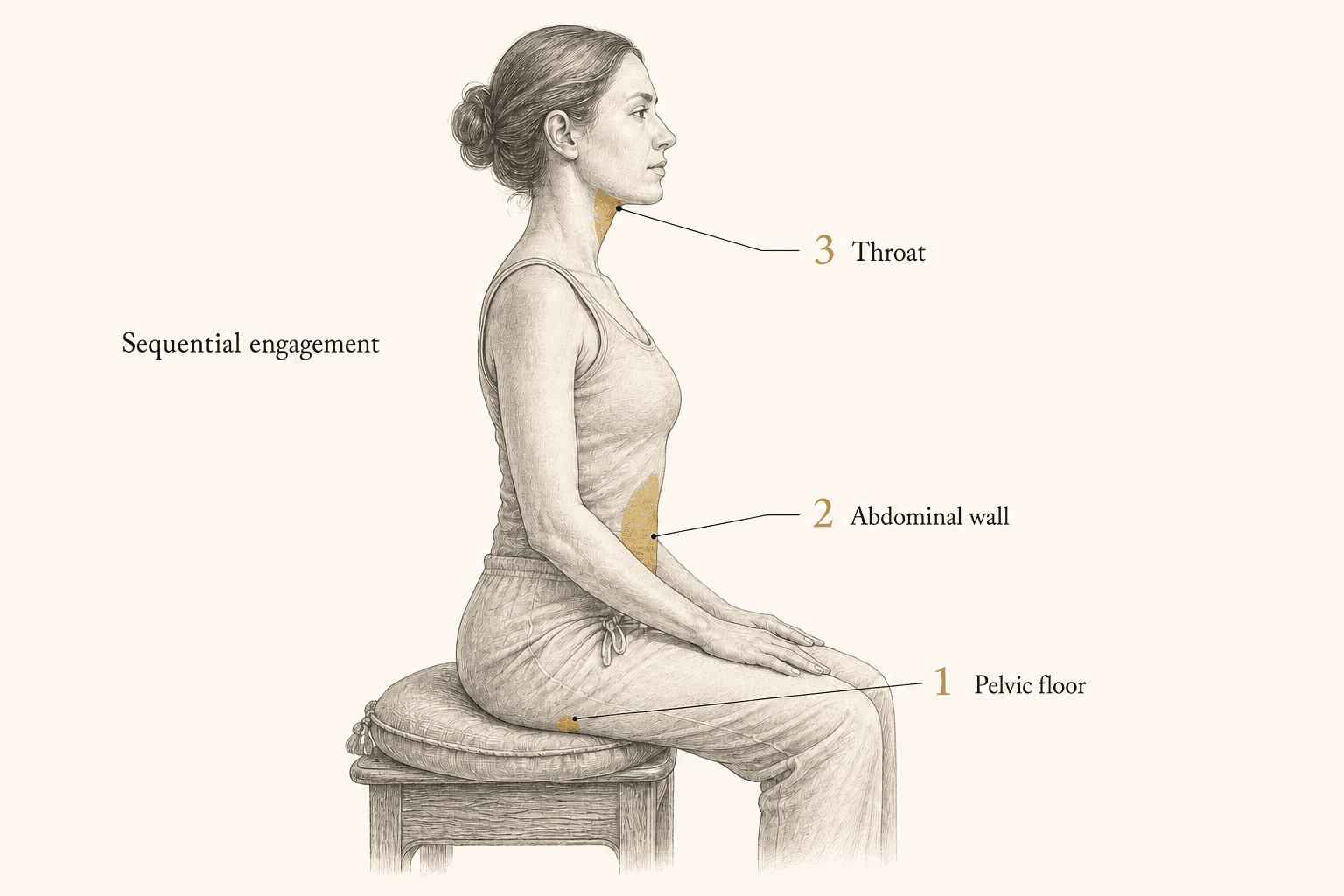
A figure seated upright in meditation rendered in aurum hairline linework on deep obsidian, three lock points marked along the central axis: a bright contracting ring at the pelvic floor, a drawn-in luminous hollow beneath the rib cage, and a sealing band at the throat where the chin meets the sternal notch.
The three lock points on one seated body. Root sealed at the perineal floor, the abdomen drawn up and back into a hollow under the ribs, the throat capped by the chin. Sealed below, sealed above, the current driven up between.

Uddiyana Bandha, the upward-flying lock

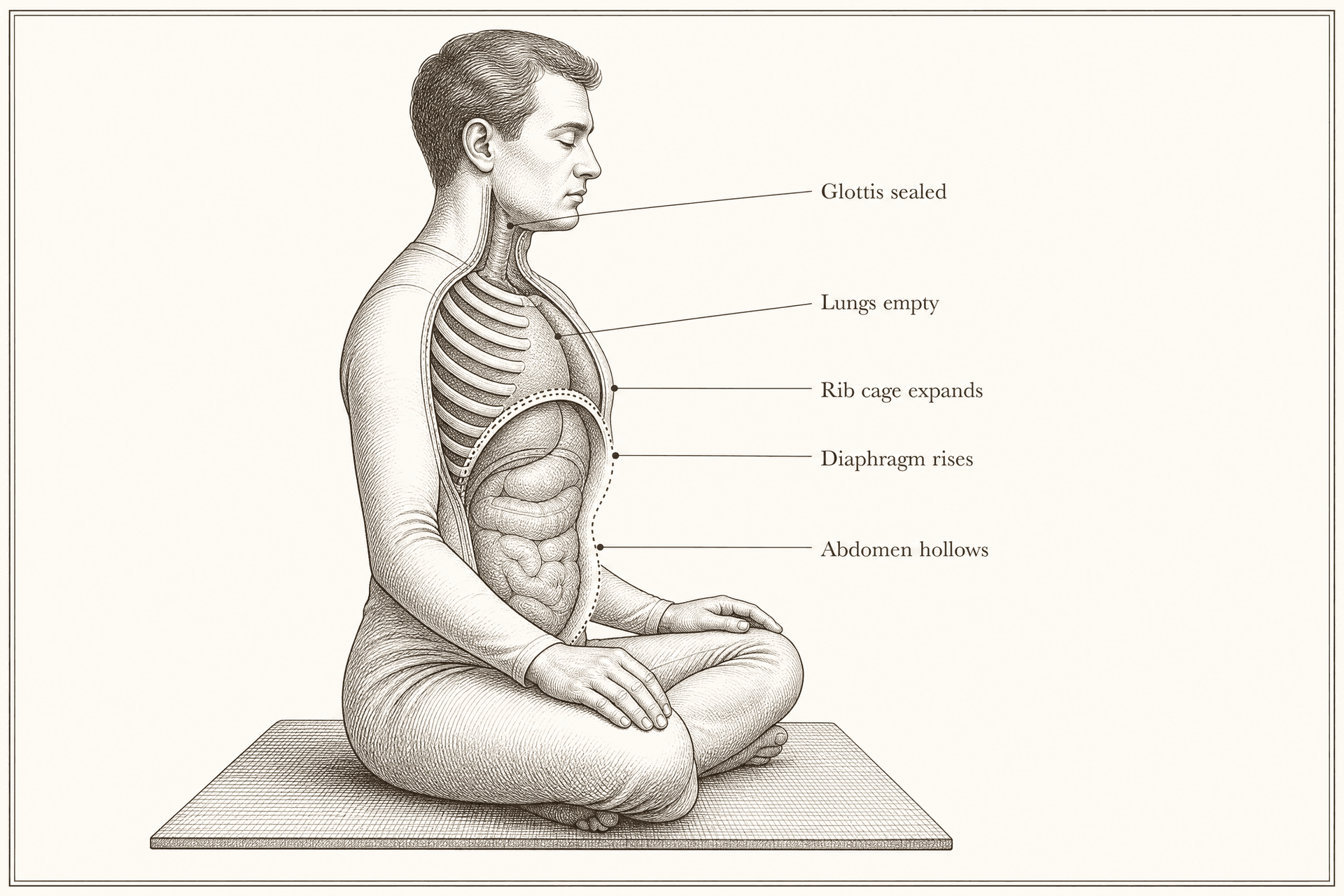
The name means flying up, the great bird of the breath soaring through the central channel, and the mechanism is a modified Muller maneuver, the exact inverse of the strain most people make. Exhale completely and forcefully. Seal the glottis, helped by the chin lock. Now perform a mock inhalation: expand the rib cage as if drawing a deep breath, but let no air enter. The vacuum this creates inside the sealed chest pulls the relaxed diaphragm up under the ribs and sweeps the abdominal organs back toward the spine and upward. The belly hollows on its own; it is sucked in by the vacuum, it does not clench. This is done only on empty-lung retention and only on an empty stomach, because the viscera have to be free to ride up. Iyengar's hard safety rule is part of the technique itself: release the abdominal grip and let the chest drop BEFORE you open the glottis to inhale, or you shock the heart and lungs. What it does is create the upward suction that pumps the current up the spine. It is the pump that gives the root lock somewhere to send what it has sealed.

Jalandhara Bandha, the throat lock

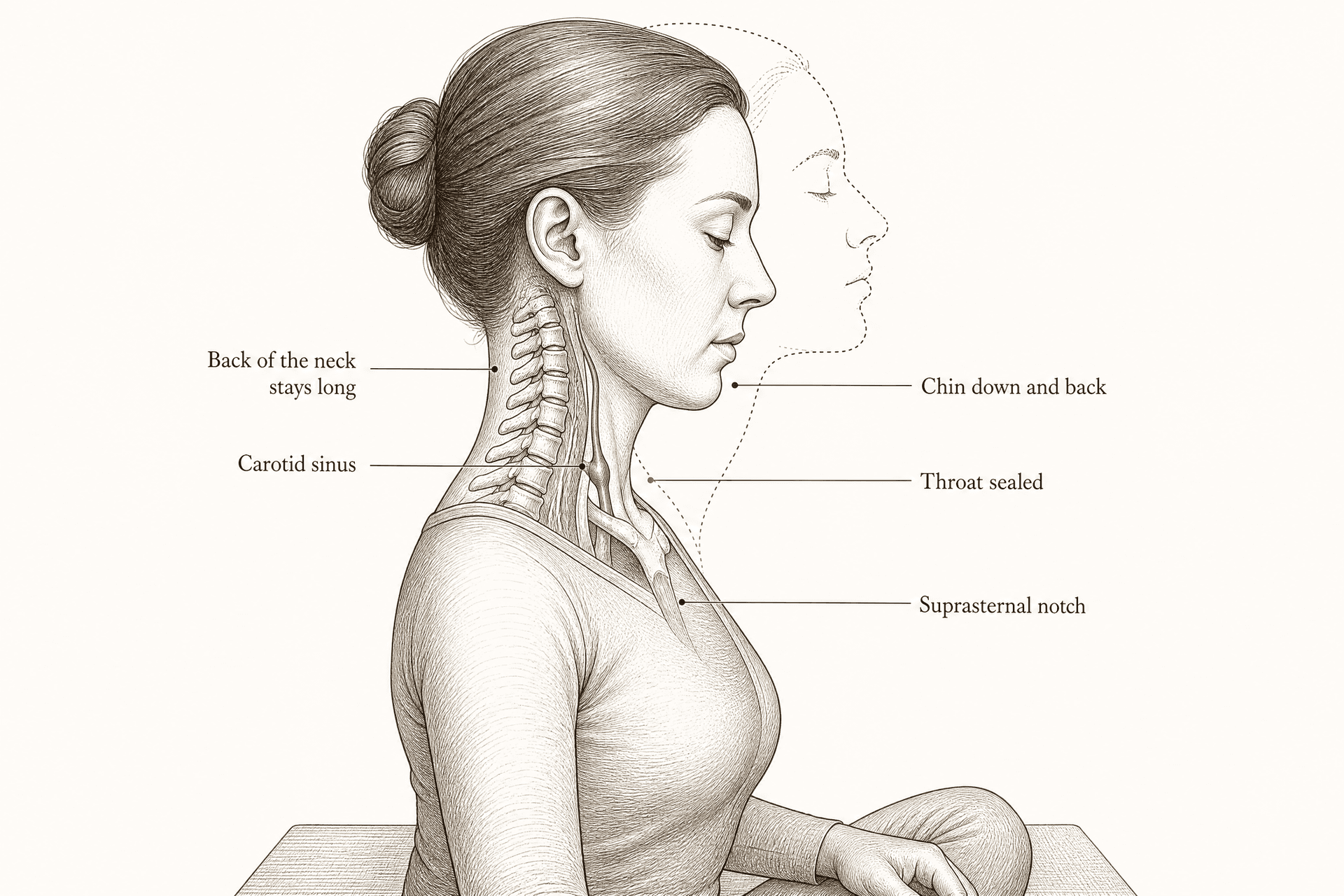
Spine erect, draw the chin down and back into the suprasternal notch, the soft hollow at the very top of the sternum, sealing the throat, and hold it there through the retention. The reading I give for why this works is the modern mechanistic one, not a claim the classical authors made: retention drives a pressure surge upward toward the head, and the chin lock presses on the carotid sinuses, the baroreceptors at the fork of the carotid arteries. They signal a false spike in pressure through the glossopharyngeal nerve, the brainstem answers with a parasympathetic vagal reflex, the heart rate slows, and systemic pressure drops. In plain function: it caps the current at the top so the pressure does not blow out through the head, it protects the heart and brain on retention, and it locks the charge inside the trunk where the abdomen can drive it up the spine. The tradition says it keeps the nectar of the head from falling into the digestive fire below; I name that and leave it.

Maha Bandha, the great lock

This is the title, and it is not a metaphor. is all three locks thrown at once on the held breath, the vessel sealed at both ends with the pump running between them. One caveat so a knowledgeable reader is not caught out: the classical texts also use the name for a seated posture, heel pressed to the perineum, performed with the locks. I mean the modern sense, the three internal locks themselves.

The integrated sequence runs on empty-lung retention. Exhale fully. Apply the throat lock first, capping the top. Then the abdominal lock, drawing the hollow up under the ribs. Then the root lock, sealing the base. Hold. Release in reverse order: root first, then abdomen, then raise the head and release the throat, and only then inhale. In that held configuration the throat caps prana above, the root seals apana below, and the abdominal vacuum compresses the two between them and drives the charge into the central channel.

Root sealed below, throat sealed above, the belly drawing the fire up between them. This is the great lock, and it is why the title is not a metaphor.

The trap

There is a distortion of all this that has trapped a great many earnest people. The claim, in its tantric and Taoist forms, is that you can pull the root lock at the moment of climax, prevent the fluid from leaving, and so have sex endlessly without loss. It travels under several names: injaculation, coitus reservatus, sexual kung fu, the Big Draw. It is wrong, and the reason is the load-bearing mechanism of this whole essay.

The orgasmic reflex is a committed cascade, and it fires in a fixed order. Emission is sympathetic and comes first: the fluid is already dumped into the urethra and the bladder neck has already clamped. Expulsion follows. The orgasm itself is brain-driven: a dopamine peak, an oxytocin burst, then a sharp dopamine drop and a prolactin surge that stays high for sixty to a hundred and twenty minutes, and that sustained prolactin IS the refractory crash. Now apply the lock at true climax. The clinical proof sits in any urology text: retrograde ejaculation is a common, documented event, caused by alpha-blocker drugs, diabetic nerve damage, prostate surgery. The bladder neck fails to close, the fluid goes backward into the bladder, and the man has a completely dry orgasm with the entire hormonal cascade intact, urinated out later. That is the physiological refutation of injaculation. Clamping the gate at climax only forces the already-committed fluid backward. It is not drawn up the spine and reabsorbed as essence. It is in the bladder.

And the order that spends the essence is issued earlier than the emission, in the brain. The of the hypothalamus integrates the whole sexual response, and the moment it is driven hard enough, by a partner or by an image on a screen, it fires the sympathetic command down the cord to the reproductive organs. The testes and the accessory glands obey it: the essence is mobilized, the seed built and staged. The fluid does not have to leave for the bill to come due. The very act of stimulating that circuitry to its threshold sends the signal to convert your energy into seed, and the conversion is the spend. Clamp the gate afterward and you have still paid, because you paid upstream, at the switch, not at the door.

An aurum schematic on obsidian showing a refined drop of essence at the top of a chain of vessels converting downward into a denser reproductive fluid, the conversion arrow itself glowing as the point of loss, with a clamp drawn uselessly at the very bottom of the chain, far below where the essence has already been spent.
The loss is upstream of the gate. The essence is spent at the conversion of ojas into seed, not at the moment the fluid exits. A clamp at the base seals nothing that has not already been given.

And Ayurveda is exact about what that signal spends. The body refines its tissues in a chain, and the most refined of the seven is , the reproductive essence. The cream skimmed from the entire chain, the essence of all seven tissues at once, is , classically the seat of strength and immunity, held in the heart. The real loss in any true orgasm is the conversion of ojas into shukra and the firing of the cascade. Once the body has committed the essence and pulled the trigger, the ojas is spent at the level of conversion and intent, whether or not the fluid exits. You cannot cheat it; the clamp comes too late by design. The only state that genuinely retains anything is never triggering the reflex at all, staying in the plateau, the old practice of male continence or Karezza, which is, by definition, not an orgasm. I note it and do not glorify it.

The loss is not the fluid. It is the conversion and the firing. By the time you clamp the gate, the essence is already spent, and the body cannot be tricked into refunding what it has already decided to give.

So the honest conclusion is plain. See sex as what it is, reproduction. The material fluid is a few calories of nutrients, trivially replenished; the loss that matters was never the fluid but the commitment of essence and the cascade. Do not build a spiritual extraction practice on top of the act. I have watched people go astray in tantric binds and stay trapped for years, and the damage is specific: a chronically clenched, hypertonic pelvic floor, prostatitis-like pelvic pain, sphincter damage from forced retrograde ejaculation, and a performance anxiety that frames every emission as spiritual failure and so destroys the very presence the practice claimed to build. They wreck their own lives and the lives of those closest to them, chasing a refund the body was never going to issue.

So the discipline is not at the level of the fluid at all. It is at the level of the signal, and the signal is born higher up, in thought, in the gaze, in action, and in deed. Refuse the second glance and the circuit never reaches threshold. Starve the thought before it roots and the brain never issues the order. Keep the conduct clean and there is nothing staged to convert. This is the continence the texts actually mean, fought everywhere at once and never in the bedroom alone. Carry that refusal through all four, thought, gaze, action, and deed, and lay the bandhas underneath it to seal and reverse what is no longer being spent, and the charge that used to drain at the base is held, turned, and driven up the spine. Do this consistently, in mind and eye and hand alike, and you awaken in yourself a force most people live and die without ever meeting, the full creative current of the body turned to its highest use.

Fight it where it is born, in thought, gaze, action, and deed, not where it leaves. Seal the signal with the locks, and a force most people never meet wakes up in you.

The substrate

The locks move the current, but a pump is only as good as the pipes it pushes against. If the rising charge reaches a sealed gate it goes nowhere. If the pineal is calcified, if the endocrine line is sluggish, the current hits a closed valve and the work stalls no matter how clean the technique. A perfect pump driving against a shut valve produces nothing but heat. You can run the locks for a decade and go nowhere if the gates above are shut. This is the part the single-practice enthusiast never sees.

The error is always the same, and it is universal across disciplines. A person finds one lever and swears the whole answer is that one lever. Only pranayama. Only the diet. Only the supplements. Only the sitting. They miss what every serious tradition eventually arrives at, that the body is a single integrated instrument and there is no complete picture from any one angle. The current has to be raised, but it also has to have an open to rise through, which means the gates along it have to be clear. That is why no one essay on this site is the answer. Calcification shuts the highest gate, the argument of the pineal essay. The body as an instrument run on flow with the lowest loss is the gold of the philosophers. The fuel and the clean pipes are the substrate of biophotons and living food, the essential minerals, and the liver and gallbladder flush. The locks are one angle on an instrument that has to be sound in every dimension at once. Take them as the whole and you will run a flawless pump into a wall for years.

A translucent human figure in aurum linework on obsidian shown as a single instrument, a chain of glandular nodes glowing softly along the central axis from base to crown, with one node near the head rendered dark and hardened, the rising current visibly stalling and pooling beneath the sealed gate.
One instrument, many gates. The locks raise the charge; a single calcified or dysfunctional gate stalls it. The work needs every angle at once, not one lever pulled in isolation.

The great work

Raise the current and hold it and you have a charged reservoir, and a reservoir with no outlet upward eventually leaks back down. The charge needs a receiver, somewhere worthy of it to go, and the somewhere is not another technique. It is a great work.

This follows directly from the trap. If dissipation is at the level of intent, then the deepest continence is too, the reorientation of intent itself. When the whole of a person's wanting is turned toward God and toward the selfless service of others, there is nothing left at the level of commitment pulling the current back down. The will is no longer the thing doing the holding, which is why it holds when the will is exhausted, and the will always exhausts. The mission holds it instead. The perineum is the lock you learn first, mechanical and teachable in an afternoon. The lock that holds at three in the morning is a work large enough that you want the current more than the body wants to spend it.

Each person has a work like that to find, and the finding is itself part of the discipline. Pour the conserved charge into it. Let the surplus that no longer bleeds out at the base become the fuel of what you were made to build and to serve. The locks seal the vessel. The work is the true lock.

The path to hell feels like heaven

Now the law that makes all of this hard, and it is a law, not a complaint. The downward path is sweet, easy, and immediate. The upward path is bitter and slow. The sweetness of the descent is not incidental to the trap; it IS the trap, because the bait has to taste like heaven or no one would take the hook. The bitterness at the threshold of the ascent is the toll, and the toll is real because the gate is real.

The scriptural root is solid and I will keep the provenance honest. Wide is the gate and broad is the way that leads to destruction, and many go in by it; strait is the gate and narrow is the way that leads to life, and few find it. That is the spine of the thing. The proverb that hell is paved with good intentions is folk wisdom misattributed for centuries to Bernard of Clairvaux; it is not his. The line that the path to hell feels like heaven has no canonical author at all, only modern phrasing echoing the wide gate, and I give it as that and never as a saint's.

The path down feels like heaven, and that feeling is the whole lie. The path up feels like hell, and that feeling is the toll at the only gate that rises.

This is why staying disciplined is among the hardest things a person ever attempts, harder than any single heroic act, because it is not a single act. The counterfeit ease of dissipation arrives as relief in the moment and only reveals itself as a cage later, after the gate has closed behind you, which is the exact design of the bait. The toll at the narrow gate arrives the other way around: bitterness now, the only door that goes up.

A wide cinematic vista in aurum and obsidian, two roads diverging from a single point: one broad and gently descending into a warm seductive glow that darkens at its far end, the other narrow and climbing steeply through a tight bright gate toward a high cold light.
Two roads from one point. The broad descent is sweet at the start and dark at the end. The narrow ascent is bitter at the gate and is the only road that rises. The sweetness of the easy road is precisely how it stays baited.

The gate is narrow because the toll is real, and the bitterness at the threshold is the price of the only door that climbs. Pay it. Flee what you cannot fight, seal the vessel, open the gates above, and pour the conserved current into a work large enough to hold it. The lock you learn first is muscle; the lock that lasts is the work.

Sources

  1. Hatha Yoga Pradipika (with commentary by Swami Muktibodhananda), Svatmarama
  2. Asana Pranayama Mudra Bandha, Saraswati, Swami Satyananda (Bihar School of Yoga)
  3. Light on Pranayama, Iyengar, B. K. S.
  4. Charaka Samhita, Sutrasthana (ch. 17, 30; Sharira 7), Agnivesha / Charaka, redacted Dridhabala
  5. Sushruta Samhita, Sutrasthana 15 (Doshadhatumalakshayavriddhi), Sushruta
  6. The Institutes, Book VI (De spiritu fornicationis), and The Conferences, Cassian, John (trans. Ramsey, B.)
  7. Prolactin secretion as a measure of sexual arousal and orgasm in humans (Psychoneuroendocrinology, 2002), Kruger, T. H. C. et al.. https://doi.org/10.1016/S0306-4530(01)00036-X
  8. The Serpent Power, the Secrets of Tantric and Shaktic Yoga, Avalon, A. (Sir John Woodroffe)
发表
阅读
15 分钟
出处
8