Sex, Power, Money, Fame
The four hungers that run the world are one energy stalled at the lowest gates. Why a force that cannot rise must discharge as ruin, and what becomes possible the moment it climbs.
Say the four words to anyone, sex, power, money, fame, and watch them nod, because between them those four words explain almost every headline, every war, every betrayal, every fortune built and every life wrecked in the building.
We treat them as four separate appetites, four problems for four sets of rules. They are four masks worn by one force, the same force that, turned the other way, has produced every saint, every genius, and every act of grace the species ever managed. The difference between a civilisation that tears itself apart and one that does not is not which appetites it has. It is where the energy behind them is allowed to go.
These are not four hungers. They are one current, stalled at the bottom of the body, looking for the only exits a low gate allows.
The mechanics of that current, what rises through the spine when the deepest drive in the body is conserved and directed upward, sit in the essay on sexual transmutation. The question here is larger. If the current can rise, what happens to a person, and to a whole world, when it cannot?
The claim is exact. The horrors of the world are a hydraulic fact, not a moral failure that better preaching could fix. A force that is generated and cannot climb does not disappear. It has to come out somewhere, and the somewheres a low gate allows are sex, power, money, and fame in their distorted forms. The only move that has ever worked, at the level of one person or of a species, is to send the energy up.
One current, one ladder
One force, the , coiled at the base of the spine. One channel, the , running to the crown. Seven gates along it, the . The current either rises through these gates or stalls at one and discharges through it. That is the whole drama.
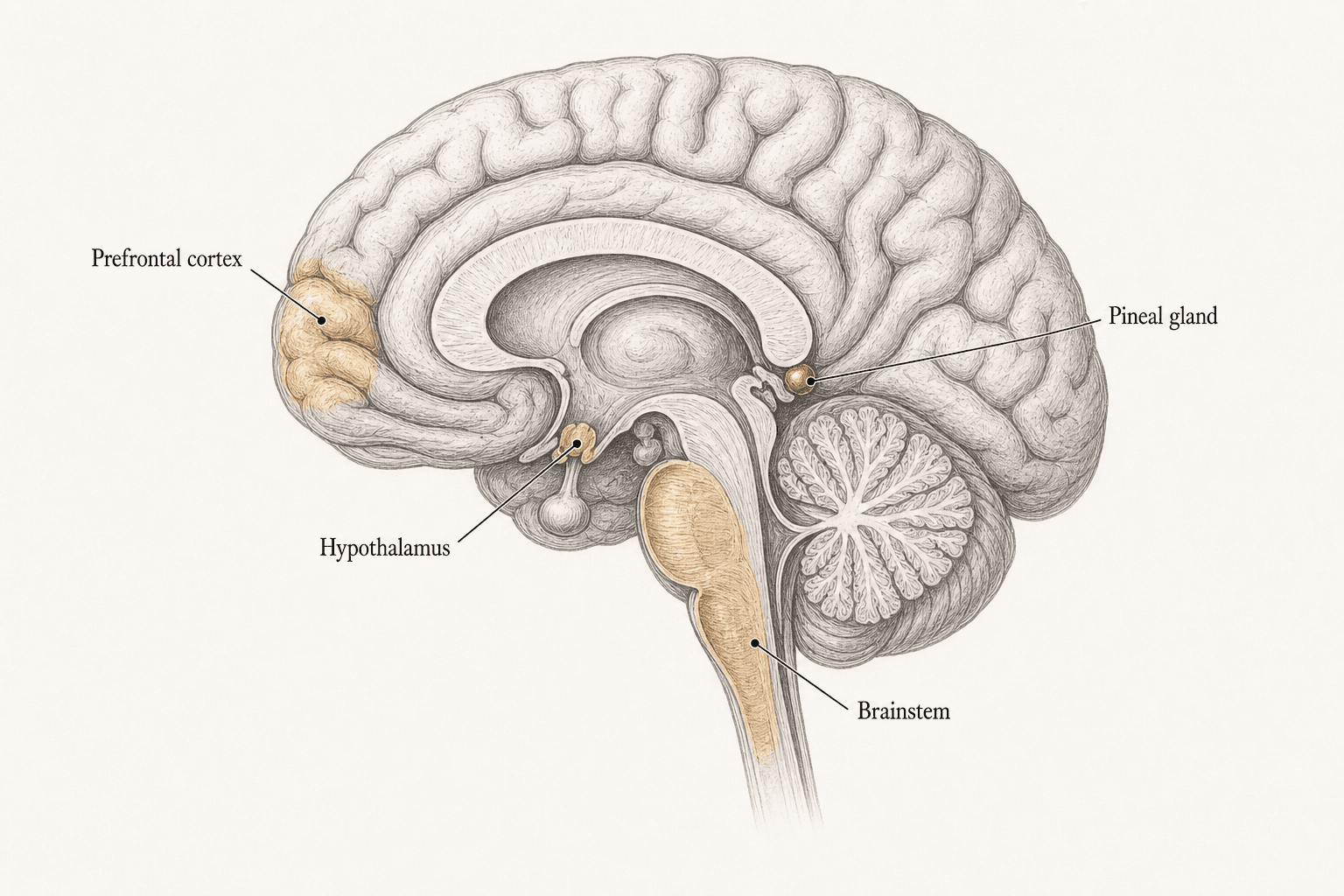
You do not have to take the map on faith from the East, because the West drew the same ladder in the language of the brain. The neuroanatomist Paul MacLean spent his career on the , the observation that the human skull holds three brains stacked in the order evolution built them.
At the base sits the reptilian complex, the brainstem, concerned with one thing only: survival, territory, the reflex to fight, flee, or seize. Wrapped around it is the limbic system, the seat of raw emotion and appetite, of pleasure and rage and the drive to mate and to dominate. Over both sits the neocortex, and at its front the prefrontal cortex, the late and fragile organ of reason, foresight, empathy, and restraint, the part that holds a longer horizon than the next reward.
Higher still, in the geometric centre of the head, sits the pineal, the organ the inner traditions always named the seat of the highest seeing, treated in full in the pineal gland essay.
The two maps are one map. The lower gates are the lower brain. To say the energy is pinned at the base is to say, in the other vocabulary, that a human being is running on the brainstem and the limbic system with the higher centres never brought into the work. When people speak of energy reaching the higher centres of the brain, they are not being poetic. They are describing the literal migration of a person's operating centre of gravity from the reptilian and limbic floors up into the cortex and beyond.
The three animal gates, and the four human ones
Lay the two maps over each other and a hard fact comes into focus. The lower three gates are the animal in us. The upper four are not.
The reptile, in MacLean's scheme, runs almost entirely on the brainstem: survival, territory, the reflex to seize or strike. That is the root gate, and little else. The mammal adds the limbic system, the warm machinery of appetite, bonding, and the care of young, and with it the second and third gates, pleasure and the drive to dominate the pack.
Now walk the gates and notice what the older tradition did: it hung a particular animal on each one to name the behaviour that lives there. The root carries the of the elephant, Airavata, heavy and immovable, the brute will to hold ground and survive. The sacral carries the , the crocodile beneath the water, appetite lurking under the surface and ready to drag you down. The solar plexus carries the ram, head lowered, the butting and charging will to power. Three gates, three beasts, and every animal that has ever lived on the earth lives entirely within them.
Then the ladder changes character. The heart carries the antelope, the first creature on the list that does not seize or charge but leaps, lightness and grace, the drive at last beginning to move beyond appetite. The throat carries a white elephant, the brute strength of the root now purified, force tamed into true speech. And at the third eye and the crown there is no animal at all. The tradition could find no beast to set there, because none reaches that high. The top two gates are left blank of any creature on purpose. They are the part of the human being the animal kingdom does not contain.
The reptile has one gate. The mammal has three. The human being is the only creature on earth built with four more above them, and almost all of us still live in the bottom three.
Sit with this. We are not animals carrying a little extra cleverness. We are the single species fitted with centres no animal possesses, and the tragedy of the human condition is not that we lack the higher gates but that we own them and do not climb.
Gurdjieff said it plainly a century ago: we are three-brained beings who live almost entirely from the lowest brain, mechanical and asleep, the higher centres present in everyone but switched off for want of the work that wakes them. The Theosophists described the whole of spiritual evolution as the raising of a fire from the generative organs at the base to the brain at the summit. Yogananda taught that the lower spine binds us to the animal kingdom and the higher brain centres are the seat of the soul.
They point at one map. The animal lives at the bottom, the human waits at the top, and the distance between them is the length of the spine.
The law of the dammed river
The energy is generated whether you like it or not. It is the basic charge of being alive, the same charge that fills the body at the base of the spine and rises as pressure looking for a path. You do not get to choose whether the river flows. You get to choose, within limits, where it goes.
A river that is dammed does not stop being a river. The water keeps arriving. The pressure keeps building. And water under pressure, denied the channel upward, does not sit politely behind the wall. It finds the cracks. It bursts the weakest seam. It comes out, with force, wherever it can.
This is why moralising never works on any of the four hungers. Tell a person not to be greedy, not to be lustful, not to be cruel, not to crave the eyes of the crowd, and you change nothing, because you have addressed the outlet and left the pressure untouched. The energy that was going to discharge as greed discharges as something else. Prohibition reliably produces not virtue but a new and uglier symptom, because the dam was never the problem. The problem was that the river had nowhere to climb.
Energy that cannot rise does not rest. It ferments. And the four hungers are simply the four shapes fermentation takes in a body that has forgotten the way up.
The whole promise of the inner work, set out in the essay on the gold of the philosophers, is to lower the resistance of the human instrument so it carries its own energy without loss, the way a superconductor carries a current without leaking it as heat.
The four hungers are the heat. They are what the current dissipates into when the channel up is blocked and the system has to shed its charge as friction. A life run on the lower gates leaks its entire energy budget into survival panic, appetite, the will to dominate, and the craving to be seen. There is nothing left over to rise.
So there are only ever two destinies for the force. Up, through the gates, into the faculties the upper centres govern. Or out, through whichever lower gate is weakest, as one of the four distortions. Every human being is living one of these two lives at every moment, and so is every civilisation, because a civilisation is only the sum of where its people's energy is allowed to go.
The four hungers, gate by gate
Now walk the lower gates and watch each hunger appear as the shadow that gate throws when the current stalls there.
Money is the root in fear
The first gate, , is the centre of survival. Its faculty is security and grounding. Its shadow, when the gate is closed and the energy pinned at the floor, is fear, the oldest and most primitive signal the body carries, the reptilian alarm that says: you might not make it.
Money is what that fear builds when it cannot rise. Strip away the abstractions and money is crystallised survival fear, the attempt to convert the terror of scarcity into a number large enough to silence it. The number never is large enough, because the fear was never about the number.
A person with ten million who cannot stop accumulating is not solving a material problem; they are feeding a root gate with no off switch. The hoarding, the scarcity mindset, the inability to feel safe at any balance, the conviction that there is never enough, these are not personality flaws. They are the signature of survival energy with nowhere to go but in circles at the bottom of the body.
Scale this to a civilisation and you get the economy we have, a machine engineered to keep the root gate in alarm, because a frightened animal consumes. Debt as a way of life, the strip-mining of the living world to feed quarterly numbers, the reduction of every relationship to a transaction, a billion people working themselves sick chasing a security the structure is designed never to deliver. None of this is a failure of economics. It is the root chakra of the species, stuck open and bleeding fear, organised into an institution.
Sex is the sacral spilling
The second gate, , is the centre of pleasure and of the creative drive, and it is the gate at which the modern world deliberately traps almost everyone. Its proper function is generative, the same energy that makes new life and, raised, makes new work. Its shadow is the leak: appetite untethered from meaning, pleasure pursued as an end until it consumes the one pursuing it.
Our era has industrialised this hunger more thoroughly than any before it. The pornographic feed, the engineered image, the algorithm tuned to fire the second gate a thousand times a day, the entire attention economy is a mechanism for keeping the energy pinned exactly here, spent before it can climb.
The cost is not only personal, the dulled mornings and the silenced higher faculties charted in the transmutation essay. At scale it is the commodification of the body, the reduction of other human beings to objects of appetite, the trade in flesh, the slow death of intimacy in a culture that has confused stimulation with connection. A society spilling its creative force out the second gate produces a great deal of stimulation and almost no creation, a great deal of contact and almost no love.
Power is the fire turned to domination
The third gate, , is the centre of will and personal power, the fire of agency, the force that lets a person act in the world and hold a discipline across years. Nothing is wrong with the fire. The fire is necessary. The distortion appears when the gate above it, the heart, stays shut, so the will has nothing to serve but itself. Then power stops meaning the capacity to do and starts meaning the capacity to dominate, to make others small in order to feel large.
This is the hunger that writes the worst of history. War, tyranny, cruelty for its own sake, the whole apparatus of one human being or one nation bending others to its will, is manipura with the heart closed above it.
David Hawkins drew the distinction precisely in his work on the levels of consciousness: force and power are opposites, not synonyms. Force is the lower thing, domination, coercion, the fist, and it always requires more force to sustain because it generates resistance. Real power, the kind that does not need to coerce, lives higher up and asks nothing of the people near it. The tyrant has force and no power, which is why he is always afraid, and why his empire always, eventually, costs more to hold than it yields.
René Girard saw the engine underneath it. We do not desire things directly; we desire them because others desire them, and that mimetic rivalry escalates, two hands reaching for the same object until the reaching becomes the point and the object is forgotten. Rivalry breeds violence, violence breeds more, and societies discharge the accumulated pressure onto a victim, the scapegoat, a temporary peace bought with blood.
That is the third gate at civilisational scale: the will to power, multiplied across millions, periodically released as war. It is the oldest pattern we have, and it is precisely the pattern of energy that cannot rise.
Fame is the crown counterfeited
The fourth hunger is the subtle one, and once you see it the whole picture locks into place.
Fame does not fit cleanly onto a lower gate the way money, sex, and power do. That is because fame is not a lower hunger at all, but the highest longing in the human being wearing a disguise.
The crown, , is the gate of union, the place where the separate self dissolves back into the whole and is, in the language of every tradition, known by everything, at one with everything, no longer afraid of death because no longer only itself. That is the deepest desire a person carries, underneath all the others: to be reunited with the source, held by the totality, to not be alone, to not end.
Now take that infinite longing for union with God and pin it at the bottom of the body, where it cannot reach its true object. It does not disappear. By the law of the dammed river, it has to come out. And the nearest counterfeit of being one with all, available to a self that cannot rise, is being seen by all.
The hunger to be known by everything becomes the hunger to be known by everyone. The longing to dissolve into the whole becomes the longing to be adored by the crowd. The craving for the eternal becomes the craving to be remembered, to leave a name, to not be forgotten. Fame is the ego's forgery of transcendence. It is the crown chakra's homesickness, misrouted into the lowest possible mirror.
Ernest Becker named the mechanism without the chakra language. The human animal, uniquely aware that it will die, spends its life on what he called the immortality project, some symbolic achievement that will outlast the body and cheat death of its finality. Fame is the purest immortality project there is, the bid to purchase a kind of deathlessness in the memory of others.
But the memory of others is not eternity, and the crowd is not God, and so the hunger is never satisfied, because the famous person has reached for union with the whole and closed their hand around the regard of strangers. They have everything except the only thing they actually wanted.
Fame is the crown's homesickness pointed at the wrong mirror. The soul wants to be one with everything; the stalled self settles for being watched by everyone.
This is why our age, which has democratised fame and made the small immortality project available to everyone with a phone, is so visibly anguished. We have built a machine that takes the deepest spiritual longing in the species, the longing for God, converts it into a metric of attention, then sells the pursuit of that metric back to us as a life. The cult of being seen, the influencer as the era's defining figure, the vanity and the comparison and the quiet despair underneath the curated image, is the counterfeit crown running at planetary scale. It is the saddest of the four hungers, because it is the holiest one, inverted.
The seven sins are the seven gates failing
Sex, power, money and fame name the loudest of the gates, the four whose distortions read off any front page. The older moral tradition was more exact. It did not stop at four. It named a particular failure for every centre, one sin per gate, and called them deadly because each one, left to run, consumes the person it lives in.
The list we inherited, greed, lust, gluttony, envy, wrath, sloth and pride, came down through the desert monk Evagrius and Pope Gregory the Great, born in a Christian world that had never heard of a chakra. The seven gates came down through the tantric texts of India, which had never heard of a catechism.
The two systems were fused by the Theosophists and then by Jung, whose 1932 seminars read the climb up the gates as the climb toward an integrated self. The pairing is uncannily clean, and it is clean for a reason: both lists were describing the same animal from different sides.
Walk them once, from the floor up, each with its gate, its sin, and what the same gate gives when it is held open instead of shut.
- Root, greed. Shut, the survival gate runs as hoarding, scarcity, and paranoia, the fear that there will never be enough. Open, the very same centre gives grounding, courage, security, and the patience to build. This is the money gate.
- Sacral, lust. Shut, it runs as appetite severed from love, addiction, obsession, the body reduced to a tool. Open, it gives creativity, healthy pleasure, and the free flow of feeling. This is the sex gate.
- Solar plexus, gluttony. The fire gate fails in two ways: as the appetite that can never be filled, and, when the older writers move wrath down into the flame, as domination, arrogance, the temper that makes others small. Open, the same fire gives will, confidence, and the discipline that holds a life together across years. This is the power gate.
- Heart, envy. Shut, the heart curdles into envy, the wound that measures itself against everyone else, and into bitterness, coldness, or the suffocating love of the martyr. Open, it gives compassion, forgiveness, and the dissolving of the line between self and other.
- Throat, wrath. Shut, the voice becomes a weapon: wrath, lies, gossip, cruelty, or else the choked silence of the truth never spoken. Open, it gives clear and honest speech, and the rarer gift of actually listening.
- Third eye, sloth. The sin here is not idleness but , spiritual sloth, the refusal to see, the wilful dullness that keeps the inner eye shut. Open, the gate gives insight, intuition, and sight into the structure of things.
- Crown, pride. The highest gate carries the highest danger: pride, the self enthroning itself in the place of God, the god-complex of the one who mistakes a glimpse of the summit for ownership of it. Open, the same centre gives wisdom, union, and presence. This is the gate fame counterfeits, and pride is the exact counterfeit, the longing to be worshipped standing in for the longing to dissolve.
Notice the shape of it. Every gate fails in two directions, too little or too much, the collapse and the excess, and the deadly sin is almost always the excess. The sin and the glory live at the same address. The centre that produces greed produces courage. The fire that becomes domination becomes discipline. The gate that curdles into pride opens into wisdom. The sin is never the gate. The sin is the gate held shut, the current arriving and finding no way up.
A world made of stalled current
Read any day's news, and there is almost nothing in the catalogue of human misery that does not resolve, on inspection, into one of these four, which is to say into the single current discharging through one of the lower gates because it cannot rise.
We have built, for the first time in history, a technology whose entire business model is to keep the current at the bottom. The feed is engineered to fire the second gate so the energy never climbs, to inflame the first gate's scarcity so we consume, to stoke the third gate's rivalry so we stay enraged and engaged, and to dangle the fourth gate's counterfeit immortality so we keep performing for the crowd.
The machine does not profit from a human being whose energy has risen to the heart, because such a person wants very little, fears very little, dominates no one, and does not need to be seen. The entire apparatus is, whether anyone designed it this way or not, a dam built across the human spine at industrial scale.
We did not just fail to raise the current. We built a machine whose profit depends on keeping it at the floor.
This is why the problems compound rather than resolve, no matter how much wealth or law or technology we throw at them. You cannot fix a hydraulic problem with a moral lecture, and you cannot fix it with a better dam. As long as the energy of billions is held at the lower three gates and milked there, the distortions are not bugs in the system but the system itself, running exactly as a system pinned to the floor must run.
Why it cannot be legislated, only raised
Follow the logic to its conclusion and the usual solutions fall away one by one. More laws against greed leave the survival fear untouched and the greed reappears as a cleverer instrument. More shame around lust drives the appetite underground and intensifies it. More force against the tyrants breeds the next tyrant, because force is the third gate and answering it in kind only feeds the gate. More moralising about vanity in a culture starving for transcendence is noise to a soul that has confused being watched with being saved. Every approach that works on the outlet fails, because the outlet was never the cause.
There is exactly one move that addresses the cause, and it is the move the inner traditions have pointed at for three thousand years. You change where the energy goes. You open the channel up. The drive that built every living thing is not yours to abolish, it is yours to direct, and the same is true of all four hungers at once, because they are the same drive.
You do not defeat greed, lust, the will to dominate, and the craving for fame one at a time. You raise the single current that was discharging as all four, and as it rises, it stops arriving at the gates that produced them. The lower gates do not have to be fought. They have to be passed.
Passing them is not a metaphor but a practice. The complete Kriya Yoga library sets down the specific kriyas that work each centre of the spine.
What opens above the floor
Above the third gate sits the heart, , and it is the hinge of the entire ascent, because the heart is the first gate where the separate self begins to dissolve. Below it, everything is about the self: my survival, my pleasure, my power, my name. At the heart, for the first time, the boundary between me and you starts to thin.
Compassion is what the current feels like when it has climbed above the gates that only know the self, not a moral decoration added to a selfish animal. A person whose energy lives at the heart does not have to be told not to exploit others, because the others no longer feel fully separate from them. The commandment has become a perception.
Above the heart, the throat, , the gate of truth and authentic voice, where what a person says begins to carry weight because it is no longer in the service of the lower hungers.
Above that, the third eye, , the seat of the pineal and of the seeing that looks into the structure of things rather than their surface, which is exactly why the calcified, sealed pineal of the modern adult matters so much, and why its decalcification is a prerequisite for any of this.
And at the summit, the crown, where the longing that fame counterfeits finds its actual object, union, not with the crowd, but with the whole.
This is measurable, and it has been measured. When researchers put long-term meditators in scanners, two things show up that map precisely onto this ascent. The first is that the brain's , the circuitry of the self-referential me, the part that runs the story of my survival and my standing and my image, goes notably quiet, which is the neural signature of exactly the self-dissolving the heart gate describes.
The second is that adepts in deep practice generate high-amplitude gamma synchrony across the cortex, the brain's highest centres lighting up and binding together at a level rarely seen otherwise. The lower self goes quiet and the higher brain comes online. The current has reached, in the other vocabulary, the higher centres of the brain. The two maps, once again, are the same map.
Two per cent
You have heard the figure. We use only a small fraction of the brain, two per cent, ten per cent, some confident number trotted out to imply a vast sleeping reserve. As neuroanatomy it is false, and worth retiring. Modern imaging shows that essentially every region of a healthy brain is active across a normal day. There are no dark, unused provinces. A small stroke almost anywhere costs you something specific, which could not be true if nine tenths of the tissue sat idle.
The brain is about two per cent of the body's mass and burns roughly a fifth of its energy,footnoteThe disproportion is real and well measured, see Herculano-Houzel on the brain's energy budget. The organ is metabolically ruinous precisely because it is busy, not because it idles. A brain with all of its neurons firing at once is not a supermind. It is the clinical definition of a grand mal seizure. and it is that expensive precisely because it is working, not resting.
The figure survives because it is reaching, clumsily, for something true. The deficit in ordinary human consciousness is coherence, not tissue in use. The untrained mind runs fragmented, its regions firing out of phase, the signal noisy, the self-referential chatter of the default mode network grinding all day like an engine that will not idle down. The instrument is fully powered and badly tuned.
When the current rises, no sleeping tissue wakes up. The brain begins to fire as one. The clearest evidence is the gamma finding we met a moment ago, from Lutz and Davidson: long-term meditators dropped into open awareness produced the highest-amplitude gamma oscillations and the broadest synchrony across distributed regions ever recorded in a healthy human brain, while the network that runs the story of the separate self went quiet. Not more brain. More of the brain beating together, and less of it lost to the noise of the ego.
The two per cent was never about how much of the brain you use. It is about how much of it you can get to fire as one.
This is what the traditions were reaching for with the language of charge and current. The charge is not a crude voltmeter reading on the cord; it is a reorganisation, a body and brain settling into far greater coherence and far less leakage, which is exactly the language of the gold of the philosophers, the instrument finally carrying its own energy without loss.
The awakened brain is not bigger, and it is not drawing on some hidden ninety per cent. It is in phase. The old claim was pointing at this all along: the ordinary person runs only a fraction of the brain's coordinated potential, not because the tissue is missing but because the nervous system cannot yet bring its regions into one rhythm at once. The trained, awakened nervous system achieves precisely that simultaneity, the widest single act of neural coherence anyone has managed to measure. That, and not a sleeping nine tenths, is the brain the higher gates switch on.
God above all, as the actual mechanism
Look at what the four lower hungers have in common. Money is the self defending its survival. Sex, distorted, is the self consuming for its pleasure. Power is the self enlarging itself over others. Fame is the self seeking to be eternal. Every one of them is a movement of the separate self, asserting, defending, aggrandising, perpetuating the I that stands apart from everything else. The lower gates are not four different problems. They are four expressions of one underlying condition: the conviction that I am a separate thing, alone in a world of other separate things, and must therefore secure, satisfy, dominate, and immortalise myself before the dark closes in.
And the heart gate, the hinge of the whole ascent, is nothing other than the loosening of exactly that conviction. The current cannot pass the heart while the self insists on its separateness, because passing the heart is the dissolving of separateness. No amount of effort aimed at the symptoms ever opens the gate. You cannot defend, satisfy, dominate, and immortalise the separate self all the way into the recognition that there is no separate self. The motion is in the wrong direction.
This is what it actually means, mechanically, to put God above all else. It is not a rule imposed on life from outside, a tax of obedience levied on an otherwise self-interested animal, but the single act that dethrones the separate self and lets the current rise. To put God above all is to stop putting the self above all, and putting the self above all is the precise blockage that holds the energy at the lower three gates.
The first commandment is not arbitrary. It is a description of the one move that opens the human being. And the recognition that follows it, that there is a single divinity present in all things and all people, is not a doctrine to be believed but simply what the world looks like from above the heart, once the wall of separateness has come down and the current is running through the upper gates as a matter of course.
To put God above all is not a commandment laid on top of life. It is the one act that takes the self off the throne, and the self on the throne is the dam.
This is the thread that runs identically through every contemplative tradition, the thing Aldous Huxley called the perennial philosophy, the single teaching that surfaces independently in the Vedanta, in Taoism, in the Christian mystics, in Sufism, in the Buddhist dharma: that there is a divine ground to all being, that the deepest self in a human being is one with it, and that the purpose of a life is to realise that unity in fact and not merely in theory.
William James, studying the raw reports of religious experience as a scientist, found the same invariant underneath every culture's account: the sense of a wider self and a reconciliation with it, arriving as the lower, anxious, self-defending consciousness gives way.
The Tao Te Ching describes the sage who does not contend and therefore cannot be contended with, the third gate dissolved into the heart. The Gita describes action offered up rather than grasped at, the will of the third gate surrendered to something above it. They are all descriptions of a current that has been allowed to rise by a self that finally got out of its own way.
The next cycle
So picture, finally, what the user of all this energy actually is when it runs the other direction, not in one rare adept, but as the ordinary condition of a population.
A human being whose current lives at the heart and above does not have to be told not to hoard, because the survival fear that drives hoarding has been passed. Does not have to be told not to exploit, because there is no one left standing far enough outside to be exploited. Does not have to be told not to dominate, because domination has nothing left to feed. Does not have to be told not to chase the eyes of the crowd, because the longing that fame counterfeits has found its real object and gone quiet.
For such a person, every virtue we currently teach, legislate, and enforce is simply the natural shape of their energy. Goodness is not effortful. It is what is left when the distortions stop being generated.
Now imagine that as the resting state of enough people that it becomes the texture of a civilisation. War would not have to be outlawed; it would become as unthinkable as it is pointless to a population whose current does not stall at the gate that produces it. Predatory economics would not have to be regulated into submission; the fear it runs on would no longer be there to exploit.
The trade in bodies, the cult of vanity, the whole catalogue of distortions, would not be suppressed. They would simply lose their fuel. This is the next evolution, and it is not a fantasy of changing human nature but human nature with the current finally allowed up the channel it was always built to climb.
The age in which goodness must be taught is the age of the lower gates. The next one is the age in which it no longer needs to be spoken, because it has become the air.
And this is the deepest mark of the shift, the thing that tells you a cycle has turned rather than merely improved. Right now, all of this has to be taught. We need the scriptures, the sermons, the laws, the essays, the constant effortful reminding of a species that keeps forgetting, precisely because the natural resting state of a person stuck at the lower gates is the forgetting. A teaching is always a sign of a deficit; you only have to be told what you are not already living.
The next cycle of humanity is the one in which the recognition of the unity and divinity in all things no longer has to be taught at all, because it has stopped being a teaching and become a fact of perception, the way you do not have to be taught that the sky is overhead. The end of the era of the lower gates is the era in which the highest things are finally silent, not because they have been forgotten, but because they have been so completely realised that there is nothing left to say about them. The teaching ends when the thing taught becomes the air everyone breathes.
That is the choice, and it is the same choice for one person and for the whole. The current is rising in you right now, as it always is, as the simple charge of being alive.
It will go up, through the gates, into the faculties that build the human beings and the world we say we want. Or it will go out, through the floor, as one of the four hungers, multiplied across billions and amplified by a machine built to keep it there, into the world we already have.
The single move that opens the way is the oldest instruction there is, which turns out, when you finally understand the mechanism, to be plain engineering: take the self off the throne, put God above all, and let the current climb.
And the moment you understand that the current must climb, the question stops being why and becomes how: by what exact technique a human being takes hold of the deepest energy in the body and drives it up the spine, gate by gate, on purpose. There is a science built for nothing else. It was guarded, master to prepared student, for most of recorded history, and it is the next chapter.
Sources
- The Serpent Power, . https://openlibrary.org/works/OL8421143W
- Autobiography of a Yogi (1946 First Edition), . https://www.ananda.org/support/files/2017/11/AYEbookDownload.pdf
- Practice of Brahmacharya, . https://www.dlshq.org/download2/brahmacharya.pdf
- Power vs. Force, . https://openlibrary.org/works/OL6212873W
- The Denial of Death, . https://openlibrary.org/works/OL154572W
- Violence and the Sacred, . https://openlibrary.org/works/OL36015017W
- The Perennial Philosophy, . https://openlibrary.org/works/OL64463W
- The Varieties of Religious Experience, . https://www.gutenberg.org/ebooks/621
- The Triune Brain in Evolution, . https://openlibrary.org/works/OL4787571W
- Meditation Experience Is Associated with Differences in Default Mode Network Activity and Connectivity, . https://www.pnas.org/doi/10.1073/pnas.1112029108
- Long-Term Meditators Self-Induce High-Amplitude Gamma Synchrony during Mental Practice, . https://www.pnas.org/doi/10.1073/pnas.0407401101
- In Search of the Miraculous, . https://openlibrary.org/works/OL7967275W
- The Chakras, . https://openlibrary.org/works/OL53410W
- The Psychology of Kundalini Yoga, . https://openlibrary.org/works/OL95140W
- Scaling of Brain Metabolism with a Fixed Energy Budget per Neuron, . https://doi.org/10.1371/journal.pone.0017514
Next in the series
The Incorruptible Body · The FireKriya YogaThe guarded technique every chapter before this one was preparing you for. What the spinal breath actually does, the arithmetic that compresses evolution, the storm that breaks the unprepared, and the conduct that makes the power safe to hold.
- Published
- Reading
- 24 min
- Sources
- 15