
Destilada y estructurada
Usted es, en su mayor parte, agua, y la mayor parte de la suya arrastra el metal disuelto, el fluoruro y el plástico de toda una vida. Redúzcala a agua pura, devuélvale su espiral, y le entrega al cuerpo la mejora más poderosa que puede recibir.
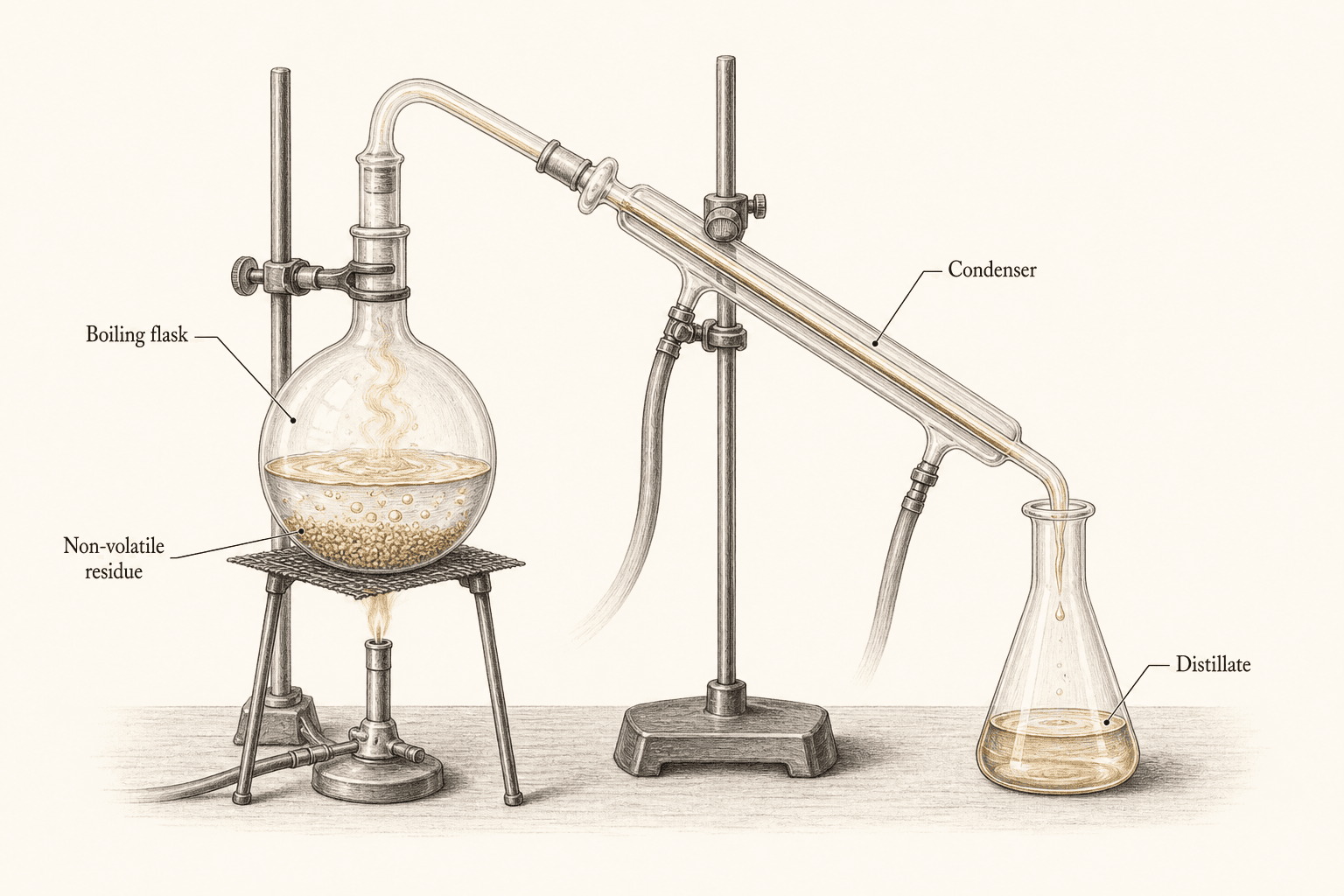
Hierva un litro del agua que bebe cada día, deje escapar el vapor y mire lo que se queda en la cámara. Un anillo de costra del color del té flojo, un fino lodo pardo, una corteza calcárea a lo largo de la línea donde solía reposar el agua. Ese residuo estaba disuelto, invisible, en un agua que en el vaso parecía perfectamente transparente, y usted se lo tragó, litro tras litro, durante años. Un destilador de encimera hace exactamente eso, de forma deliberada.
Lleva el agua a vapor y la condensa de vuelta, y como casi todo lo demás que viaja en esa agua no puede dar el salto al vapor, se queda en la cámara como el anillo pardo. Lo que cae en el frasco recolector es lo más cercano al agua pura que tendrá jamás en la mano. Lo que queda atrás es la parte de su agua que nunca debía ver.
Ese anillo zanja una discusión antes de que se pronuncie una palabra. Nos dicen que el agua del grifo es segura, que el agua embotellada es limpia, que los pocos miligramos de minerales de su vaso son un regalo que sería necio rechazar. La cámara dice lo contrario.
Dice que transparente no es lo mismo que limpio, y que usted ha estado midiendo lo que no era. De todos los hábitos diarios que hay aquí, ninguno llega tan lejos con tan poco esfuerzo como cambiar el agua misma, por agua destilada hasta la nada y luego reconstruida deliberadamente. Corre por debajo de los demás protocolos en vez de junto a ellos, porque todo aquello sobre lo que ellos actúan es, en su mayor parte, agua.
Qué hay realmente en su vaso
El agua transparente de su vaso no es agua. Es una disolución, y el soluto es el catálogo de todo lo que esa agua ha tocado en su camino hasta usted.
La única cifra que captura el grueso de ello son los , el peso combinado de todo lo que está en disolución, leído en segundos por un medidor que cuesta casi nada. El agua destilada pura marca casi cero. El agua corriente del grifo marca unos cuantos cientos de partes por millón.
Pero el TDS es solo el titular. Debajo está la carga: los metales pesados heredados que el tratamiento municipal nunca retira del todo, el plomo lixiviado de viejas soldaduras y acometidas, el arsénico y el cadmio del agua subterránea, el residuo de la industria. Los nitratos de la escorrentía agrícola. Los subproductos de la desinfección, los trihalometanos que se forman cuando el cloro se encuentra con la materia orgánica dentro de la tubería. Una bruma farmacéutica, los antidepresivos y las hormonas y los analgésicos que atraviesan cuerpos humanos, atraviesan un tratamiento de aguas residuales que nunca se diseñó para atraparlos y regresan al suministro. Y el , añadido a propósito, que tiene un órgano concreto al que va a buscar.
Luego, el contaminante de esta década, aquel del que casi todo el mundo cree escapar comprando el agua en plástico. No escapan. Se lo beben. Cuando los investigadores hicieron el recuento, encontraron partículas de polímero sintético en el noventa y tres por ciento del agua embotellada que muestrearon entre las grandes marcas.footnoteMason, S. A., Welch, V. G., Neratko, J. (2018). Synthetic Polymer Contamination in Bottled Water. Frontiers in Chemistry, 6, 407. Se hallaron partículas de microplástico en el 93 por ciento del agua embotellada muestreada, repartida entre once marcas y varios países.
Cuando en 2024 se apuntó al problema con un instrumento más fino, el recuento estalló: una media de unos doscientos cuarenta mil fragmentos de plástico detectables en un solo litro de agua embotellada, la abrumadora mayoría de ellos lo bastante pequeños para cruzar la pared de su intestino y viajar hasta el torrente sanguíneo.footnoteQian, N., Gao, X., Lang, X. et al. (2024). Rapid single-particle chemical imaging of nanoplastics by SRS microscopy. Proceedings of the National Academy of Sciences, 121(3). El agua embotellada llevaba del orden de 240.000 fragmentos de plástico detectables por litro, cerca del 90 por ciento de ellos nanoplásticos, una población invisible para los recuentos anteriores de microplásticos. La botella, el tapón, el apretón, todo suelta partículas al agua que contiene. Recurrir al agua embotellada para escapar del grifo cambia qué contaminante bebe, no si bebe alguno.
El agua transparente no es agua limpia. Es una disolución, y usted es el filtro que nunca pidió ser.
La industria del bienestar se salta esta parte, porque no puede venderle un suplemento que la arregle. El cuerpo tiene órganos cuyo trabajo entero consiste en volver a filtrar esa carga, los riñones por encima de todo, y lo hacen lo bastante bien como para que usted sobreviva. Pero cada miligramo de basura disuelta que entra es un miligramo que el sistema tiene que clasificar, secuestrar o excretar, día tras día, durante toda una vida. El anillo pardo es el total acumulado de lo que sus riñones y su hígado han venido procesando en su nombre, un vaso cada vez.
La destilación, la única purificación completa
Hay muchas maneras de limpiar el agua, y no son equivalentes. Un filtro de carbón adsorbe el cloro, mejora el sabor, retira algunos compuestos orgánicos y deja intactos la mayoría de los sólidos disueltos, el fluoruro y los metales. La ósmosis inversa es genuinamente buena, fuerza el agua a través de una membrana que rechaza la mayor parte de la carga disuelta, la segunda mejor respuesta de esta lista.
Pero la destilación es el único método que funciona cambiando la fase del agua en vez de colarla, y esa diferencia lo es todo.
Cuando hierve el agua, las moléculas se marchan como vapor y casi nada más las acompaña. Las sales disueltas no hierven a cien grados. Los metales pesados tampoco. El fluoruro tampoco.
Los nitratos, la mayoría de los pesticidas, los fragmentos de plástico, las bacterias y los fragmentos de bacterias muertas llamados , los minerales disueltos, todo ello es no volátil, todo ello se queda en la cámara. El vapor que asciende es agua y casi nada más, y cuando se condensa es el agua más pura disponible fuera de un laboratorio. La destilación elimina prácticamente el catálogo entero de una vez, mientras que cada filtro elimina una lista y deja otra.
Hay exactamente una clase de contaminante que el cambio de fase por sí solo no atrapa, y la ingeniería ya lo resuelve. Un puñado de hierven a la temperatura del agua o por debajo de ella y viajan con el vapor. Por eso precisamente un destilador bien construido hace pasar lo que produce por una pequeña etapa de carbón activado, que adsorbe justamente esos volátiles. Cambio de fase para todo lo pesado, carbón para las pocas cosas ligeras que cabalgan el vapor. Juntos son la purificación más completa que puede hacer funcionar sobre la encimera de una cocina, y lo que le entregan es una pizarra en blanco: agua reducida a casi nada más que a sí misma.
¿Pero no necesito los minerales?
La primera objeción que plantea todo el mundo, y la mitad de ella es correcta. Necesita minerales, desde luego. El cuerpo moderno está gravemente falto de magnesio, de yodo, de boro y del resto, y nada de lo que hay aquí lo contradice.
La cuestión es si el agua que bebe es un sitio sensato para obtenerlos.
No lo es, y este es el mecanismo. Los minerales disueltos en el agua del grifo y en la embotellada son predominantemente inorgánicos, carbonato de calcio y similares, la misma dureza que incrusta un hervidor. Los minerales inorgánicos se absorben mal en comparación con los mismos elementos ligados a la matriz orgánica de una planta, donde llegan quelados, escoltados por cofactores, en la forma que su intestino evolucionó para captar. Un puñado de espinacas, unas cuantas semillas de calabaza, entregarán más magnesio utilizable que litros de agua dura, y sin el plomo y el fluoruro que viajan con la variedad acuática. Sus minerales vienen de la comida, y del pequeño número de suplementos deliberados que de verdad mueven los niveles tisulares. Nunca debieron venir de la tubería.
Vale la pena nombrar una excepción real, y apunta directamente de vuelta a la tesis. La epidemiología muestra que las poblaciones que beben agua rica en magnesio tienen tasas más bajas de muerte súbita cardíaca, una correlación lo bastante fuerte como para que la World Health Organization la haya tomado en serio durante décadas.footnoteWorld Health Organization (2009). Calcium and Magnesium in Drinking-water: Public Health Significance. El informe revisa la persistente asociación epidemiológica entre el magnesio del agua y una menor mortalidad cardiovascular, señalando al mismo tiempo que la comida es la fuente dietética dominante de la mayoría de los minerales.
El magnesio del agua importa. Pero mire a favor de qué argumenta ese hecho en realidad. No argumenta a favor de beberse el cóctel de costra de calcio, fluoruro y contaminantes que su suministro local resulte llevar, por si acaso lleva también algo de magnesio. Argumenta a favor de reponer el magnesio a propósito. Ese es precisamente el movimiento.
Destile el agua base hasta cero y luego remineralícela deliberadamente, con el agua de bicarbonato de magnesio del ensayo sobre los minerales, una pizca de una fuente limpia de oligoelementos, los elementos exactos que quiere, en las formas biodisponibles exactas que quiere, sin nada de la carga que no quiere. La destilación no le niega los minerales. Le entrega una pizarra limpia para que pueda elegirlos.
Destile hasta la nada, luego reconstruya a propósito. Una pizarra en blanco no es una carencia. Es control.
La segunda objeción es la vieja consigna de que el agua destilada es peligrosamente ácida, que le lixivia los minerales del cuerpo y le desgasta el esmalte. También esta se deshace en cuanto se la mira.
El agua pura, dejada al aire, se equilibra con el dióxido de carbono atmosférico y se asienta en una lectura levemente ácida en torno a 5,8, pero su carga ácida real es insignificante, porque casi no tiene contenido disuelto con el que transportarla. No está tamponada, no es agresiva. Y en cuanto remineraliza con bicarbonato, el mismo ion sobre el que está construido el protocolo del limón y el bicarbonato, habrá sustituido de todos modos esa acidez tenue por un suave tampón alcalino. El miedo estaba pegado a la etapa equivocada del proceso. Usted no se bebe la pizarra en blanco. Se bebe lo que escribe en ella.
El fluoruro y el tercer ojo
Vamos ahora al contaminante que aparté antes, porque es el que convierte una práctica general de salud en una específicamente espiritual. De todo lo que retira al destilar su agua, el fluoruro es lo más trascendente para el trabajo del que trata de verdad este cuerpo de escritura.
El fluoruro no se distribuye de forma pareja por el cuerpo. Caza. Es un , primo químico del yodo, y se concentra en el único órgano al que este canon vuelve una y otra vez: la glándula pineal, el grano de tejido en el centro geométrico del cerebro que las tradiciones contemplativas llaman la sede del ojo interior. Cuando la investigadora Jennifer Luke diseccionó y analizó por primera vez glándulas pineales envejecidas, encontró fluoruro apretado dentro de su tejido calcificado a concentraciones más altas que en huesos ya dañados por la exposición crónica al fluoruro, las más altas de cualquier tejido blando del cuerpo.footnoteLuke, J. (2001). Fluoride deposition in the aged human pineal gland. Caries Research, 35(2), 125 a 128. El fluoruro se concentró en el tejido pineal calcificado a niveles superiores a los hallados en hueso dañado por fluoruro, lo que convierte a la pineal en el principal lugar de acumulación de fluoruro del cuerpo.
La glándula se vuelve, despacio, en parte de piedra, y la mayor dosis diaria del mineral que lo está haciendo es el agua fluorada que usted bebe, unos dos litros al día, todos los días, durante toda una vida.
El protocolo completo de descalcificación pineal vive en otro sitio, el yodo que desplaza a los haluros, el boro que expulsa al fluoruro del tejido por competencia, el magnesio y los cofactores. Pero todo eso rema contra la corriente si al mismo tiempo usted se echa fluoruro fresco por litros. Destilar su agua es la precondición de ese protocolo. No puede descalcificar la glándula mientras sigue resuministrando el mismo haluro que la calcificó. Cierre el grifo primero, y todas las demás palancas del protocolo empiezan a funcionar. Este es el ejemplo más nítido de la tesis entera: un solo cambio en el agua, hecho una vez, que en silencio desbloquea todo un cuerpo de práctica aguas abajo.
La cuarta fase, el agua estructurada
Hasta aquí el movimiento ha sido sustractivo, todo él sobre lo que se quita. Ahora gira. El agua pura es el suelo limpio sobre el que se construye, y lo que se construye es estructura.
El agua tiene más de tres fases. Más allá del sólido, el líquido y el vapor hay una cuarta, y el hombre que pasó dos décadas demostrándola en el laboratorio es Gerald Pollack, en la University of Washington. Contra cualquier superficie amante del agua, una membrana viva, una proteína, una sola fibra hidrofílica, el agua se organiza espontáneamente en una fase ordenada, en capas, de tipo gel, estructuralmente distinta del líquido a granel que hay más allá.
Pollack la llamó , porque expulsa físicamente los solutos y las partículas, negándose a dejarlos entrar. Está más ordenada que el agua líquida, porta una carga eléctrica neta negativa y, lo más llamativo de todo, se construye en gran medida con energía radiante, con luz, sobre todo con el infrarrojo que nos baña constantemente.footnotePollack, G. H. (2013). The Fourth Phase of Water: Beyond Solid, Liquid, and Vapor. Ebner & Sons. Dos décadas de trabajo de laboratorio que demuestran que el agua forma una fase cargada, ordenada y de tipo gel contra las superficies hidrofílicas, construida por energía radiante. Esta es la forma que el agua adopta dentro de cada célula viva.
Esta es la forma que el agua adopta dentro de usted. El agua de sus células está dispuesta en capas contra la vastísima superficie hidrofílica de su maquinaria celular, ordenada, cargada, estructurada. Esta es el agua que entrega la comida cruda y fresca, ya en su forma viva y estructurada, el agua que sus células reconocen, el agua que un vaso del grifo no puede sustituir. Usted es un gel vasto, organizado y cargado, una batería de agua estructurada que el infrarrojo mantiene cargada, y el grado en que su agua sostiene ese orden es el grado en que la maquinaria funciona.
La espiral, reestructurar el agua
Si la estructura es lo que el agua viva tiene y el agua muerta ha perdido, la pregunta práctica es si puede devolvérsela al agua antes de bebérsela. Puede, y el método es el mismo que usa la naturaleza: el movimiento, y en concreto el vórtice.
El hombre que construyó una filosofía alrededor de esto fue Viktor Schauberger, el guardabosques austríaco que pasó la vida observando el agua salvaje y advirtió algo que a un ingeniero se le enseña a ignorar. El agua sana en la naturaleza nunca viaja en línea recta. Un arroyo de montaña se enrosca, se pliega sobre sí mismo, gira en espiral alrededor de las piedras, cae por pozas, y cuanto más fría y más vigorosamente gira, más viva y más autolimpiante se mantiene. Encauce esa misma agua recta y quieta, del modo en que la movemos por las ciudades, y se vuelve rancia y muerta.
Schauberger sostenía que el vórtice no es decoración sino función, que el agua se organiza a sí misma mediante un movimiento implosivo, en espiral hacia dentro, y que así es como la naturaleza la carga y la estructura.footnoteBartholomew, A. (2003). Hidden Nature: The Startling Insights of Viktor Schauberger. Floris Books. La observación de toda una vida de Schauberger: el agua natural se autoestructura mediante un movimiento de vórtice frío y en espiral hacia dentro, y se degrada cuando se la fuerza por tuberías rectas, quietas y presurizadas. El principio sobre el que están construidos los aparatos modernos de agua estructurada.
Hay dos maneras de hacerlo. Comprar una máquina construida exactamente para esto, un estructurador de agua por vórtice que hace girar el agua en un embudo cerrado hacia dentro y se la estructura en un minuto o dos. Los hay desde unidades sencillas que se voltean con la mano hasta sistemas conectados a la fontanería de toda la casa, así que elija el que encaje con su forma de vivir. O hacerlo a mano, por nada.
Vierta con fuerza su agua destilada y remineralizada entre dos frascos, varias veces. Remuévala con una cuchara hasta formar un vórtice profundo y giratorio, déjelo colapsar, hágala girar en el sentido contrario. El giro desgasifica el agua, expulsa el dióxido de carbono disuelto, baja la tensión superficial y la predispone hacia la fase ordenada y estructurada en la que sus células están a punto de recibirla, la misma fase que Pollack midió contra membranas vivas. El agua pasada por vórtice sabe más suave y más redonda por una razón: está más cerca de la forma que el agua adopta dentro de usted.
Luego dele la fuerza estructurante más antigua de todas, gratuita y a la espera. Ponga el agua al sol. El infrarrojo y la luz visible son exactamente lo que Pollack mostró que construye la zona de exclusión, así que un frasco de vidrio cargándose al sol de la mañana es un aparato de estructuración que no cuesta nada. Hágala girar, dele luz, y el agua llega a sus células con casi todo el camino ya hecho.
La destilación borra la pizarra, el vórtice escribe en ella
La destilación es la gran sustracción. Despoja al agua de sus contaminantes y, con ellos, de cualquier estructura incoherente que toda una vida de tuberías, presión y contaminación le hubiera impuesto. El vórtice, los minerales, la luz del sol son la gran adición. Vuelven a escribir la estructura encima, deliberadamente, el orden que usted elige en vez del orden que dejó la ciudad.
Por eso importa la secuencia y por eso ninguna de las dos mitades funciona sola. Estructure agua sucia y solo habrá organizado la basura. Purifique el agua y bébala inerte y le habrá dado al cuerpo un insumo limpio pero sin vida, al que le tocará hacer todo el trabajo de darle vida.
Haga las dos cosas, en orden, y le entrega a la célula un agua que ya viene limpia y que ya se mueve hacia la fase estructurada, cargada y ordenada que iba a construir de todos modos. Ha hecho fuera del cuerpo la preparación que el cuerpo haría, si no, por dentro. Destilar, remineralizar, hacer girar, iluminar. Réstelo todo, y luego añada de vuelta solo lo que usted quiere.
La energía que recupera
Cada paso que ejecuta fuera del cuerpo es un paso que el cuerpo ya no ejecuta dentro, y el cuerpo paga su trabajo interno en la única moneda que tiene, que es la energía.
Piense en lo que gasta su sistema para lidiar con agua ordinaria. Los riñones filtran el volumen sanguíneo entero muchas veces por hora, unos ciento ochenta litros de fluido al día pasando por los glomérulos, y cada contaminante disuelto eleva la carga de clasificación y de excreción de esa maquinaria. El hígado etiqueta y empaqueta las toxinas liposolubles para su retirada. Las células hacen funcionar sus bombas de iones sin pausa para sostener los gradientes de los que depende la vida, y ese bombeo por sí solo consume una fracción grande del presupuesto energético basal del cuerpo, la mayor de todas en el sistema nervioso.footnoteGuyton, A. C., Hall, J. E. Textbook of Medical Physiology. Los riñones filtran del orden de 180 litros de plasma al día, y las bombas de sodio y potasio que mantienen los gradientes celulares consumen una parte sustancial de la tasa metabólica basal, la fracción más alta en el tejido nervioso. Bajar la carga de contaminantes disueltos baja el trabajo de clasificación, tamponamiento y excreción que el sistema debe realizar aguas abajo.
Un cuerpo al que se le entrega agua limpia, estructurada y preorganizada rebaja el impuesto de procesamiento de contaminantes que ha venido pagando cada día, y recibe su agua ya a medio camino del estado intracelular ordenado, en vez de tener que forcejear con un líquido contaminado para llevarlo a la coherencia desde cero.
Esa energía recuperada no se desvanece. Queda liberada, y un sistema que ya no la gasta en control de daños puede gastarla en algo más alto. A esto apuntaban los textos antiguos, en su propio vocabulario, cuando hablaban de la pureza como precondición del ascenso. No tenían la palabra riñón ni la palabra zona de exclusión. Tenían la observación de que un cuerpo limpio y lleno de luz se vuelve capaz de estados que uno atascado y afanoso no alcanza. El campo funciona más limpio cuando se deja de alimentarlo con ruido. Y en un registro más hondo, usted es un transmisor, y el agua es el medio por el que se mueve su señal, de modo que la coherencia del agua es la coherencia de la emisión. Libere la energía de la refinería y se irá a la reparación, a la claridad, al lento trabajo ascendente que la tradición llama evolución. Deja de gastar su vida limpiando su propia agua y empieza a gastarla en llegar a ser algo.
Usted es el agua
Termine donde el cuerpo realmente está. Usted no es una criatura que bebe agua.
Usted es, en masa, sobre todo agua, alrededor del sesenta por ciento siendo adulto, y la proporción sube en los órganos que más importan: el cerebro y el corazón cerca de tres cuartas partes de agua, los pulmones más del ochenta por ciento, el plasma sanguíneo por encima del noventa. Cada señal eléctrica que cruza una neurona, cada proteína que se pliega, cada reacción que le mantiene vivo ocurre en el agua y a través del agua y gracias al agua. El agua es el medio de la máquina, su disolvente, su sustrato, el mar en el que está suspendida cada célula.
Lo que significa que la calidad de su agua fija las condiciones bajo las que corre cualquier otro proceso. Cambie el agua y cambiará de golpe el medio de todas las reacciones, la única intervención que llega a todas partes porque todas partes son, en su mayor parte, agua. Los suplementos y los protocolos son ajustes a un sistema. El agua es la sustancia del sistema. Destílela hasta la nada para que no lleve daño, remineralícela y hágala girar y dele luz para que lleve orden, y habrá mejorado no un órgano sino el mar en el que flota el cuerpo entero.
De todos los hábitos diarios de este cuerpo de trabajo, este es el que llega más lejos con menos esfuerzo. Es callado, es barato una vez que el destilador está sobre la encimera, no le pide nada después de los primeros minutos del día, y trabaja por debajo de todo lo demás, cada hora, en cada célula.
Saque la basura del agua. Devuélvale la espiral. Usted es, en su mayor parte, agua, y casi no hay nada que pueda hacerse a sí mismo más poderoso que volver esa agua limpia y volverla viva.
Con el agua ya limpia y estructurada, queda una última pregunta, la afirmación más ruidosa de todo el campo del agua y la salud y la que casi todo el mundo entiende al revés: que el secreto está en volver alcalina su agua, su sangre, su cuerpo.
Es la idea más seductora del mundo del bienestar, y es falsa de una manera que vale la pena desmontar con cuidado, porque la verdad sobre el ácido y la base es más extraña y más útil que el eslogan. Ahí es adonde va esto a continuación.
Sources
- The Fourth Phase of Water, . https://openlibrary.org/works/OL19996046W
- Synthetic Polymer Contamination in Bottled Water, . https://doi.org/10.3389/fchem.2018.00407
- Rapid Single-Particle Chemical Imaging of Nanoplastics by SRS Microscopy, . https://doi.org/10.1073/pnas.2300582121
- Fluoride Deposition in the Aged Human Pineal Gland, . https://pubmed.ncbi.nlm.nih.gov/11275672/
- Calcium and Magnesium in Drinking-Water: Public Health Significance, . https://www.who.int/publications/i/item/9789241563550
- Hidden Nature: The Startling Insights of Viktor Schauberger, . https://openlibrary.org/works/OL13622327W
- Textbook of Medical Physiology, . https://openlibrary.org/works/OL17627866W
- Biophotons and Living Food, . https://samsinger.tech/writing/2026-06-03-biophotons-and-living-food
- Distilled Water, . https://drsircus.com/water/distilled-water/
- Introduction to Water-Based Medicine, . https://drsircus.com/water/introduction-to-water-based-medicine/
- What Is the Best Water to Drink?, . https://www.youtube.com/watch?v=DFFyxxoZ82U
Siguiente en la serie
El cuerpo incorruptible · La luzEl agua que la naturaleza nunca creóNingún agua que bebiera jamás un ancestro suyo alcanzó el pH que ahora le vende una máquina, su estómago borra ese pH al contacto, y el propio amortiguador del cuerpo, el bicarbonato, hace el trabajo por unos céntimos. Apoye al regulador, no crea que un aparato de encimera es más listo que sus riñones.
- Publicado
- Lectura
- 16 min
- Fuentes
- 11