
La Luz, Capítulo 13
Los biofotones y la luz de los alimentos vivos
Sus células absorben y emiten fotones, y el alimento los transporta. Qué son los biofotones, por qué el alimento vivo sigue emitiendo la señal, y la limpieza de fruta cruda y jugos que vuelve a dejar entrar la luz.
La fresa que tiene en el plato sigue emitiendo luz. No calor, no un resplandor que usted pudiera llegar a ver, un flujo ordenado de fotones que sale de su tejido ahora mismo, la misma señal tenue que emite toda célula viva y una de las primeras cosas que se desvanecen cuando una célula muere. La emite un pepino. La emite un higo recién cortado. También la mano que los sostiene.
La cantidad de luz que un alimento conserva todavía es una medida honesta de cuán vivo estaba cuando usted se lo comió, y la nutrición moderna no tiene ninguna casilla para ella.
Ese es su gran punto ciego. Cuenta calorías, gramos de proteína, miligramos de los pocos minerales que aún se molesta en medir, y trata una fresa recogida hace una hora y una fresa irradiada, transportada y almacenada durante tres semanas como el mismo alimento. No son el mismo alimento.
Una sigue emitiendo un campo de luz organizado. La otra es un cadáver con los macronutrientes correctos.
El cuerpo quema combustible, y esa es la mitad menor de lo que es. Es también un campo coherente de luz que los fotones sostienen, y sabe, célula por célula, distinguir entre el alimento que aún lleva la señal y el alimento que se ha apagado. La práctica que sigue es una de las más antiguas de las que hay registro: comer alimento vivo, beber el agua que ese alimento contiene, y vaciar el sistema con la frecuencia suficiente para que la luz pueda pasar.
Una caloría le dice cuánto calor desprende un alimento al quemarlo. No le dice nada sobre si el alimento seguía vivo.
La luz en el tejido vivo
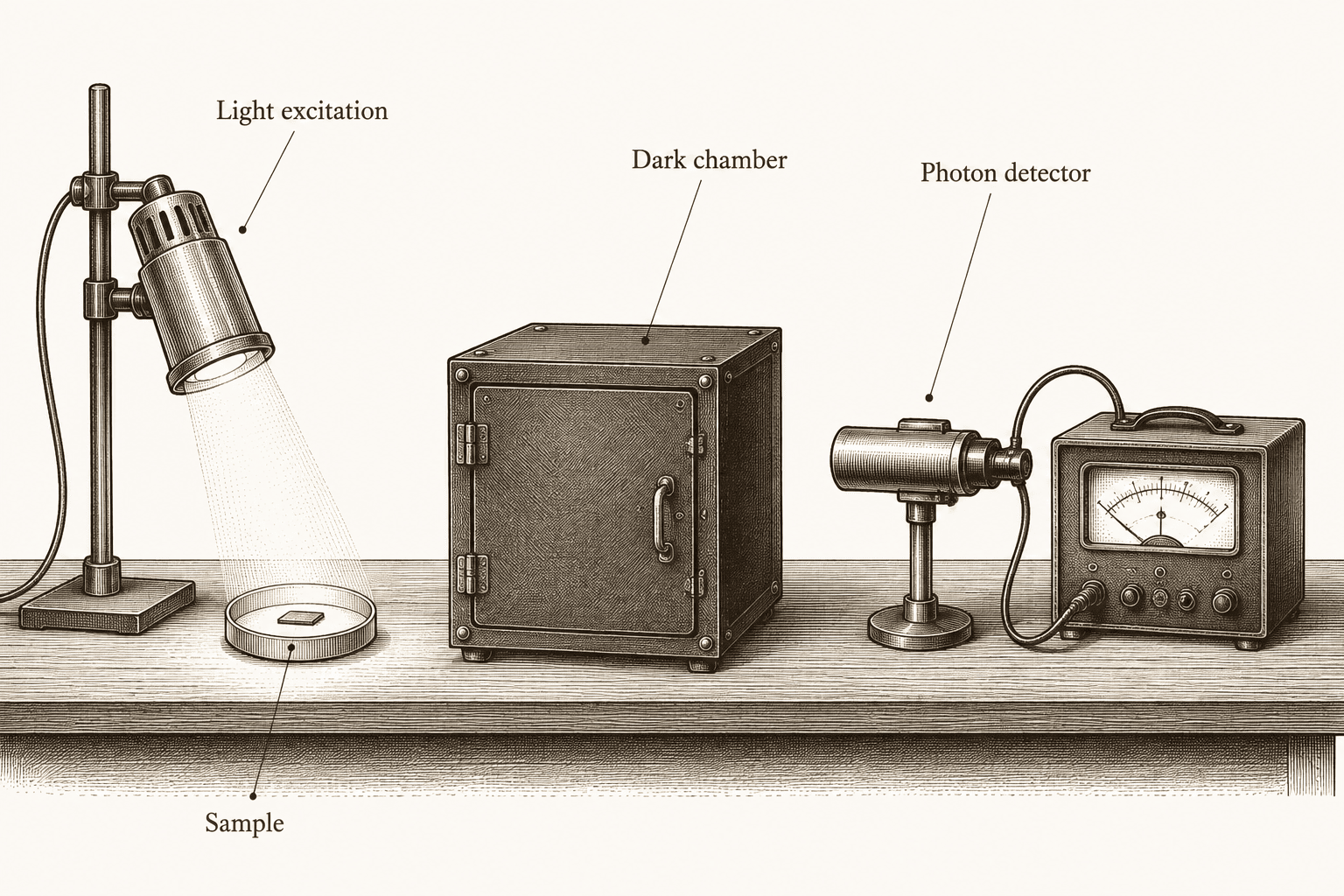
El fenómeno tiene un nombre técnico y seco, , y otro más evocador acuñado en los años setenta por el biofísico alemán Fritz-Albert Popp: . El tejido vivo emite del orden de , en una banda que va del ultravioleta al infrarrojo cercano, . El ojo no puede verla. Un tubo fotomultiplicador enfriado en una habitación sellada a oscuras la cuenta fotón a fotón.footnoteCifra, M. y Pospisil, P. (2014). Journal of Photochemistry and Photobiology B. "Ultra-weak photon emission from biological samples." La revisión moderna definitiva del campo: intensidades, espectros, métodos de detección y el mecanismo que la ortodoxia está dispuesta a admitir. Las cifras no están en disputa. Lo que la luz significa es la parte que el campo ha tardado más en asumir.
Hay dos maneras de leer esta luz, y elegir entre ellas es todo el argumento.
La lectura ortodoxa es metabólica, y es pequeña. Al quemar combustible, las células generan , que atacan las grasas de las membranas celulares en una reacción en cadena llamada . La reacción desprende moléculas excitadas y, al volver a asentarse, estas liberan un fotón. Según ese relato, la luz es un gas de escape, el humo de un motor y nada más. Es la lectura prudente, la que no le pide nada y no cambia nada, y se le escapa lo que más importa.
Popp sostuvo algo mayor. Demostró que esta luz es , más parecida a un láser que a una lámpara, y que su fuente primaria es el propio de la célula.
Esto no es un gas de escape. Es una señal, un campo vivo de luz coherente por el que cada célula habla con todas las demás a la velocidad de la luz, más rápido de lo que podría viajar cualquier mensajero químico. Usted es una orquesta de luz, y el ADN sostiene la partitura.footnotePopp, F. A., Nagl, W., Li, K. H. et al. (1984). Cell Biophysics. "Biophoton emission. New evidence for coherence and DNA as source." El trabajo fundacional de Popp. La coherencia sobrevive en la célula cálida y húmeda, y el recuento de fotones es bajo porque una señal coherente no necesita ser ruidosa. Las mediciones de coherencia de Popp se sostienen por sí solas, y portan exactamente el significado que él les dio: la luz es una señal, y la célula está gobernada por ella.
Esta es la lectura sobre la que se sostiene la práctica. La luz es la vida. Arde con más fuerza en el tejido íntegro y ordenado, y se dispara cuando una célula resulta herida. En el instante de la muerte da un último estallido brillante y se apaga, el , la luz que organizaba la célula saliendo de ella toda a la vez.footnoteSlawinski, J. (1988). Experientia. "Luminescence research and its relation to ultraweak cell radiation." Describe la emisión necrótica, el estallido terminal de luz cuando una célula muere, tras el cual la emisión cae al nivel de fondo. La luz y el estado vivo empiezan y terminan juntos. Eso no es una metáfora, es una medición.
Cuando usted come, no solo traga carbono y minerales. Introduce la luz de aquello que come en el campo de su propio cuerpo. Coma lo que brilla y alimentará el campo. Coma lo que está apagado y lo atenuará.
Por qué el alimento crudo lleva más luz
Si la luz marca la vida, la manera de comparar dos alimentos no es solo analizar su química sino observar su luz. El laboratorio de Popp hizo exactamente eso, con una técnica llamada : se ilumina la muestra con un destello y luego se observa cómo devuelve la luz.
El tejido sano y bien ordenado la libera despacio, en una curva hiperbólica larga. La materia degradada o muerta la suelta de golpe y ahí termina. Esa curva se convirtió, en manos de Popp, en un instrumento para calificar los alimentos.footnoteKohler, A. y Popp, F. A. (2000). Journal of Alternative and Complementary Medicine. "Biophoton emission as a potential measure of food quality." Publicado en una revista de medicina alternativa y no en una de nutrición convencional, porque la nutrición convencional no tiene ninguna casilla para la luz. Las mediciones son reales y repetibles, y califican el alimento por lo vivo que estaba.
Lo que su grupo publicó apunta exactamente adonde las viejas tradiciones alimentarias siempre sostuvieron. Los huevos de gallinas camperas dieron un decaimiento más lento y más organizado que los huevos de aves enjauladas y estresadas. Los productos frescos mantuvieron una curva más limpia que los que habían pasado por almacén. La irradiación, la dosis esterilizante que se usa para alargar la vida útil, aplanó el decaimiento hiperbólico vivo hasta convertirlo en la caída exponencial abrupta de la materia inerte. La química del alimento irradiado apenas cambió. Su luz cambió por completo.
La prueba más nítida está en las semillas, donde la medición está asentada y lo que está en juego es concreto. Moje una semilla y emitirá un estallido de fotones, y el brillo de ese estallido sigue el de la semilla con fidelidad suficiente para usarse como prueba de viabilidad.
Una semilla que va a brotar brilla. Una semilla muerta apenas registra nada.footnoteGallep, C. M. et al. (2014). Journal of Photochemistry and Photobiology B. "Ultra-weak photon emission from germinating wheat seedlings." La emisión de fotones durante la imbibición sigue la capacidad de germinación con la fidelidad de una prueba de laboratorio. La luz es un marcador cuantitativo de si el potencial vivo sigue presente. La misma técnica ha separado los tomates de cultivo ecológico de los convencionales por su perfil de emisión, y el fruto ecológico se lee como de menor estrés y mayor luz almacenada.footnotevan Wijk, R. et al. (2013). PLoS One. "Ultra-weak photon emission and biological quality of tomatoes grown under different crop management systems." Los productos ecológicos y los convencionales dieron perfiles de emisión y de luminiscencia retardada distinguibles. Los autores lo interpretan como diferencias de estrés y de capacidad de almacenamiento de luz.
Le dirán que aquí es donde esto deja de ser ciencia, que un fotón comido dentro de una fresa no puede importar, que la luz es solo un marcador de frescura y que nada cruza de la planta a usted. La objeción no sigue su propia lógica.
La luz no se destruye al comerla. El campo ordenado y coherente de una planta viva no se apaga en sus labios; entra en un cuerpo que es él mismo un campo de luz, y o eleva el orden de ese campo o lo rebaja. Toda cultura que comía a pocas horas de la cosecha sabía que el alimento fresco y crudo lleva algo que el alimento cocinado, almacenado y muerto no lleva. Lo llamaron prana, qi, fuerza vital, vitalidad. Ahora podemos fotografiarlo, y el instrumento no ha hecho más que alcanzar lo que ellos siempre supieron.
Así que aquí va la versión fuerte, sin rodeos. Usted está comiendo luz.
Una dieta de alimento vivo eleva la vibración del cuerpo que lo come, y es más que una figura retórica, es una descripción exacta de lo que ocurre cuando deja de alimentar el campo con materia muerta y empieza a alimentarlo con luz ordenada. Coma alimento que todavía brilla y el brillo pasará a ser suyo. Llega con sus enzimas intactas, con las vitaminas frágiles que el calor destruye, y con su , el agua estructurada que sus células reconocen y que ningún vaso de grifo puede sustituir. La luz, el agua, las enzimas, la conciencia, todo apunta en la misma dirección. El alimento vivo hace un ser humano más vivo.
Usted es un campo de luz. Puede alimentarlo con luz viva o alimentarlo con oscuridad, y no existe la comida neutra.
El agua, y el residuo viejo del intestino
El alimento vivo hace algo que un suplemento no puede hacer. Llega empapado en su propia agua, retenida dentro de las paredes celulares, y lleva esa agua hasta el fondo del intestino.
La fruta fresca y las verduras crudas van del setenta a más del noventa por ciento de agua en peso y, a diferencia del agua que usted bebe entre comidas, que se absorbe en su mayor parte en la parte alta del intestino delgado antes de poder llegar al extremo final, el agua ligada al alimento viaja con la fibra y alcanza la pared del colon.footnoteAl colon entran a diario entre 1,5 y 2 litros de líquido; reabsorbe cerca del noventa por ciento y deja las heces normales en torno a un 70 a 75 por ciento de agua. El alimento rico en agua y en fibra mantiene más agua en la luz del colon, lo que ablanda las heces y estimula la pared muscular para desplazarlas. Véase Slavin, J. (2013). Nutrients. "Fiber and prebiotics, mechanisms and health benefits." Esto importa por lo que el colon moderno suele albergar.
En las tradiciones curativas más antiguas este residuo acumulado tiene nombre. Arnold Ehret, que construyó un sistema entero a su alrededor en los años veinte, lo llamó moco e ideó una dieta para disolverlo. Norman Walker, el pionero de los jugos, describió cómo el alimento cocinado y procesado deja una capa de baba endurecida sobre la pared del colon. El naturópata contemporáneo Robert Morse basa toda su práctica en inundar el cuerpo de fruta cruda y astringente para despegarla. Richard Anderson, el clínico más asociado a documentarlo en términos modernos, vio a sus pacientes expulsar largos moldes gomosos de material oscuro durante limpiezas sostenidas y lo llamó , descrita por completo en el ensayo sobre la limpieza parasitaria.
La medicina convencional dice que este residuo no existe, que el colon se limpia solo y que lo que uno expulsa durante una limpieza es la limpieza misma. Sale demasiado, de demasiada gente, para que esa negación se sostenga.
Una tubería que nada arrastra se llena de sedimento, y un colon privado de fibra, escaso de agua y lento durante años no es distinto. La forma más fiable de soltar esa carga es inundar el sistema con alimento crudo rico en agua y mantenerlo en movimiento. La fibra retiene agua en las heces. El agua ablanda lo que se ha endurecido. El volumen estira la pared y dispara el músculo. La en la que el hígado ha vertido sus desechos, y la saca en vez de dejar que vuelva a circular. Llame al residuo como quiera. El plato crudo y jugoso es como se mueve.
La limpieza de fruta cruda
La versión más simple y más antigua de esto es una tanda de fruta rica en agua, comida sola, durante un número fijo de días. Es suave, es difícil de hacer mal, e inunda el cuerpo con las tres cosas que una liberación necesita a la vez: agua, azúcar que el cuerpo puede quemar sin desmontar músculo, y la luz viva del alimento comido minutos después de cortarlo.
Hágala a lo largo de uno a tres días, solo fruta, en monocomidas siempre que sea posible, es decir, un solo tipo de fruta en cada toma para que la digestión siga siendo sencilla. Las frutas que llevan más agua y los azúcares más suaves: sandía y melón, uvas, cítricos, papaya, pera madura, bayas, y el pepino y el tomate, que botánicamente son fruta y tienen su lugar aquí. Coma hasta quedar satisfecho, no hasta la restricción; esto no es un protocolo de inanición, y la clave es el volumen de alimento vivo y acuoso, no la privación. Sandía durante una mañana. Uvas a lo largo de una tarde. Cítricos y papaya, que llevan sus propias enzimas digestivas, cuando el intestino pida ayuda. Beba agua con una pizca de sal sin refinar entre las comidas de fruta para mantener los electrolitos.
Lo que hace, en orden. El agua y la fibra llegan al colon y ablandan lo que hay allí. Los azúcares simples de la fruta mantienen la glucosa en sangre lo bastante estable como para que el cuerpo no desmonte músculo para obtener combustible, el modo de fallo de un ayuno más duro. Las frutas astringentes, sobre todo los cítricos y la uva, son las que las viejas tradiciones aprecian para despegar el residuo de la pared. Y como usted come con frecuencia, el intestino sigue en movimiento, de modo que lo que se suelta sale de verdad. Espere heces más frecuentes, más sueltas y a veces más oscuras hacia el segundo día. De eso se trata. Espere también un día de sentirse ligeramente peor antes de mejorar, la conocida reacción de liberación cuando el sistema descarga más rápido de lo que acostumbra. Pasa.
Una tanda de fruta es el movimiento de entrada. La liberación más profunda funciona con jugo de verduras y, resulta, el jugo le gana a no comer nada en absoluto.
La limpieza con jugo de verduras, y por qué le gana al ayuno con agua
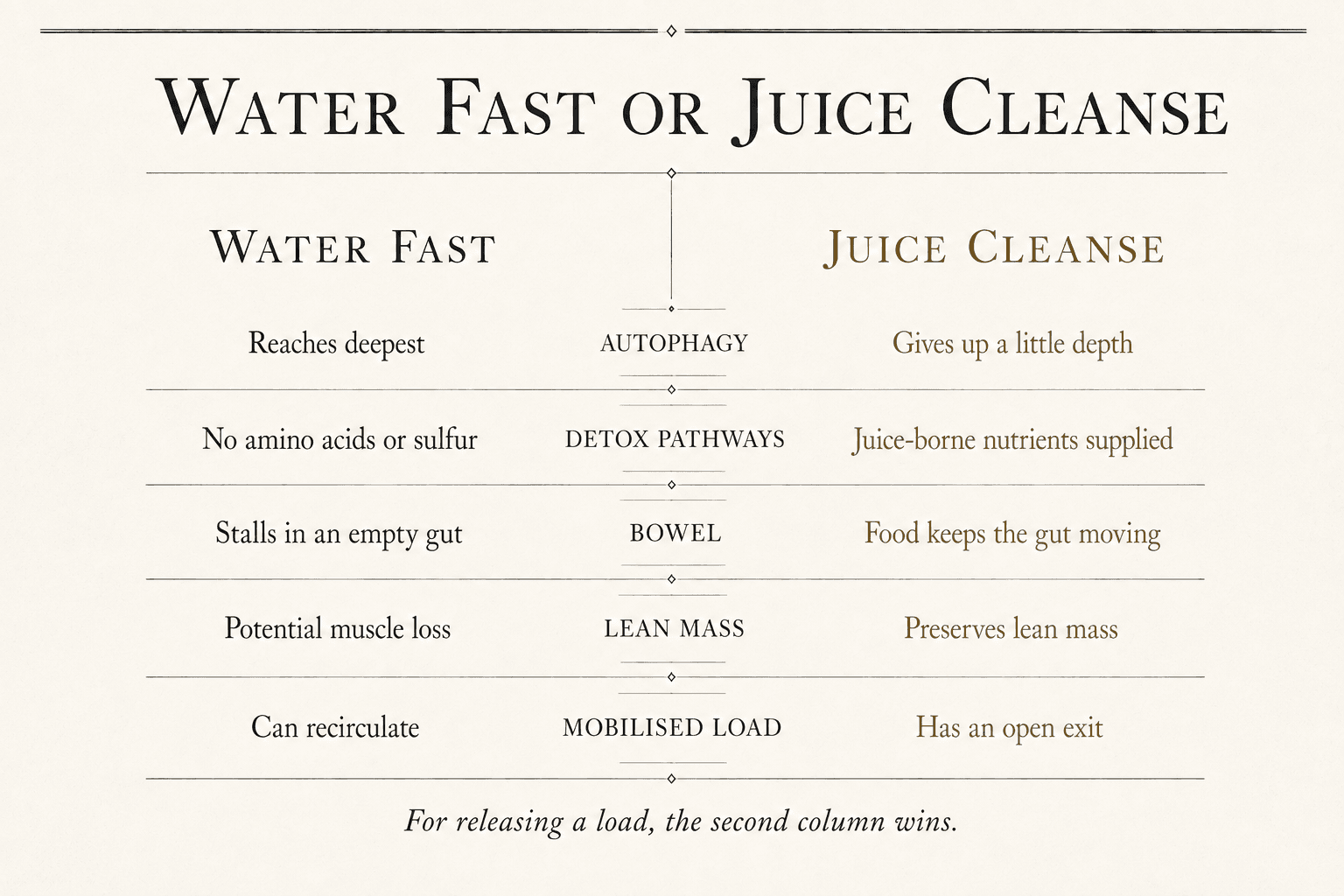
El ayuno estricto con agua tiene su romanticismo, la idea de que no tomar nada en absoluto es el reinicio más puro. La fisiología es genuinamente impresionante. En uno o dos días sin comer, las reservas de azúcar del hígado se agotan, el cuerpo pasa a quemar grasa y suben las cetonas, la principal de ellas el , que no es solo combustible sino una señal que apacigua la inflamación. Más hondo aún, la privación sostenida de nutrientes enciende la , el programa de limpieza doméstica de la célula, en el que digiere sus propias partes dañadas y recicla las piezas. Son cosas reales y que vale la pena tener.footnoteSobre los beneficios establecidos del ayuno, la cetosis y la autofagia: Longo, V. D. y Mattson, M. P. (2014). Cell Metabolism. "Fasting, molecular mechanisms and clinical applications"; y Anton, S. D. et al. (2018). Obesity. "Flipping the metabolic switch."
Pero el ayuno estricto con agua tiene un defecto que los folletos omiten, y es precisamente un defecto de eliminación. Cuando el cuerpo quema grasa, no solo libera energía. La grasa es donde el cuerpo almacena las que no pudo excretar: los contaminantes persistentes, los viejos residuos de pesticidas, los metales pesados. La quema rápida de grasa inunda el torrente sanguíneo con esa carga movilizada, y ahora el cuerpo tiene que neutralizarla y retirarla. Dos cosas que necesita para hacerlo se las niega el ayuno con agua. Las del hígado funcionan con aminoácidos y azufre, la materia prima de la proteína, y un ayuno con agua no aporta ninguno, así que la línea de conjugación se queda sin material y las toxinas medio procesadas se represan. Y como un intestino vacío deja de moverse, lo que el hígado sí consigue verter a la bilis se queda en un intestino quieto, donde las bacterias lo desenvuelven y vuelve a ser .footnoteHodges, R. E. y Minich, D. M. (2015). Journal of Nutrition and Metabolism. "Modulation of metabolic detoxification pathways using foods and food-derived components." Expone por qué la conjugación de fase II depende de los aminoácidos y el azufre de la dieta, y por qué movilizar toxinas sin aportar esos cofactores, o sin mantener la eliminación, frustra el propósito. El alegato de la literatura de desintoxicación contra el ayuno ingenuo con agua. Usted ha hecho la parte difícil, arrancar las toxinas de su almacén, y luego las ha dejado dar la vuelta y volver. Desintoxicar sin eliminar no es desintoxicar. Es redistribuir.
Un ayuno de jugo crudo de verduras conserva lo que importa y cierra el defecto. Con unos pocos cientos de calorías diarias de jugo recién prensado, el cuerpo entra igualmente en ese estado suave de quema de grasa, insulina baja y ligera cetosis que aporta buena parte del descanso metabólico. Pero ahora recibe además exactamente lo que el ayuno estricto le negaba. El jugo vierte dentro las vitaminas, los minerales y los que la maquinaria de desintoxicación del hígado necesita para terminar el trabajo. El goteo constante de azúcar preserva el músculo, así que el cuerpo quema grasa en vez de desmontar tejido magro para fabricar glucosa. El alto contenido mineral, sobre todo de potasio y magnesio, amortigua la leve acidez de la quema de grasa y deja el cuerpo más alcalino. Los jugos verdes son ricos en , que abre los vasos sanguíneos y mejora la circulación que lleva los desechos a los órganos de salida. Y el volumen de líquido, la fibra soluble residual y los azúcares simples mantienen vivo el reflejo intestinal, de modo que el intestino sigue moviéndose y la carga ligada a la bilis sale del cuerpo en vez de dar vueltas.
Esto no es solo teoría. Una dieta de tres días de jugo de verduras y frutas prensado en frío desplazó de forma medible el microbioma intestinal hacia un perfil más sano, elevó el óxido nítrico circulante, bajó un marcador de daño por oxidación de grasas y redujo el peso, en un estudio controlado.footnoteHenning, S. M. et al. (2017). Scientific Reports. "Health benefit of vegetable/fruit juice-based diet, role of the microbiome." Una dieta de tres días basada en jugos desplazó el microbioma intestinal (más Bacteroidetes, menos Firmicutes), elevó el óxido nítrico plasmático, bajó un marcador de peroxidación lipídica y redujo el peso corporal. La dieta de jugos del estudio aportaba unas 1.300 kcal al día, y un ayuno más profundo con menos empuja el mismo desplazamiento con más fuerza.
Y la mayor cohorte observacional de ayuno jamás publicada, más de 1.400 personas, no funcionó con agua sino con el método Buchinger, unas 250 calorías diarias de jugos frescos y caldo de verduras, y documentó una seguridad profunda, un alto cumplimiento, descensos de la presión arterial y de los lípidos, y una mejora del bienestar, precisamente porque esa pequeña ingesta de nutrientes evitó el colapso electrolítico que vuelve peligroso el ayuno estricto con agua.footnoteWilhelmi de Toledo, F. et al. (2019). PLoS One. "Safety, health improvement and well-being during a 4 to 21-day fasting period in an observational study including 1422 subjects." El protocolo Buchinger es un ayuno de jugos y caldo, no de solo agua, de unas 250 kcal al día. Su historial de seguridad a gran escala es el argumento clínico a favor del ayuno alimentado frente al vacío.
El uso clínico más agresivo del principio, el protocolo Gerson, empuja más de una docena de vasos de jugo crudo al día junto con una eliminación intestinal forzada, con exactamente la lógica de esta sección: inundar el cuerpo con los nutrientes que trae el jugo y que hacen funcionar la desintoxicación mientras se fuerzan las salidas de par en par. Eso no es marginal. Eso es fisiología.
Que siga en movimiento
Todo lo anterior suelta. La disciplina que decide si una limpieza le cura o le envenena en silencio es si lo que se suelta sale de verdad.
Esta es la mitad más desatendida de toda desintoxicación. Movilizar una toxina almacenada y luego no eliminarla es peor que dejarla donde estaba, porque ahora está en circulación. Dos sistemas sacan la carga, el intestino y la linfa, y los dos necesitan ayuda durante una limpieza.
Primero el intestino. La tarea es mantener el tránsito lo bastante rápido para que los desechos ligados a la bilis salgan antes de reabsorberse en el bucle enterohepático.footnoteJandacek, R. J. y Tso, P. (2001). American Journal of Physiology, Gastrointestinal and Liver Physiology. "Enterohepatic circulation of organochlorine compounds, a site for nutritional intervention." Establece que las toxinas excretadas en la bilis se reabsorben cuando el tránsito es lento, y que mantener el intestino en movimiento, o fijar las toxinas, rompe el bucle. Hay dos palancas para esto, y no son intercambiables.
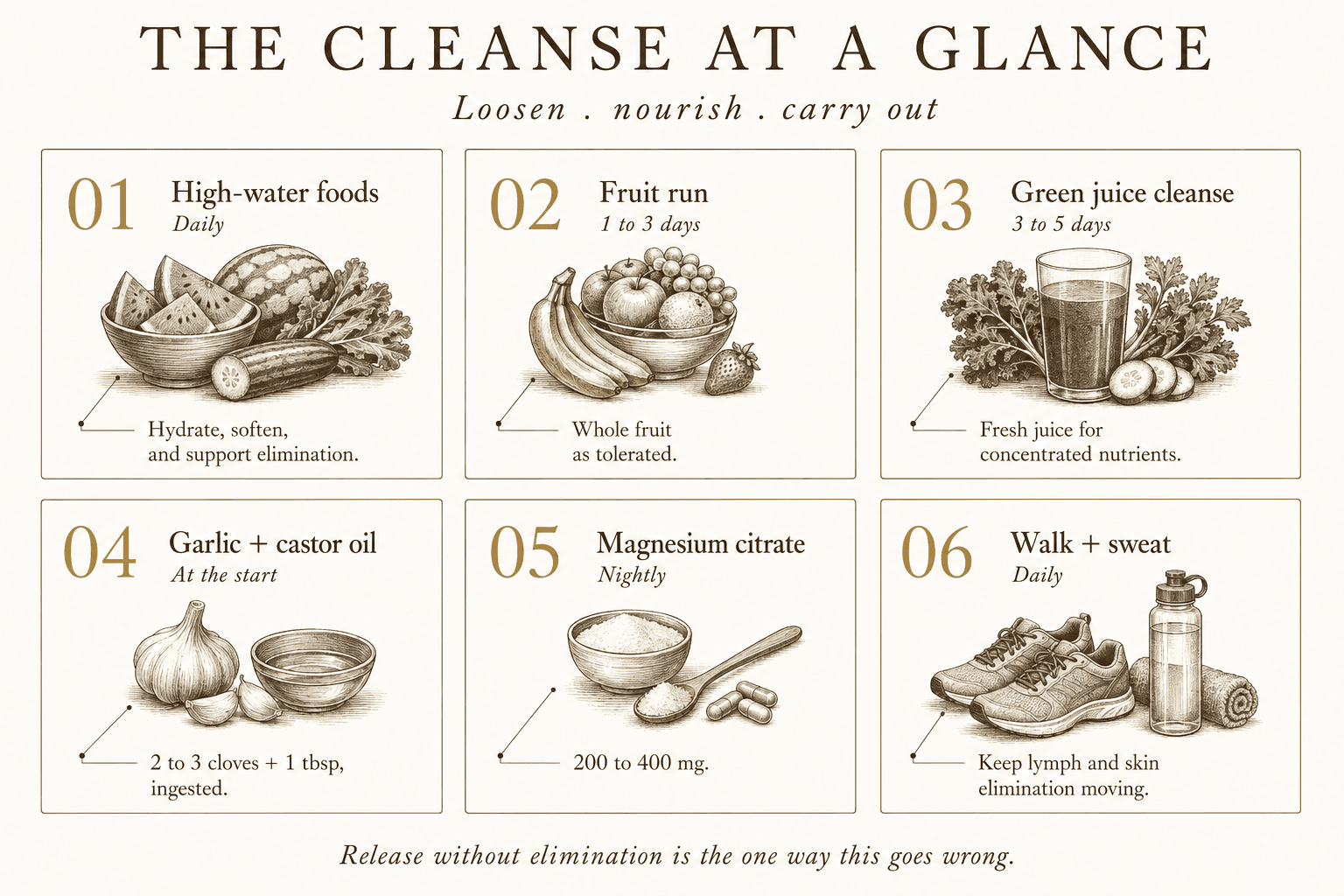
La primera viene del protocolo intestinal: de dos a tres dientes de ajo crudo, picados en trozos gruesos en vez de machacados hasta hacer pasta, tragados por la noche en una cucharada de aceite de ricino prensado en frío. El aceite de ricino es el motor mecánico. Su ácido graso activo, el , se une a receptores del músculo intestinal y lo obliga a contraerse, y saca durante la noche el material que se ha soltado.footnoteTunaru, S. et al. (2012). PNAS. "Castor oil induces laxation and uterus contraction via ricinoleic acid activating prostaglandin EP3 receptors." Esa misma acción uterina es la razón por la que el aceite de ricino está contraindicado en el embarazo.
El ajo va montado como antimicrobiano y quelante. La descripción completa está en el ensayo sobre la limpieza parasitaria; trátelo como la palanca pesada, para usar al principio de una limpieza, no todas las noches para siempre.
La segunda palanca es el magnesio, y aquí la forma equivocada no sirve de nada para este trabajo. El magnesio que toma casi todo el mundo, el que se toma cada noche para dormir y para reponer, es el , la herramienta correcta para restaurar el mineral y para la calma. Es la herramienta equivocada para mover el intestino, porque se absorbe tan bien que nunca llega al colon a hacer trabajo osmótico. La forma que mantiene las cosas en marcha es el , que se queda en el intestino, atrae agua al colon y ablanda y desplaza las heces por ósmosis.footnoteSobre las formas: el glicinato de magnesio se absorbe de forma eficiente y casi no ejerce efecto laxante, ideal para reponer (véase el protocolo de minerales esenciales); las formas mal absorbidas, el citrato y el óxido, se quedan en la luz intestinal y atraen agua por ósmosis, que es lo que produce la deposición. Mori, S. et al. (2021). Nutrients. "Clinical evaluation of magnesium oxide in the treatment of constipation."
Así que la regla es simple: glicinato para el cuerpo, citrato para el intestino. Durante una limpieza, de 200 a 400 mg de magnesio elemental en forma de citrato por la noche mantienen la salida abierta sin la fuerza catártica del aceite de ricino, una opción diaria más suave para los días entre los reinicios más duros.
Después, la linfa. El que drena los desechos de los espacios entre sus células no tiene corazón propio. Sus vasos colectores se contraen en un ritmo callado, y el resto de la fuerza viene de sus músculos y de su respiración, así que el drenaje solo se mueve cuando usted se mueve.
Por eso el movimiento ligero diario durante una limpieza no es decoración. Camine, respire hondo hacia el diafragma y manténgalo suave: el sentido de una limpieza es descanso y liberación, no un bloque duro de entrenamiento. Si el olor corporal se agudiza, la energía cae o la niebla se espesa, la liberación ha adelantado a las salidas, así que baje la presión y ensánchelas. La mecánica completa y la secuencia diaria están en La bomba ausente, y esta limpieza las da por hechas.
Una salida más, la piel. Sudar es una vía de eliminación genuina, no folclore. Los estudios que miden sangre, orina y sudor a la vez han hallado que el sudor saca metales pesados, cadmio, plomo, mercurio, y compuestos industriales como el bisfenol A, a concentraciones que a veces superan las de la sangre o la orina.footnoteGenuis, S. J. et al. (2012). Archives of Environmental Contamination and Toxicology. "Blood, Urine, and Sweat (BUS) Study." Y el artículo complementario sobre la excreción de bisfenol A en el sudor (2012, Journal of Environmental and Public Health). El sudor es una vía de eliminación medible para varios tóxicos persistentes, y ese es el argumento clínico a favor de la sauna durante una limpieza. Por eso La bomba ausente pone el calor en la secuencia diaria. Una sauna, o sencillamente el movimiento suficiente para romper a sudar, abre una cuarta puerta por la que la carga puede salir. Hidrátese y reponga minerales cuando la use; sudar es también una manera de perder los electrolitos que la limpieza ya está gravando.
Lo ecológico, y el problema del suelo
Si el argumento es comer alimento vivo en su punto más brillante, la siguiente pregunta es inevitable: ¿más brillante venido de dónde? Y aquí la respuesta separa la práctica real de la versión ingenua del sueño crudívoro.
Opte por lo ecológico cuando pueda, y no por las razones que vende la etiqueta. El mayor metaanálisis sobre la cuestión, con 343 estudios agrupados, halló que los cultivos ecológicos son notablemente más altos en antioxidantes y polifenoles, la química defensiva propia de la planta, y, lo que importa más, tienen cuatro veces menos probabilidad de llevar residuos detectables de pesticidas y en torno a un cuarenta y ocho por ciento menos de , el metal tóxico que se cuela en el suelo convencional desde el fertilizante sintético y de ahí al alimento.footnoteBaranski, M. et al. (2014). British Journal of Nutrition. "Higher antioxidant and lower cadmium concentrations and lower incidence of pesticide residues in organically grown crops." La cita individual más fuerte para elegir ecológico: no muchas más vitaminas, sino más fitoquímicos defensivos, muchísimo menos pesticida y alrededor de la mitad de cadmio.
Una dieta cruda es, por definición, una dieta que se come sin el lavado que le daría la cocción, así que la carga de contaminantes de la materia prima importa más, no menos.
Pero el problema más hondo es la tierra misma. El contenido mineral del alimento va detrás del contenido mineral del suelo, y un siglo de agricultura industrial ha desnudado el suelo. Las tablas oficiales de alimentos lo muestran sin ambages: a lo largo del siglo veinte, el calcio, el hierro, el magnesio y el potasio de los productos comunes cayeron entre un quince y casi un cincuenta por ciento, en parte por agotamiento y en parte por seleccionar los cultivos por tamaño y velocidad en vez de por densidad de nutrientes, el llamado efecto de dilución.footnoteDavis, D. R., Epp, M. D. y Riordan, H. D. (2004). Journal of the American College of Nutrition, tablas del USDA de 1950 frente a 1999; y Mayer, A. M. (1997). British Food Journal, tablas del Reino Unido de 1936 frente a 1991. Descensos de aproximadamente el 15 al 50 por ciento en calcio, hierro, magnesio y potasio, tanto por agotamiento del suelo como por el "efecto de dilución" de seleccionar por rendimiento y contenido de agua en vez de por densidad de nutrientes. Ese es el argumento que desarrollan por completo el ensayo sobre la muerte del suelo y los alimentos animales y el texto sobre los minerales esenciales. Una hoja moderna de espinaca es una fracción del aporte mineral que fue su abuela. No se puede salir de eso comiendo más de la hoja empobrecida, porque más hoja significa también más oxalato, más carga quelante y más pesticida.
Por eso fracasa la dieta cruda estricta y a largo plazo dentro de un sistema alimentario industrial moderno. El estudio Giessen Raw Food siguió a 257 personas que comían entre un setenta y un cien por cien de crudo, y halló bajo peso crónico en todo el grupo y, en aproximadamente un tercio de las mujeres menores de cuarenta y cinco años, pérdida parcial o completa de la menstruación, la señal inequívoca del cuerpo de que funciona con un déficit de energía y de nutrientes demasiado profundo para sostener la reproducción.footnoteKoebnick, C. et al. (1999). Annals of Nutrition and Metabolism. "Consequences of a long-term raw food diet on body weight and menstruation" (el estudio Giessen Raw Food). Cerca del 30 por ciento de las mujeres menores de 45 años desarrollaron amenorrea parcial o completa, un marcador clínico de déficit energético grave. Los crudívoros estrictos de largo plazo presentan además una densidad ósea medible más baja (Fontana et al., 2005, Archives of Internal Medicine).
Los crudívoros de largo plazo llevan también una densidad ósea medible más baja. La ligereza que trae una dieta cruda en sus primeros meses es real, y también lo es el empobrecimiento que la alcanza en el segundo año si la dieta se lleva sin respeto por lo que la cadena alimentaria moderna ya no puede entregar.
Hay un conjunto de condiciones bajo el cual el camino crudo se sostiene, y es exactamente el que el ideal crudívoro siempre estuvo buscando. Funciona allí donde el alimento es local, se come en temporada y crece en suelo vivo, esa tierra volcánica, densa en minerales o gestionada de forma regenerativa que todavía contiene lo que la tierra industrial ha perdido. Las granjas regenerativas sí cultivan, de forma medible, alimentos más densos en minerales y más ricos en fitoquímicos que sus vecinas convencionales.footnoteMontgomery, D. R. et al. (2022). PeerJ. "Soil health and nutrient density." Los cultivos de manejo regenerativo dieron valores más altos de magnesio, calcio, potasio y zinc y entre un 15 y un 25 por ciento más de fitoquímicos que sus vecinos convencionales. Es la biología del suelo, y no la etiqueta ecológica por sí sola, la que restaura el piso mineral. Si el alimento se cultiva así y recorre una distancia corta hasta el plato, una dieta escorada hacia lo crudo no solo es posible, es excelente. Allí donde el producto se selecciona para durar en el estante, se recoge verde, se transporta a través de un continente y crece en suelo agotado, la misma dieta es una carencia lenta, por muy disciplinado que sea quien la come. El movimiento honesto en ese caso: comer alimento crudo y vivo como centro de gravedad, conseguirlo tan local y tan bien como se pueda, y suplementar los minerales que el suelo ya no puede aportar en vez de fingir que las plantas los siguen llevando. Y vivo no quiere decir solo vegetal: los alimentos animales crudos más frescos, las yemas de huevo de pasto, los lácteos crudos, el pescado recién capturado, llevan la misma luz ordenada y la nutrición densa sin la cual el ensayo sobre la muerte del suelo y los alimentos animales sostiene que el cuerpo no puede pasar. Haga la limpieza cruda como práctica periódica, no como forma de vida permanente y sin apoyo, salvo que su suelo se lo gane.
El arco
El ritmo es estacional, no constante. Una tanda de fruta de uno a tres días cuando el cuerpo se siente pesado o cambia la estación. Una limpieza de jugo verde de tres a cinco días unas cuantas veces al año, hecha con las salidas abiertas: aceite de ricino y ajo al principio, citrato de magnesio para mantener las cosas en marcha, una caminata y un sudor cada día, y suficiente agua mineral para ir por delante de la pérdida.
Entre limpiezas, la versión de todos los días es el mismo principio a menor intensidad: haga que el plato sea húmedo y vivo, encabécelo con producto crudo y ligeramente cocinado, consígalo de buen origen, y mantenga el intestino y la linfa en movimiento con movimiento corriente y agua suficiente.
Lo que vuelve es constante y rápido. Hacia el segundo o el tercer día la eliminación ha cambiado con claridad, más abundante y más completa. Luego la ligereza, luego la lucidez, luego una conciencia afilada y una sensibilidad recuperada hacia la comida, la sensación de que puede notar lo que le hace un plato, algo que un cuerpo atascado y sobrealimentado no puede.
Esto no es solo un intestino descargado. Es el campo funcionando limpio, la luz coherente reconstruyéndose a medida que usted deja de verter materia muerta en él. Está elevando su vibración en el sentido más literal que permiten esas palabras. El cuerpo siempre estuvo construido para portar luz de forma coherente. El trabajo consiste solo en dejar de estorbarle.
Y la luz tiene una pareja. Mire otra vez lo que el alimento vivo entrega realmente dentro de usted y verá que los fotones viajan dentro de algo: agua, retenida en una fase ordenada y estructurada contra las membranas celulares, la forma que sus tejidos reconocen. El campo que porta la luz está construido sobre agua viva, y esa agua es adonde va esto a continuación: qué hace distinta el agua del interior de una célula viva del agua de una botella, y cómo beber la clase viva.
Coma el alimento que todavía brilla. Empape el sistema en su agua. Suelte lo viejo, y asegúrese de que sale. El cuerpo hace el resto.
Sources
- Ultra-Weak Photon Emission from Biological Samples: Definition, Mechanisms, Properties, Detection and Applications, . https://doi.org/10.1016/j.jphotobiol.2014.02.009
- Biophoton Emission: New Evidence for Coherence and DNA as Source, . https://doi.org/10.1007/BF02788579
- Ultra-Weak Photon Emission: A Nondestructive Detection Tool for Food Quality and Safety Assessment, . https://doi.org/10.15586/qas.v12iSP1.766
- Influence of External Light on Ultra-Weak Photon Emission of Fruits: Forensic Differentiation of Organic and Conventional Fruits, . https://doi.org/10.3390/s25061799
- Health Benefit of Vegetable/Fruit Juice-Based Diet: Role of Microbiome, . https://doi.org/10.1038/s41598-017-02200-6
- Safety, Health Improvement and Well-Being during a 4 to 21-Day Fasting Period in 1422 Subjects, . https://doi.org/10.1371/journal.pone.0209353
- Modulation of Metabolic Detoxification Pathways Using Foods and Food-Derived Components, . https://doi.org/10.1155/2015/760689
- Enterohepatic Circulation of Organochlorine Compounds: A Site for Nutritional Intervention, . https://doi.org/10.1016/j.jnutbio.2006.12.001
- Castor Oil Induces Laxation and Uterus Contraction via Ricinoleic Acid Activating Prostaglandin EP3 Receptors, . https://www.pnas.org/doi/10.1073/pnas.1201627109
- Blood, Urine, and Sweat (BUS) Study: Monitoring and Elimination of Bioaccumulated Toxic Elements, . https://pubmed.ncbi.nlm.nih.gov/21057782/
- Higher Antioxidant and Lower Cadmium Concentrations and Lower Incidence of Pesticide Residues in Organically Grown Crops, . https://pubmed.ncbi.nlm.nih.gov/24968103/
- Consequences of a Long-Term Raw Food Diet on Body Weight and Menstruation, . https://pubmed.ncbi.nlm.nih.gov/10436305/
- Solid Food Vacation - DO’s & DON’Ts, . https://www.youtube.com/watch?v=WQEcd6l6PwM
- Living on Light, . https://drsircus.com/cancer/living-light/