
El Suelo, Capítulo 2
Limón y bicarbonato
La bebida matutina de cinco céntimos que le devuelve al cuerpo su amortiguador ácido-base, y la química de por qué funciona.
Ahora mismo, entre las palabras que está leyendo, su cuerpo está robándole en silencio a su propio esqueleto. Cada minuto que pasa sin bicarbonato suficiente, disuelve calcio y magnesio de sus huesos para neutralizar el ácido que produce el simple hecho de vivir, porque la alternativa es dejar que el pH de su sangre se salga de la franja que mantiene vivas sus enzimas. El zumo de un limón entero y una cucharadita de en doce onzas de agua, tomados a primera hora de la mañana, detienen el robo. Le devuelven al cuerpo el amortiguador que ha estado tomando prestado de sus huesos, y empujan el pH de la primera orina del día hasta la ventana en la que los riñones empiezan de verdad a excretar la carga ácida metabólica de la jornada. La literatura clínica sobre el tamponamiento alcalino es buena. El protocolo es más antiguo que la farmacología. El coste total es de menos de un dólar al día.
La mayor parte de la enfermedad crónica transcurre en un cuerpo que lleva tiempo gastando su amortiguador más rápido de lo que lo repone. La bebida corrige eso en el origen. Su efecto sobre la energía basal, la profundidad del sueño, la digestión y el trabajo diario de detoxificación que hacen el hígado y los riñones es desproporcionado respecto al precio.
Si hay una sola cosa que pudiera hacer a diario que combatiera drásticamente la enfermedad y aumentara su energía, consumir zumo de limón combinado con bicarbonato estaría en lo más alto de la lista.
Es el Dr. Loyd Jenkins, del Budwig Center. Tiene razón, y lo que sigue es la química de por qué.
Lo que recupera
Siete cosas. La química que hay detrás de cada una está desarrollada más abajo.
- Tamponamiento ácido-base restaurado. Un más alto le mantiene fuera de la franja inferior, donde la mortalidad por todas las causas fue un 24% mayor en la cohorte de Raphael de 2017. La mayoría de los médicos nunca hace aflorar ese número.
- Entrega de oxígeno más eficiente. La reserva de CO2 tamponada por el bicarbonato es lo que permite a la hemoglobina soltar de verdad el oxígeno en el tejido que lo necesita. La misma respiración, más oxígeno donde cuenta.
- Sueño más profundo. El trabajo nocturno de aclaramiento de residuos del cerebro depende de una oxigenación tisular adecuada.
- Mañanas más limpias. Nada de esa sensación de «ácido al despertar», y un intestino que se mueve como debe.
- Conservación mineral. Suministre el amortiguador directamente y el cuerpo deja de sacar calcio y magnesio del hueso para hacer el trabajo. Menos calambres musculares, menos de la cascada de calcificación que traza el ensayo sobre la pineal.
- Una dosis diaria de bioactivos cítricos. Alrededor de 50 mg de vitamina C y los flavonoides cítricos que cruzan con el zumo.
- Ácido cítrico gratis. Unos pocos gramos al día, con su propia historia en el metabolismo del cáncer.
Todo eso a partir del zumo de un limón y una cucharadita de bicarbonato, tomados antes del desayuno.
La biología, por qué el CO2 es la palanca
Remueva una cucharadita de bicarbonato en el agua, exprima el limón encima y la superficie empieza a burbujear en cuestión de segundos. Ese burbujeo es química real, dióxido de carbono desprendiéndose de la reacción, y es la razón por la que la bebida no debe quedarse en el vaso. Déjela burbujear en el vaso y el CO2 se gasta en el aire de la cocina. Bébala cuando la reacción empieza y la misma química llega a su término dentro del estómago, donde el gas se libera en el cuerpo.
La reacción:
NaHCO3 + HCl produce NaCl + H2O + CO2
El bicarbonato más el ácido cítrico del limón producen , y el trabajo del limón es ser ese ácido, para que el bicarbonato no neutralice más ácido del estómago del que debe.
El dióxido de carbono es la clave del asunto. No es un desecho. Es una de las moléculas señalizadoras más consecuentes de la fisiología humana.
La comprensión moderna de su papel empezó con dos investigadores a finales del siglo XIX, Christian Bohr en Dinamarca y Bronisław Verigo en Rusia. Trabajando por separado, descubrieron la misma ley contraintuitiva: el oxígeno no se desprende del transportador sanguíneo de oxígeno sin que haya dióxido de carbono presente.
El es este: la , el transportador de oxígeno de la sangre, libera su oxígeno solo donde hay suficiente dióxido de carbono en el tejido circundante. Un músculo en sprint, un cerebro pensando, una herida que se cura, todos ellos producen la mayor cantidad de CO2, que es la manera que tiene el cuerpo de decir entregue oxígeno aquí. Sin CO2 en escena, el oxígeno permanece anclado a la hemoglobina y el tejido se muere de hambre aunque la sangre esté llena de oxígeno.
Por esto la durante la ansiedad produce los síntomas que produce. El paciente expulsa CO2 más rápido de lo que los tejidos lo fabrican. La hemoglobina aprieta. El cerebro, el órgano más hambriento de oxígeno del cuerpo, siente primero la escasez, lo que alimenta la ansiedad, que alimenta la respiración. Un bucle que se cierra, y la salida es la misma química: devolver dióxido de carbono al sistema.
El bicarbonato oral con el estómago vacío y con limón eleva el nivel de bicarbonato en sangre del cuerpo, y un nivel de bicarbonato más alto es, en efecto, más dióxido de carbono almacenado en forma químicamente tamponada. El cuerpo lleva más reserva. La oxigenación tisular funciona con más eficiencia para la misma cantidad de respiración. Esto es lo que el Dr. Sircus ha llamado medicina del CO2, y casi nadie en la práctica preventiva moderna la está usando.
Qué lo bloquea, la carga ácida que carga casi todo el mundo
El cuerpo defiende ferozmente el pH de la sangre, entre 7,35 y 7,45, la franja de la que depende cada enzima.
Sin bicarbonato suficiente, el ácido diario que producen la digestión de las proteínas, el estrés, el ejercicio y la dieta moderna desplazaría la sangre fuera del rango de supervivencia en cuestión de horas. Así que el cuerpo encuentra el amortiguador en alguna parte. Suminístrele poco bicarbonato y sacará calcio y magnesio del hueso para hacer el tamponamiento en su lugar.
La acidez crónica de bajo grado es una de las entradas al problema de la calcificación que trazan el protocolo de descalcificación pineal y la pila mineral de ocho elementos. El mineral del hueso se filtra, el ácido se neutraliza, y el calcio ahora circulante tiene que aterrizar en alguna parte.
Sin suficiente magnesio y vitamina K2 para enrutarlo, se deposita en arterias, articulaciones y tejido blando. La bebida de limón y bicarbonato interrumpe ese bucle en el punto más barato posible.
La correlación con la longevidad
En 2017 el equipo del Dr. Kalani Raphael, en la Universidad de Utah, publicó un análisis del en adultos mayores residentes en la comunidad. El hallazgo fue directo: un bicarbonato sanguíneo bajo conllevaba un 24% más de riesgo de muerte prematura, con independencia de cualquier otro factor de riesgo que controlaran.
Comentario de Raphael: «Lo que encontramos fue que las personas mayores generalmente sanas con niveles bajos de bicarbonato tenían un mayor riesgo de muerte.»
La práctica clínica estándar no lo mide de forma rutinaria; el número queda enterrado dentro del panel metabólico básico y rara vez aflora como factor de riesgo. Debería hacerlo. La suficiencia de bicarbonato sigue la mortalidad del modo en que el LDL sigue los eventos cardiovasculares, con más limpieza y con mucha más posibilidad de corrección, y la intervención más barata disponible para corregirla es una cucharadita de bicarbonato de grado alimentario al día.
El encuadre del cáncer como hongo
El Dr. Tullio Simoncini, el oncólogo italiano, ha construido su carrera sobre el hallazgo de que , creciendo en entornos locales bajos en oxígeno y ácidos y respondiendo al bicarbonato a dosis altas del modo en que una infección fúngica responde a un antifúngico. Ha usado bicarbonato de sodio intravenoso como intervención primaria contra el cáncer, con regresiones reportadas en varios tipos de tumor.
La biología subyacente está asentada. , de que las células cancerosas queman glucosa preferentemente de un modo derrochador que se salta el oxígeno y acidifican el tejido a su alrededor, es biología oncológica fundamental. El bicarbonato eleva el pH local y estresa el entorno del tumor. La dosis intravenosa alta es una intervención bajo supervisión médica. La cucharadita oral diaria, tomada como prevención, es el suelo que cualquiera puede sostener en casa.
Qué es en realidad el zumo
Un limón no es un dispositivo de entrega de vitamina C. El zumo de una fruta aporta unos 50 mg de vitamina C, una ración diaria razonable, y aporta los flavonoides cítricos, la hesperidina y la eriocitrina en cabeza, cada uno con su propio efecto vascular y antiinflamatorio.
El zumo entrega además , que trae su propia historia metabólica. El Dr. Alberto Halabe Bucay ha aplicado un protocolo de tratamiento en pacientes oncológicos usando de 10 a 15 gramos de ácido cítrico puro por vía oral tres veces al día, emparejado con un fármaco protector del estómago para preservar el revestimiento gástrico. Su mecanismo propuesto: el ácido cítrico atasca las de las que las células cancerosas dependen más que las células normales. Ha reportado mejora clínica en más de 80 pacientes oncológicos con este régimen.
El limón diario le entrega unos pocos gramos de ácido cítrico como efecto secundario de todo lo demás que la fruta está haciendo.
El protocolo
Cada mañana, antes de la comida, antes del café, antes de cualquier otra cosa.
La receta
- 12 onzas de agua destilada a temperatura ambiente, ni fría ni caliente. El frío suprime la reacción; el calor aplana el zumo fresco.
- Una cucharadita (~4 g) de bicarbonato de grado alimentario, primero. Remuévalo un poco, lo justo para que se disuelva. Puro, sin aluminio, de un proveedor fiable. Algunas rotaciones matutinas incluyen también media cucharadita de , para equilibrar la dosis de sodio.
- El zumo de un limón entero ecológico, exprimido al final, directamente sobre el bicarbonato disuelto. Nada más elaborado que eso. No lo remueva.
EL OBJETIVO NO ES QUE LA BEBIDA BURBUJEE EN EL VASO. NO LA REMUEVA NI LA DEJE REACCIONAR CONSIGO MISMA. La reacción y el burbujeo son el CO2 liberándose, y cada burbuja que estalla en el vaso es dióxido de carbono que el cuerpo nunca recibe. En cuanto entra el limón, beba el vaso entero, bicarbonato y zumo juntos, para que la reacción ocurra dentro del estómago y el CO2 se libere en el cuerpo, donde la química descrita arriba puede usarlo. Lo que reacciona en el estómago gasta además el ácido del limón y no el suyo: tomado así, el bicarbonato no neutraliza más ácido del estómago del que debe, y el citrato que deja la reacción el cuerpo lo convierte de vuelta en bicarbonato más adelante. El amortiguador llega de las dos maneras. El gas solo llega si lo bebe a tiempo.
Cuándo y por qué
Por la mañana, con el estómago vacío. Es la ventana de mayor apalancamiento. Durante la noche el cuerpo ha estado tirando de sus reservas de bicarbonato y ha acumulado una carga ácida del trabajo celular ordinario; la dosis matutina restablece el amortiguador y entrega la vitamina C y el ácido cítrico cuando la absorción está en su pico.
Una segunda dosis 30 a 45 minutos antes de acostarse, con el estómago vacío y lejos de la comida, sostiene la detoxificación nocturna y las fases más profundas del sueño, la dosis que más afecta a la calidad subjetiva del sueño. El efecto de dióxido de carbono del bicarbonato es más útil para el cerebro, que pasa la noche haciendo , y los efectos de conservación mineral sostienen ese proceso.
Evite tomarlo con las comidas.
El bicarbonato neutraliza el ácido estomacal, y usted quiere ácido estomacal para la digestión de las proteínas que llega con la comida. Manténgase a 60 minutos o más de cualquier comida.
El límite duro del protocolo es el sodio.
Una cucharadita de bicarbonato son aproximadamente 1,2 g de sodio, dentro de la ingesta diaria admisible pero acumulativos si ya come una dieta alta en sodio. Las personas con hipertensión o enfermedad renal deberían consultar a un médico y probablemente sustituir la forma sódica por la potásica.
El otro lado de la balanza, el vinagre de sidra de manzana
Todo lo anterior es una mitad de un sistema de dos lados, y es la mitad de la que la mayoría de la gente anda escasa. De ahí no se sigue que más alcalinidad sea siempre mejor. El cuerpo no intenta ser alcalino, intenta regular, y la regulación necesita las dos manos: una reserva alcalina para neutralizar el ácido del metabolismo ordinario, y ácido suficiente para digerir proteína, liberar los minerales del alimento y disolver lo que se ha endurecido donde no debía. Quite cualquiera de los dos lados y el regulador pierde el agarre. Ese es el error enterrado en el negocio del agua alcalina, que vende la idea de que un cuerpo empujado más hacia lo alcalino es un cuerpo que va mejor. Merece la pena nombrarlo aquí para que la bebida de la mañana no se lea como un empujón en una sola dirección. El bicarbonato rellena la reserva. No lleva el cuerpo hacia lo alcalino, y no debería hacerlo.
El lado ácido tiene su propio instrumento diario, y es el vinagre de sidra de manzana crudo.
Una cucharada en un vaso de agua es una de las cosas más útiles de la cocina. Lleva ácido acético, que afila la digestión y amortigua la subida de glucosa que sigue a una comida, y lleva ácido málico, el mismo ácido que ablanda el colesterol endurecido a lo largo de los seis días de preparación previos a una limpieza hepática. Lo que el ácido málico le hace a un cálculo biliar se lo hace más despacio al calcio que el cuerpo ha aparcado donde no corresponde. El ácido moviliza el mineral. Un cuerpo que tiene suficiente mantiene su calcio en solución y en movimiento; un cuerpo que anda corto lo aparca en arterias, articulaciones y tejido blando, que es la misma cascada contra la que el bicarbonato trabaja desde el otro extremo. Los dos son manos sobre el mismo problema.
Manténgalos separados en el tiempo. El vinagre y el bicarbonato en un mismo vaso se cancelan al contacto, se gastan en burbujas y no entregan ninguno de los dos. Tome el limón y el bicarbonato con el estómago vacío, como arriba. Tome el vinagre antes de una comida, donde el ácido tiene trabajo que hacer, y deje al menos una hora entre ambos.
El origen no es una nota al pie. Las manzanas cargan una de las mayores cargas de pesticida de todos los cultivos comerciales, y el vinagre es un concentrado: lo que estaba sobre la fruta acaba en la botella, afilado en vez de diluido. El vinagre de sidra de manzana no ecológico, y cualquier cosa fermentada con descuido, entrega una dosis concentrada de lo que se roció sobre el huerto, que es exactamente lo contrario de aquello por lo que usted lo bebe. Cómprelo ecológico, crudo y sin filtrar, con todavía dentro, y en vidrio, porque el ácido arranca plastificante de una botella de plástico a lo largo de los meses que pasa en un armario.
El arco, qué esperar
- Dentro de la primera semana: sueño más profundo, mañanas más claras, menos de la clásica sensación de «ácido al despertar». La motilidad intestinal suele mejorar en los primeros tres días.
- Dentro del primer mes: piel más limpia por la fibra más la vitamina C, menos calambres musculares por el magnesio que el bicarbonato conserva, energía más estable a lo largo del día.
- Más allá de tres meses: las líneas de tendencia del bicarbonato en sangre (si su médico accede a pedirlo) y del pH de la primera orina de la mañana (que puede medir a diario con tiras por unos pocos dólares) se desplazan al extremo superior del rango normal. Esa es la prueba mensurable, y es la que hay que seguir.
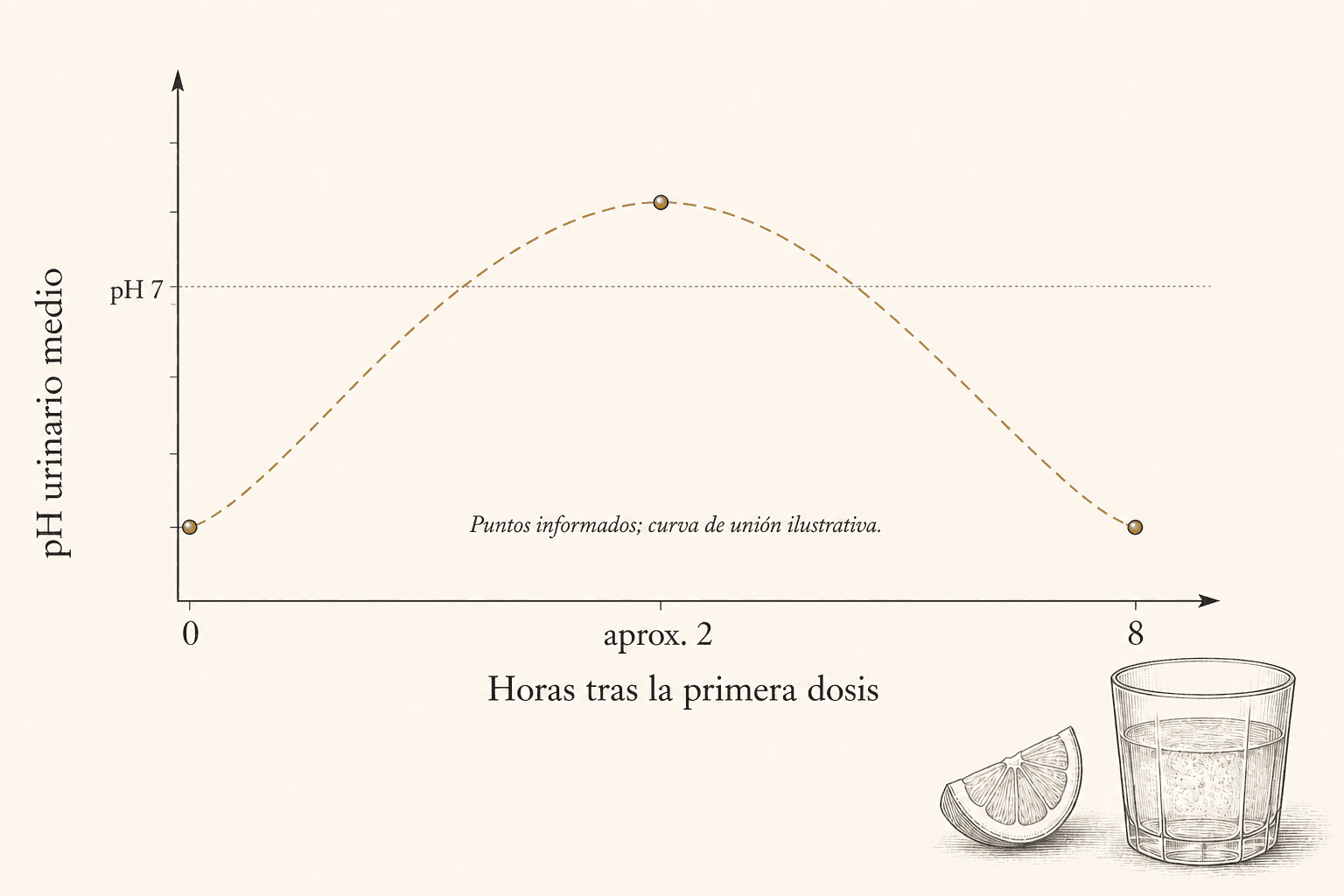
Cohen y colegas pusieron números a la curva. Nueve hombres sanos tomaron 4 g de bicarbonato de sodio por vía oral en el momento cero. El pH urinario medio estaba por encima de 7 hacia las dos horas y de vuelta en el valor basal a las ocho, que es exactamente la razón por la que la dosis se repite a lo largo del día en lugar de cargar sola con todo el trabajo.footnoteCohen, B. et al. (2013). "Efficacy of urine alkalinization by oral administration of sodium bicarbonate: a prospective open-label trial." American Journal of Emergency Medicine 31(12):1703-1706. Nueve hombres sanos recibieron 4 g a las 0, 8 y 16 horas. Valor basal en el momento de la dosis, pH medio por encima de 7 hacia las 2 horas, retorno al basal a las 8 horas. DOI: 10.1016/j.ajem.2013.08.031.
El contexto más amplio
Este protocolo no se sostiene solo. Es el cimiento más barato y accesible de una práctica mineral y ácido-base más amplia que incluye la pila mineral de ocho elementos, el protocolo de descalcificación pineal de siete elementos, una hidratación adecuada, la exposición solar diaria y la práctica de respiración lenta que eleva y empuja la misma fisiología de Bohr-Verigo hacia adelante por una palanca distinta.
La medicina más barata de la casa es la que el cuerpo reconoce con mayor rapidez.
Pero el amortiguador solo puede neutralizar el ácido que llega. La mayor fuente única de esa carga ácida diaria es la comida del plato, y aquí la sabiduría convencional lo tiene exactamente al revés.
La dieta que se vende como la limpia, la ligera, la virtuosa, la que promete alcalinizar y sanar, está privando en silencio al cuerpo de los mismos minerales y proteínas que necesita para construir su propio amortiguador y su propia estructura. Eso es lo siguiente que hay que desmontar.
Sources
- The Biological Significance of Cancer: Mitochondria as a Cause of Cancer and the Inhibition of Glycolysis with Citrate as a Cancer Treatment, . https://pubmed.ncbi.nlm.nih.gov/17368752/
- Bicarbonate Concentration, Acid-Base Status, and Mortality in the Health, Aging, and Body Composition Study, . https://pubmed.ncbi.nlm.nih.gov/26769766/
- Efficacy of Urine Alkalinization by Oral Administration of Sodium Bicarbonate: A Prospective Open-Label Trial, . https://pubmed.ncbi.nlm.nih.gov/24055481/
- Physiology, Bohr Effect, . https://www.ncbi.nlm.nih.gov/books/NBK526028/
- Sodium Bicarbonate, . https://openlibrary.org/works/OL20335481W
- Bicarbonate and CO2, . https://drsircus.com/carbon-dioxide/bicarbonate-and-co2/
- Lemon Medicine and Cancer, . https://drsircus.com/cancer/lemon-medicine-and-cancer/
- The Power of Lemons (Part 1 of 2), . https://www.youtube.com/watch?v=w5t8kv_Vtlk
- The Power of Lemons (Part 2 of 2), . https://www.youtube.com/watch?v=wB2J_d4tcoo