
Die Isolatoren
Quecksilber, Blei, Cadmium, Aluminium und Arsen teilen ein einziges Verbrechen, sie blockieren den Strom des Körpers und dämpfen sein Licht. Wo jedes von ihnen tatsächlich in Sie hineingelangt, wie Sie diese Tür schließen, und die mineralische Maschinerie, Glutathion, Selen und Schwefel, die herauszieht, was bereits durchgekommen ist.
Es gibt keinen sicheren Bleispiegel in Ihrem Blut. Keine niedrige Schwelle, unterhalb derer es nichts bewirkt, keinen Boden, keine Mindestdosis, die der Körper abschüttelt, nur kleinere und größere Schadensmengen, gemessen bis ganz hinunter auf null. Der Grund ist mechanisch und exakt: Blei trägt das Gesicht des Calciums gut genug, um durch die für Calcium gebauten Tore durchgewunken zu werden, gelangt auf diesen Wegen ins Gehirn und schweißt sich in eine Schaltung ein, die auf Ladung läuft. Es ist eines von fünf Metallen, die dieselbe Art von Schaden anrichten, und der Schaden trägt einen einzigen Namen.
Führt man ein hinreichend feines Instrument über einen lebenden Körper, so findet man keinen chemischen Beutel, der vor sich hinschwappt. Man findet einen Stromkreis. Sie sind ein Ding, das leitet, und ein Ding, das leuchtet. Gesundheit ist keine Substanz, die Sie besitzen. Sie ist eine Eigenschaft des Flusses: Ladung, die sauber fließt, Licht, das frei fließt, Energie, die den Körper mit so wenig Verlust durchquert, wie die Verdrahtung es zulässt.
In dieses leitende, leuchtende System lagert ein modernes Leben einen kleinen Satz von Metallen ein, die genau das Gegenteil von Leiten tun. Sie binden. Sie blockieren. Sie löschen. Wo sie sich festsetzen, verlangsamt sich der Strom, und das Licht wird dunkel.
Dies ist die einfachste wahre Aussage über Quecksilber, Blei, Cadmium, Aluminium und Arsen, und sie ist die These: Schwermetalle sind Isolatoren, die in einen Draht getrieben werden.
Sie sind die niedere Materie, die einen Stromkreis verschmutzt, der dafür gebaut wurde, sauber zu laufen, das dunkle Spiegelbild des Goldes der Philosophen, in dem es um die Metalle geht, die leiten, ohne zu korrumpieren. Hier befassen wir uns mit denen, die korrumpieren: was jedes von ihnen mit der Verdrahtung anstellt, die bestimmten Türen, durch die jedes von ihnen hereinkommt, und wie man sie schließt, wo der Körper verbirgt, was er nicht ausstoßen kann, und die Maschinerie, vieles davon billig und in Reichweite, die den Rest wieder herauszieht.
Die Türen kommen zuerst, denn sie sind der einzige Teil davon, den Sie unmittelbar in der Hand haben. Ein Metall zu beseitigen ist langsame, teure Arbeit, die auf Energie läuft, die eben dieses Metall gerade stiehlt. Es gar nicht erst aufzunehmen kostet nichts und wirkt noch am selben Tag.
Der Körper ist ein Leiter, und ein Licht
Der Schaden ergibt erst dann einen Sinn, wenn Sie sehen, was geschädigt wird. Die , die das Sauerstoff-Essay vollständig nachgezeichnet hat, ist im Wortsinn ein Draht: Elektronen springen eine Kette von Metallrelais hinab, und der Fall wird als Brennstoff der Zelle eingefangen. Selbst der Ruhezustand der Zelle ist elektrisch, jede gesunde Zelle hält eine Ladung über ihrer Membran wie eine winzige Batterie.
Und der Körper leitet nicht nur. Er emittiert. Der Biophysiker Fritz-Albert Popp verbrachte seine Laufbahn damit, den stetigen Strom zu messen, das lebendes Gewebe abgibt, und fand es in gesunden Zellen geordnet und kohärent und in versagenden Zellen durcheinandergeraten. Die vollständige Argumentation für den Körper als Geschöpf des Lichts läuft in Biophotonen und lebendige Nahrung. Der Punkt hier ist nur dieser: Der Körper ist auf die saubere Übertragung von sowohl Ladung als auch Licht verdrahtet, und die Edelmetalle sind sein Sinnbild dafür, wie saubere Übertragung aussieht. Gold sitzt in Ihrem Telefon und auf dem Spiegel eines Weltraumteleskops, weil es das seltene Ding ist, das wunderbar leitet und niemals korrodiert, jene Eigenschaft, die die Alchemisten als Unverweslichkeit verehrten. Der Körper möchte das sein: ein Leiter, der nicht verrottet.
Gesundheit ist Leitung. Krankheit ist sehr oft ein Kurzschluss, den irgendein Metall zugeschweißt hat.
Was ein Schwermetall tatsächlich tut
Die Sabotage, als ein einziger Mechanismus formuliert, bevor wir sie Metall für Metall aufschlüsseln. Die toxischen Schwermetalle teilen einen chemischen Appetit: Sie sind, in der Sprache der Chemie, weich, und Weiches bindet Weiches. Der weichste, am leichtesten verfügbare Griff im gesamten Körper ist der Schwefel, genauer das , das Schwefel-Wasserstoff-Paar, das an der Aminosäure Cystein hängt und das funktionierende Scharnier eines enormen Anteils der Proteine und Enzyme des Körpers bildet. Die leitende Maschinerie ist im Besonderen durch Schwefel und durch eine Handvoll leichter, wohlerzogener Metalle zusammengefügt, die der Körper mit Absicht einbaut, Zink, Magnesium, Calcium, Eisen, Selen, jedes an genau jener Stelle eingesetzt, wo seine Ladung und Größe eine präzise Aufgabe verrichten.
Ein Schwermetall tritt in diese Maschinerie ein und tut eines von zwei Dingen.
Entweder es klemmt sich an ein Thiol und lässt nicht mehr los, friert das Enzym oder Protein ein, dessen funktionierender Teil es war, oder es ahmt eines der guten leichten Metalle nach, schlüpft auf den für Zink oder Calcium oder Eisen reservierten Platz und sitzt dort, ohne etwas Nützliches zu tun, ein totes Gewicht in einer lebenden Fassung.
So oder so hört die Reaktion auf, die an dieser Stelle hätte stattfinden sollen. Multiplizieren Sie das über Millionen von Stellen, und Sie haben etwas Messbares: einen Körper, dessen Strom langsam läuft und dessen Licht matt brennt, dessen Leiter mit isolierenden Defekten gespickt sind.
Jedes der fünf Metalle treibt seine Defekte in einen anderen Abschnitt des Stromkreises, und jedes kommt auf seiner eigenen Straße an. Im Folgenden für jedes einzelne: der Defekt, den es setzt, die Straßen, auf denen es zu Ihnen gelangt, und was gegen diese Straßen zu tun ist.
Quecksilber, und das Zerbrechen des Neurons
Quecksilber ist der Archetyp, das Metall, dessen Liebe zum Schwefel so vollständig ist, dass es nach der Art benannt wurde, wie es lebendig jedem Versuch entflieht, es festzuhalten. Seine Affinität zu Thiolen ist nahezu absolut, sodass es fast kein schwefeltragendes Protein im Körper gibt, das es nicht verschmutzen kann. Zwei seiner Taten stechen hervor. Erstens zerlegt es das , das Protein, das das Mikrotubuli-Gerüst der Zelle baut, und in einer Nervenzelle ist dieses Gerüst die eigentliche Architektur des Axons. Boyd Haleys Gruppe zeigte, wie Quecksilber die Thiole am Tubulin bindet und es am Zusammenbau hindert, sodass das innere Gerüst des Neurons, seine Schienen und seine Antennen, auseinanderfällt.footnoteDuhr, E. F., Pendergrass, J. C., Slevin, J. T., and Haley, B. E. (1993). "HgEDTA complex inhibits GTP interactions with the E-site of brain beta-tubulin." Toxicology and Applied Pharmacology 122(2):273-280. Quecksilber stört in nanomolaren Konzentrationen die GTP-Tubulin-Wechselwirkung, die für den Mikrotubuli-Zusammenbau erforderlich ist, der strukturelle Mechanismus hinter der bei Quecksilberexposition beobachteten neurofibrillären Desorganisation. Zweitens verbrennt es das , das wichtigste Thiol des Körpers und seinen wichtigsten mobilen Entgifter, und entwaffnet so genau das Molekül, das der Körper zu seiner Entfernung aussenden würde.
Der schärfste Beweis ist das, was Quecksilber menschlichen Nervenzellen in der Schale antut, wo das Gewebe direkt dort liegt und kein Streit darüber überlebt, ob die Dosis es erreicht. Die Form, auf die es hier ankommt, ist , ein Konservierungsmittel, das gewichtsmäßig etwa zur Hälfte aus Quecksilber besteht und Ethylquecksilber freisetzt, sobald es im Körper ist. An kultivierten menschlichen Neuronen, bei Konzentrationen, die eine nachlässige Intuition als belanglos bezeichnen würde, bringt es das Zytoskelett zum Einsturz, stößt die Mitochondrien auf und verschüttet die Signale, die einer Zelle befehlen, sich selbst zu zerlegen, zerreißt die DNA und startet das Selbstmordprogramm. Unterhalb der Dosis, die unmittelbar tötet, blockiert es noch immer das Nervenwachstumsfaktor-Signal, das ein sich entwickelndes Neuron braucht, um seine Verzweigungen auszustrecken.footnoteYel, L. et al. (2005). "Thimerosal induces neuronal cell apoptosis by causing cytochrome c and apoptosis-inducing factor release from mitochondria." International Journal of Molecular Medicine 16(6):971-977. Baskin, D. S., Ngo, H., and Didenko, V. V. (2003). "Thimerosal induces DNA breaks, caspase-3 activation, membrane damage, and cell death in cultured human neurons and fibroblasts." Toxicological Sciences 74(2):361-368. Parran, D. K., Barker, A., and Ehrich, M. (2005). "Effects of thimerosal on NGF signal transduction and cell death in neuroblastoma cells." Toxicological Sciences 86(1):132-140. Sharpe, M. A., Livingston, A. D., and Baskin, D. S. (2012). "Thimerosal-derived ethylmercury is a mitochondrial toxin in human astrocytes." Journal of Toxicology 2012:373678.
Das Metall, das den Schwefel am meisten liebt, ist das Metall, das das Neuron am vollständigsten zerbricht, und es tut dies über das Mitochondrium, das leitende Herz der Zelle, zu dem all dies immer wieder zurückkehrt.
An menschlichen Neuronen in einer Schale bringt Ethylquecksilber das Gerüst zum Einsturz, vergiftet das Kraftwerk und beginnt, die Zelle sich selbst zerreißen zu lassen. Es bleibt kein Dosis-Argument mehr, wenn die Zelle direkt dort unter der Linse liegt.
Woher Ihr Quecksilber kommt
Drei Türen tragen nahezu alles davon herein, und eine davon steckt in Ihrem Kopf.
Der Mund. Eine silberfarbene Füllung ist nicht aus Silber. Zahnamalgam besteht gewichtsmäßig zu etwa der Hälfte aus elementarem Quecksilber, und es liegt nicht still. Die Füllung gibt fortwährend Quecksilberdampf ab, solange sie im Zahn sitzt, und Kauen, Knirschen, Zähneputzen und heiße Getränke heben diese Abgabe jeweils für eine Weile danach an. Für jemanden mit mehreren Amalgamflächen ist dies gewöhnlich die größte Quecksilberbelastung, die er hat, größer als alles, was er isst.footnoteRichardson, G. M. et al. (2011). "Mercury exposure and risks from dental amalgam in the US population, post-2000." Science of the Total Environment 409(20):4257-4268. Die täglich aufgenommene Dosis skaliert mit der Zahl der Amalgamflächen und steigt mit der Kauhäufigkeit und mit Bruxismus. Dampf ist zudem die schlechteste Form, in der man es aufnehmen kann, denn die Lunge nimmt etwa achtzig Prozent des Eingeatmeten auf, und elementares Quecksilber tritt ungehindert ins Gehirn über.
Der Teller. Quecksilber, das ins Wasser fällt, wird von Bakterien in Methylquecksilber verwandelt, und Methylquecksilber klettert die Nahrungskette hinauf und reichert sich auf jeder Stufe an, sodass die Belastung fast vollständig davon entschieden wird, wie weit oben das Tier fraß und wie lange es lebte. Ein Schwertfischsteak trägt rund vierzigmal so viel Quecksilber wie dasselbe Gewicht Wildlachs. Das schwere Ende sind Schwertfisch, Hai, Königsmakrele, Ziegelbarsch, Marlin, Granatbarsch und die großen Thunfische, die als Steak und Sushi verkauft werden. Das leichte Ende sind Sardinen, Sardellen, Hering, Wildlachs, Forelle und Seezunge, die zufällig auch die selenreichen Fische sind, und der Selen-Abschnitt weiter unten erklärt, warum diese Paarung von Bedeutung ist.
Die Nadel. Thimerosal besteht gewichtsmäßig zu etwa fünfzig Prozent aus Quecksilber, und es war fast ein Jahrhundert lang das Standardkonservierungsmittel in injizierbaren Mehrdosis-Fläschchen, mit 25 Mikrogramm Quecksilber in einer 0,5-Milliliter-Erwachsenendosis aus einem Mehrdosis-Grippefläschchen. Die Kinderimpfpläne der Vereinigten Staaten und der Europäischen Union wurden zwischen 1999 und 2001 davon befreit, die Grippeimpfstoffe der Vereinigten Staaten folgten im Juni 2025. Aus diesen Daten folgen zwei Dinge. Jeder, der vor ihnen geimpft wurde, hat es erhalten, und das sind die meisten heute lebenden Erwachsenen. Und Mehrdosis-Fläschchen sind in weiten Teilen der übrigen Welt noch immer die übliche Darreichungsform, sodass dies für einen großen Teil der Weltbevölkerung eine gegenwärtige und keine historische Belastung ist. Thimerosal bleibt außerdem Konservierungsmittel in manchen Allergenextrakten, Tuberkulinpräparaten und anderen Mehrdosis-Injektionsmitteln. Eine Injektion ist der vollständigste Weg auf dieser Seite: Sie liefert die gesamte Dosis an der Darmwand und der Lunge vorbei, den beiden Filtern, die von allem anderen, dem Sie ausgesetzt sind, einen Teil abfangen.
Und der Rest. Hautaufhellende Cremes sind die am meisten unterschätzte Quecksilberquelle der Welt, viele von ihnen tragen Quecksilbersalze in Konzentrationen im Prozentbereich und werden täglich auf eine große Fläche dünner Haut aufgetragen. Zerbrochene Leuchtstoffröhren und Energiesparlampen setzen Dampf unmittelbar in einen Raum frei. Alte Thermometer, Thermostate und Barometer. Manche traditionellen und ayurvedischen Zubereitungen verwenden Quecksilber mit Absicht. Und Kohlekraftwerke bringen Quecksilber in die Luft, von wo es ins Wasser fällt und die Nahrungskette von Neuem in Gang setzt, weshalb sich das Kraftwerk und der Teller als dieselbe Tür erweisen.
Wie man sie schließt.
- Wenn Sie Amalgam haben, ist der gefährliche Zug, es schlecht entfernen zu lassen. Ein Amalgam ohne Kofferdam, starke Absaugung, reichlich Wasser und eine getrennte saubere Luftzufuhr für Sie herauszubohren, versetzt in wenigen Minuten eine große Dosis in Aerosolform, und dieser eine Termin kann mehr liefern als Jahre stiller Ausgasung. Nehmen Sie eine Zahnärztin oder einen Zahnarzt, die nach dem Protokoll der sicheren Entfernung arbeiten, oder lassen Sie es, wo es ist.
- Essen Sie die Nahrungskette hinunter, statt ihre Spitze zu rationieren. Sardinen, Sardellen, Hering, Wildlachs, und lassen Sie die Räuber ganz weg.
- Fragen Sie, was in dem Fläschchen ist. Eine Apothekerin oder ein Apotheker kann die Darreichungsform lesen und Ihnen in etwa zehn Sekunden sagen, ob sie eine Einzeldosis und thimerosalfrei ist, und Einzeldosis-Darreichungen gibt es für fast alles.
- Werfen Sie die hautaufhellende Creme weg. Wenn das Etikett nicht quecksilberfrei sagt und das Produkt nicht aus einem regulierten Markt stammt, nehmen Sie an, dass es drin ist.
- Lüften Sie den Raum und saugen Sie eine zerbrochene Leuchtstoffröhre niemals mit dem Staubsauger auf. Ein Staubsauger verwandelt die Bruchstelle in ein Aerosol und bläst es dann durch das ganze Haus.
Aluminium, das Metall, das entzünden soll
Aluminium ist das häufigste Metall in der Erdkruste und, in einem Körper, eines der am meisten fehl am Platz befindlichen, weil die Biologie mit fast keiner Verwendung dafür evolviert ist. Es ist technisch ein Leichtmetall, doch es verdient seinen Platz in dieser Galerie durch sein Verhalten. Seine Salze werden aus genau einem Grund als verwendet: Das Immunsystem liest eine Aluminiumablagerung als Bedrohung und entzündet sich darum herum, und diese Entzündung wird genutzt, um eine Antwort zu verstärken. Die entzündliche Wirkung ist der Sinn der Sache, kein Zufall. Die Frage, die daraus folgt, ist, wohin das Metall danach geht, und die Antwort lautet, dass ein Teil davon von Immunzellen davongetragen wird und wandert, auch über die Blut-Hirn-Schranke hinweg, wo Aluminium Phosphat bindet, Proteine quervernetzt, den Umgang des Körpers mit Eisen durcheinanderbringt und eine langsame Neuroinflammation antreibt.
Christopher Exleys Gruppe in Keele verbrachte Jahre damit, Aluminium direkt im menschlichen Hirngewebe zu messen, und fand auffallend hohe Belastungen bei Autismus und bei familiärer Alzheimer-Krankheit, vieles davon innerhalb der eigenen Immunzellen des Gehirns gelegen, und injiziertes Aluminiumhydroxid erzeugt in adjuvansrelevanten Dosen bei Tieren motorische Defizite und die Degeneration von Motoneuronen.footnoteMold, M., Umar, D., King, A., and Exley, C. (2018). "Aluminium in brain tissue in autism." Journal of Trace Elements in Medicine and Biology 46:76-82. Der Gehalt gehörte zu den höchsten, die je in menschlichem Hirngewebe gemessen wurden, und die Fluoreszenzmikroskopie lokalisierte vieles davon innerhalb von Mikroglia und anderen Entzündungszellen; Exleys begleitende Arbeit dokumentierte vergleichbare Belastungen in Gewebe bei familiärer Alzheimer-Krankheit. Shaw, C. A., and Petrik, M. S. (2009). "Aluminum hydroxide injections lead to motor deficits and motor neuron degeneration." Journal of Inorganic Biochemistry 103(11):1555-1562. Es legt ein schwelendes Feuer in dem einen Gewebe an, das es sich am wenigsten leisten kann.
Woher Ihr Aluminium kommt
Das Adjuvans. Beginnen Sie hier, denn es ist die einzige Aluminiumbelastung, die absichtlich erfolgt, und die einzige, die den Darm überspringt. Aluminiumhydroxid, Aluminiumphosphat und amorphes Aluminiumhydroxyphosphatsulfat sind die Adjuvanzien in den Diphtherie-, Tetanus- und Keuchhustenimpfstoffen, in Hepatitis A und Hepatitis B, in HPV, in manchen Darreichungen gegen Haemophilus influenzae Typ b, in den Pneumokokken-Konjugaten, in Meningokokken B und in jedem Kombinationspräparat, das diese bündelt. Die Regulierung der Vereinigten Staaten deckelt eine Einzeldosis bei 0,85 Milligramm Aluminium. Die Lebendimpfstoffe, Masern, Mumps, Röteln, Varizellen und Rotaviren, enthalten keines, und die meisten Grippeimpfstoffe ebenso wenig.
Die übliche Erwiderung lautet, die Dosis sei belanglos neben dem, was ein Antazidum liefert, und in rohen Milligramm stimmt das. Es ist auch der falsche Vergleich, denn die beiden Wege sind nicht dasselbe Ereignis. Geschlucktes Aluminium wird an der Darmwand größtenteils abgewiesen, in der Größenordnung eines Zehntel Prozents davon gelangt ins Blut, sodass ein Gramm Antazidum etwa ein Milligramm beiträgt und der Rest mit dem Stuhl abgeht. Ein injiziertes Adjuvans wird in diesem Sinne überhaupt nicht resorbiert. Es wird als fester Partikel im Ganzen in den Muskel gesetzt, und es muss dort bleiben und intakt bleiben, denn das langsame Verharren an der Injektionsstelle ist der gesamte Mechanismus, durch den es wirkt. Gherardis Gruppe in Paris verfolgte, was als Nächstes geschieht: Immunzellen verschlingen die Partikel, verlassen den Muskel und tragen sie mit sich und lagern sie über Monate in Lymphknoten, Milz und Gehirn ab.footnoteKhan, Z., Combadiere, C., Authier, F.-J., Gherardi, R. K. et al. (2013). "Slow CCL2-dependent translocation of biopersistent particles from muscle to brain." BMC Medicine 11:99. Injizierte Aluminium-Adjuvans-Partikel werden von Zellen der Monozytenlinie aufgenommen und wandern in die drainierenden Lymphknoten, die Milz und das Gehirn, wobei die Geschwindigkeit von der CCL2-Signalübertragung bestimmt wird.
Der Medizinschrank. Aluminiumhydroxid-Antazida sind die größte orale Aluminiumdosis, die die meisten Menschen je einnehmen werden, Hunderte Milligramm des Salzes in einer einzigen Tablette und oft über Jahre hinweg gleich in Handvoll genommen. Gepuffertes Aspirin, Sucralfat und die aluminiumbasierten Phosphatbinder stehen daneben.
Die Küche. Aluminiumpfannen, Aluminiumfolie und Einwegschalen aus Folie, die alle in die Speise auslaugen und weit mehr auslaugen, wenn die Speise sauer oder salzig ist: Tomate, Zitrone, Essig, Lake. Backpulver und selbsttreibendes Mehl, wo Natriumaluminiumphosphat und Natriumaluminiumsulfat die üblichen Säuerungsmittel sind. Schmelzkäsescheiben, wo ein Aluminiumsalz der Emulgator ist. Kuchen- und Pfannkuchenmischungen. Die Aluminiumlacke, mit denen Lebensmittelfarben fixiert werden. Teeblätter nehmen Aluminium aus dem Boden auf und reichern es an.
Das Badezimmer. Ein Antitranspirant wirkt, indem es den Schweißkanal verstopft, und was da verstopft, ist Aluminiumchlorohydrat oder Aluminium-Zirkonium. Da Schweiß einer der wenigen echten Ausgänge ist, die der Körper für Cadmium und Blei hat, richtet ein Antitranspirant zweierlei Schaden auf einmal an, es fügt ein Metall hinzu und schließt eine Tür.
Der Wasserhahn. Aluminiumsulfat ist das übliche Flockungsmittel in der kommunalen Wasseraufbereitung, sodass aufbereitetes Wasser konstruktionsbedingt einen Rückstand davon trägt.
Wie man sie schließt.
- Aluminiumfreies Antitranspirant, oder ein schlichtes Deodorant, das das Schwitzen in Ruhe lässt.
- Edelstahl oder Gusseisen statt Aluminiumpfannen, und keine sauren Speisen in Folie garen.
- Aluminiumfreies Backpulver. Das Etikett sagt es klar, und das, was zurück ins Regal gehört, führt Natriumaluminiumsulfat oder Natriumaluminiumphosphat auf.
- Wenn Sie ein Antazidum brauchen, nehmen Sie ein Magnesium- oder Calciumpräparat. Besser noch, beheben Sie das, was den Reflux verursacht.
- Destillieren Sie das Trinkwasser, wofür das Wasser-Essay aus eigenen Gründen argumentiert und was den Flockungsmittelrückstand als Zugabe entfernt.
- Finden Sie heraus, welche der angebotenen Injektionen aluminiumadjuvantiert sind und welche nicht. Es steht in der Packungsbeilage, es ist eine vernünftige Frage vor einer Einwilligung, und es ist der Unterschied zwischen einer gewählten Belastung und einer, die man erhält, ohne es zu erfahren.
Cadmium, das Metall im Rauch
Cadmium ist das Metall der Verbrennung. Es reitet aus jedem fossilen Brennstoff heraus, der verbrannt wird, und ist stark angereichert in Zigaretten- und Holzrauch, in Fahrzeugabgasen, im Staub der Industrie, sodass ein Körper, der moderne Luft atmet, es ständig aufnimmt und ohne gute Möglichkeit, es abzulehnen.
Und Cadmium ist geduldig. Seine biologische Halbwertszeit reicht bis zu zehn oder zwanzig Jahren oder mehr, sodass es nicht durchläuft, sondern sich anreichert, Jahrzehnt um Jahrzehnt, in der Niere und im Knochen.
Sein isolierender Trick ist die Nachahmung. Cadmium sitzt eine Reihe unter Zink im Periodensystem und ahmt es gut genug nach, um in die Plätze des Zinks zu schlüpfen, die Zinkfinger-Proteine, die DNA lesen, die Enzyme, die auf ein Zinkatom in ihrem Kern angewiesen sind, und, am perversesten, die eigentliche , die der Körper zur Entgiftung von Metallen nutzt. Indem es Zink aus seinen rechtmäßigen Plätzen schlägt, blockiert Cadmium sowohl die Stromkreise, die Zink betrieb, als auch schwächt es die Fähigkeit des Körpers, sich selbst zu reinigen. In der Niere vernarbt es die filternden Tubuli; im Knochen stört es die Mineralisierung und treibt den Calciumverlust an, der in den cadmiumvergifteten Tälern Japans Mitte des Jahrhunderts die Itai-Itai-Krankheit hervorbrachte, benannt nach den Schmerzensschreien von Knochen, die bei einer Berührung brachen. Das Metall, das Sie in der Luft, die Sie atmen, nicht sehen können, ist einer der hartnäckigsten Untermieter, die der Körper je aufnimmt.
Woher Ihr Cadmium kommt
Rauch, wenn Sie rauchen. Nichts sonst auf dieser Liste kommt auch nur nahe heran. Eine Zigarette trägt rund ein bis zwei Mikrogramm Cadmium, die Lunge nimmt einen weit größeren Anteil dessen auf, was sie erreicht, als der Darm es je tut, und ein lebenslanger Raucher trägt am Ende etwa die doppelte Körperlast eines Menschen, der nie geraucht hat. Der Rauch anderer Leute zählt mit. Dampfen löst es auch nicht: Der Verzicht auf den Tabak entfernt das Cadmium der Pflanze, und dann steuert die Heizwendel ihre eigenen Metalle bei, Blei, Nickel und Chrom darunter, direkt in das Aerosol.
Nahrung, wenn Sie nicht rauchen. Für Nichtraucher kommt praktisch alles davon auf einem Teller an, denn Pflanzen ziehen Cadmium bereitwillig aus dem Boden, und Tiere reichern es in den Organen an, die es speichern. Das schwere Ende sind Niere und Leber älterer Tiere, Meeresfrüchte, besonders Auster, Miesmuschel, Jakobsmuschel, Krabbe und Tintenfisch, Sonnenblumen- und Leinsamen, Kakao und damit dunkle Schokolade, und die Grundnahrungspflanzen, die auf cadmiumhaltigem Boden wachsen, vor allem Reis und Weizen. Blattgemüse und Kartoffeln tragen eine geringere Last, werden aber in Mengen gegessen, was für die meisten Menschen mehr ausmacht als jedes einzelne cadmiumreiche Lebensmittel.
Der Boden, in dem es wuchs. Phosphatdünger trägt Cadmium als Verunreinigung des Gesteins, aus dem er gemacht ist, und er wird seit einem Jahrhundert auf Ackerland ausgebracht, sodass das Cadmium im Agrarboden steigt statt zu fallen. Auf Felder aufgebrachter Klärschlamm tut dasselbe.
Niedriges Eisen, das all das vervielfacht. Dies ist der Hebel, von dem fast niemandem erzählt wird. Der Darm nimmt Cadmium über denselben Transporter auf, den er für Eisen nutzt, und wenn das Eisen knapp wird, baut der Körper mehr von diesem Transporter, sodass ein Mensch mit erschöpften Speichern aus der identischen Mahlzeit einen weit größeren Anteil des Cadmiums aufnimmt.footnoteAkesson, A. et al. (2002). "Cadmium exposure in pregnancy and lactation in relation to iron status." American Journal of Public Health 92(2):284-287. Ein niedriges Serumferritin war mit deutlich höherem Blutcadmium verbunden, im Einklang mit einer Hochregulierung des divalenten Metalltransporters, der beide Metalle durch die Darmwand trägt. Deshalb tragen Frauen im menstruierenden Alter messbar mehr Cadmium als Männer, die dasselbe essen. Ein niedriges Ferritin zu korrigieren schließt die Tür, durch die die gesamte Ernährung hindurchgeht.
Wie man sie schließt.
- Hören Sie auf zu rauchen, und hören Sie auf, im Rauch anderer Leute zu sitzen. Bei diesem Metall wiegt diese eine Änderung alles andere zusammengenommen auf.
- Lassen Sie das Ferritin testen und heben Sie es an, wenn es niedrig ist. Es ist die billigste Cadmium-Maßnahme, die es gibt, und sie wirkt auf jede Nahrungsquelle zugleich.
- Halten Sie Niere von der Speisekarte fern und behandeln Sie Leber als gelegentliches Essen von jungen Tieren statt als wöchentliche Grundlage.
- Kaufen Sie die dunkle Schokolade, den Kakao und das Proteinpulver, die eine Schwermetallanalyse veröffentlichen. Lassen Sie die liegen, die es nicht tun.
- Zink, ohnehin im Protokoll weiter unten, konkurriert mit Cadmium an der Darmwand und noch einmal an dem Proteinplatz, den Cadmium einzunehmen versucht.
Blei, der Calcium-Hochstapler
Blei vergiftet uns, so lange wir schmelzen, und die in der Eröffnung genannte Fälschung erkauft ihm zwei Adressen. Es gelangt über die für Calcium gebauten Tore ins Gehirn, und es lagert sich im Skelett ab, wo es, das Calcium des Knochens nachahmend, jahrzehntelang sitzen kann. Von diesen beiden Positionen aus richtet es seinen Schaden an. Im Nervensystem blockiert es die calciumgesteuerte Freisetzung von Neurotransmittern und korrumpiert die calciumgetriebene Signalübertragung, die der Anlage von Erinnerung zugrunde liegt, weshalb Blei so eigens ein Dieb des sich entwickelnden Geistes ist. Und es trifft das leitende Pigment an seiner Quelle: Blei hemmt die Enzyme, die aufbauen, den eisenkernigen Ring, den der Körper sowohl zum Transport von Sauerstoff im Blut als auch zum Transport von Elektronen entlang des mitochondrialen Drahtes verwendet. Indem es das Häm blockiert, baut Blei die Sauerstoffzufuhr des Körpers und seine elektrische Leitung mit ein und demselben Schlag ab. Und es gibt, wie die Eröffnung sagte, keinen sicheren Bleispiegel im Blut, keine Schwelle, unterhalb derer es nichts bewirkt, nur kleinere und größere Schadensmengen.
Woher Ihr Blei kommt
Das Haus, wenn es alt ist. Bleifarbe wurde in den Vereinigten Staaten 1978 für den Wohnbereich verboten, europäische Verbote folgten im darauffolgenden anderthalb Jahrzehnt. In jedem Gebäude, das älter ist, sitzt sie noch an den Wänden, unter allem, was seither gestrichen wurde. Die unversehrte Wand ist nicht die Gefahr. Der Staub ist es: Fensterflügel und Türrahmen mahlen Farbe zu Pulver, jedes Mal wenn sie sich bewegen, und Schleifen oder Abbeizen bei einer Renovierung kann ein ganzes Haus an einem Nachmittag in eine Belastung verwandeln.
Das Rohr. Bleianschlussleitungen, das Bleilot in Kupferverbindungen, das die Vereinigten Staaten 1986 verboten, und das Blei in gewöhnlichen Messingarmaturen. Weiches und saures Wasser löst mehr davon, und heißes Wasser löst mehr als kaltes, weshalb Kochwasser, Trinkwasser und Säuglingsnahrung niemals aus der Warmwasserleitung kommen sollten. Wasser, das über Nacht im Rohr stand, trägt am meisten.
Der Boden. Verbleites Benzin wurde fast ein Jahrhundert lang verbrannt, und das letzte Land stellte den Verkauf 2021 ein. Dieses Blei ist nicht zerfallen. Es setzte sich ab, und es liegt noch immer im Boden neben alten Straßen, in der Traufkante alter gestrichener Gebäude und in sehr vielen städtischen Gemüsegärten.
Dinge, die von anderswo hereinkommen. Glasierte Keramik und Tongeschirr, dessen Glasur nie richtig gebrannt wurde. Bleikristallkaraffen, aus denen das Blei in alles wandert, was darin gestanden hat. Kurkuma und andere Gewürze, die mit Bleichromat für die Farbe verfälscht sind. Traditionelle Kosmetika wie Kajal und Surma und manche traditionellen und ayurvedischen Heilmittel. Kolbenflugzeuge verbrennen noch immer Tetraethylblei, sodass der Boden rund um einen kleinen Flugplatz eine lebendige Quelle ist. Indoor-Schießstände, das Wiederladen und mit Bleimunition geschossenes Wild.
Ihr eigenes Skelett. Dies ist die Quelle, vor der niemand gewarnt wird, und sie ist der Grund, warum das Beseitigungsprotokoll in genau dieser Reihenfolge aufgebaut sein muss. Knochenblei hat eine in Jahrzehnten gemessene Halbwertszeit, und es sitzt nicht einfach dort. Es wird immer dann ins Blut zurückgegeben, wenn das Skelett umgebaut wird, und genau das tun Schwangerschaft, Stillzeit, Wechseljahre, längere Bettlägerigkeit und rascher Gewichtsverlust.footnoteGulson, B. L. et al. (2003). "Mobilization of lead from human bone tissue during pregnancy and lactation, a summary of long-term research." Science of the Total Environment 303(1-2):79-104. Skelettblei wird in Phasen hohen Knochenumbaus ins mütterliche Blut freigesetzt, wobei der Beitrag über Schwangerschaft und Stillzeit hinweg steigt. Ein hartes Fasten oder eine aggressive Kur kann Ihren eigenen Blutbleispiegel von innen heraus anheben. Die Binder und die Mineralien weiter unten sind keine optionalen Zugaben zu dieser Arbeit, sie sind ein Teil von ihr.
Wie man sie schließt.
- Testen Sie das Wasser, statt zu raten. Wo das Ergebnis schlecht ist, filtern Sie am Zapfpunkt, lassen Sie den Hahn laufen, bevor Sie etwas trinken, das gestanden hat, und nehmen Sie nichts zum Kochen oder für die Säuglingsnahrung aus der warmen Seite.
- In einem vor 1978 gebauten Haus wischen Sie Fensterbänke, Böden und Fensternischen feucht ab, statt trocken zu stauben, und schleifen Sie alte Farbe niemals trocken. Renovieren Sie mit ordentlicher Abschottung oder warten Sie, bis niemand mehr darin wohnt.
- Schuhe aus an der Tür. Für die meisten Haushalte ist damit der gesamte Bodenweg geschlossen.
- Kaufen Sie Gewürze von Marken, die testen, und halten Sie saure Speisen und Getränke aus importierter glasierter Töpferware und Bleikristall heraus.
- Halten Sie Calcium, Eisen und Zink aufgefüllt. Blei überquert die Darmwand auf den Transportern, die für diese drei gebaut sind, sodass ein gut mineralisierter Körper das meiste davon wegkonkurriert, während ein erschöpfter es durchwinkt. Das tägliche Gramm Vitamin C im Protokoll senkt den Blutbleispiegel obendrein.
Arsen, das Tor, das sich nicht öffnen will
Arsen ist der Attentäter der Energie selbst. Es erreicht die Menschen meist durch verseuchtes Grundwasser und die Feldfrüchte, vor allem Reis, die es aufsaugen, und einmal drinnen geht es der Kehle des Stoffwechsels an den Kragen. Sein Ziel ist die , der schwefeltragende Cofaktor im Herzen der Pyruvatdehydrogenase, des Enzymkomplexes, der das Tor zwischen dem Glucoseabbau und dem Krebszyklus steuert. Arsen klemmt die beiden Thiole der Liponsäure zusammen und verriegelt das Tor, sodass kein Brennstoff in die aerobe Maschinerie gelangen kann. Obendrein entkoppelt es die Energieleitung direkt und lässt den Protonengradienten, der die Turbine der Zelle antreibt, als Wärme abfließen. Arsen verschließt das Einlassventil des langsamen Feuers, weshalb sich eine Arsenvergiftung als ein Körper darstellt, der keine Energie erzeugen kann, ganz gleich wie gut er ernährt wird.
Woher Ihr Arsen kommt
Wasser, das mancherorts die ganze Geschichte ist. Natürlich vorkommendes Arsen im Grundwasser hat in Bangladesch und Westbengalen zig Millionen Menschen vergiftet, und es sitzt in den Grundwasserleitern von Teilen Chiles, Argentiniens, Mexikos, Vietnams und des amerikanischen Südwestens und Mittleren Westens. Eine kommunale Versorgung wird getestet und aufbereitet. Ein privater Brunnen wird nur getestet, wenn Sie ihn testen, und nichts am Geschmack, am Geruch oder an der Klarheit des Wassers wird Ihnen irgendetwas verraten.
Reis, der fast überall sonst die ganze Geschichte ist. Reis wächst auf gefluteten Feldern, und Flutung ist genau die Bedingung, die Arsen aus dem Boden freisetzt und den Wurzeln übergibt, weshalb Reis etwa das Zehnfache an anorganischem Arsen aufnimmt wie jedes andere Getreide. Innerhalb des Reises sind die Unterschiede groß und wert, sie zu kennen. Brauner trägt mehr als weißer, weil sich das Arsen in der Kleie anreichert, die das Schälen entfernt. Reis, der im amerikanischen Süden gewachsen ist, auf Böden, die Baumwollland waren und jahrzehntelang arsenhaltige Pestizide abbekamen, liegt hoch; kalifornischer Reis liegt niedriger, und Basmati aus Indien und Pakistan noch niedriger.
Reis abermals, in Dingen, die nicht wie Reis aussehen. Brauner Reissirup süßt sehr viele Müsliriegel und ist in Säuglingsnahrung aufgetaucht. Dann Reismilch, Reisbrei, Reiswaffeln, Reisnudeln und das Reismehl, das einen großen Teil des glutenfreien Regals trägt. Für ein kleines Kind mit täglichem Reisbrei oder einen Erwachsenen, dessen glutenfreie Ernährung auf Reismehl gebaut ist, ist dies eine größere Belastung als das Wasser.
Der Garten. Mit Chrom-Kupfer-Arsenat druckimprägniertes Holz war bis 2003 der Standard für Terrassen, Zäune und Spielgeräte. Es laugt Arsen in den Boden darunter und daneben aus, und auf die Hände jedes Menschen, der mit der Handfläche am Geländer entlangfährt.
Nicht Meeresfrüchte. Der größte Teil des Arsens in Fisch und Meeresfrüchten ist Arsenobetain, eine organische Form, die weitgehend unangetastet hindurchgeht, weshalb eine Fischmahlzeit einen Arsen-Urintest hochtreibt, ohne irgendetwas zu bedeuten. Hijiki-Alge ist die echte Ausnahme und trägt tatsächliches anorganisches Arsen.
Wie man sie schließt.
- Destillieren Sie das Trinkwasser. Die Destillation entfernt Arsen vollständig, wo eine Kohlefilterung es kaum berührt, und das ist ohnehin schon die Position, für die das Wasser-Essay aus anderen Gründen argumentiert. Bei einem privaten Brunnen testen Sie vor allem anderen.
- Kochen Sie Reis wie Nudeln. Spülen Sie ihn, kochen Sie ihn in sechs bis zehn Teilen Wasser und gießen Sie das Wasser am Ende ab. Das entfernt rund die Hälfte des anorganischen Arsens und kostet Sie nichts als ein wenig Stärke.footnoteRaab, A., Baskaran, C., Feldmann, J., and Meharg, A. A. (2009). "Cooking rice in a high water to rice ratio reduces inorganic arsenic content." Journal of Environmental Monitoring 11(1):41-44. Das Kochen in überschüssigem Wasser und dessen Abgießen entfernte einen erheblichen Anteil des anorganischen Arsens; die Quellmethode mit wenig Wasser behält alles davon. Es ist die einfachste Änderung auf dieser Seite.
- Wählen Sie Basmati und kalifornischen Reis, und wechseln Sie das Getreide durch. Buchweizen, Quinoa, Hirse, Hafer und Gerste tragen alle einen Bruchteil der Last.
- Halten Sie Reisbrei, Reismilch und braunen Reissirup aus der täglichen Ernährung eines Kindes heraus, und wechseln Sie das Getreide eines Säuglings so durch, wie Sie Ihr eigenes durchwechseln würden.
- Ziehen Sie keine Nahrung im Beet neben einer alten imprägnierten Holzterrasse, und lassen Sie ein Kind nicht mit den Händen essen, mit denen es darauf herumgeklettert ist.
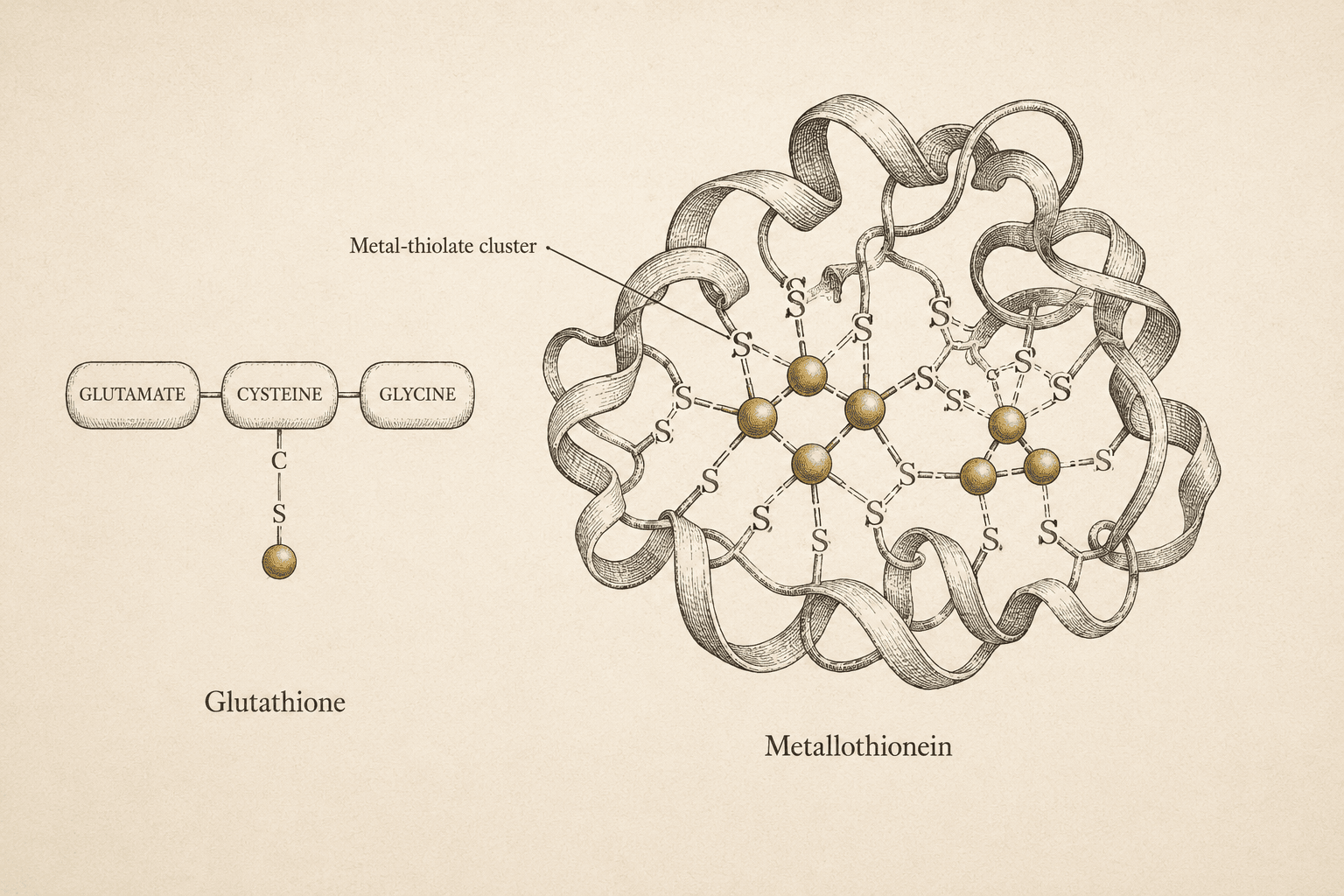
Wo der Körper begräbt, was er nicht ausstoßen kann
Der Körper ist nicht wehrlos. Mit einem Metall konfrontiert, das er nicht sofort hinauswerfen kann, tut er das Nächstbeste: Er begräbt es. Das Werkzeug ist eines der elegantesten Proteine der Physiologie, das , eine kurze Kette, die fast zu einem Drittel aus Cystein besteht, so dicht mit Thiolen, dass sie im Grunde eine Handvoll Schwefelkäfige ist. Ihre Alltagsarbeit ist das Hin- und Herbewegen der guten Metalle, Zink und Kupfer, doch wenn ein Schwermetall auftaucht, klemmt sie den Eindringling in einen jener Käfige und hält ihn fest, träge und harmlos, tief in der Leber und der Niere.footnoteKlaassen, C. D., Liu, J., and Choudhuri, S. (1999). "Metallothionein: an intracellular protein to protect against cadmium toxicity." Annual Review of Pharmacology and Toxicology 39:267-294. Die Metallothionein-Induktion ist die primäre intrazelluläre Abwehr des Körpers gegen Cadmium und ein wichtiger Puffer für Quecksilber und andere weiche Metalle.
Dies ist Quarantäne, nicht Beseitigung, und der Unterschied ist von Bedeutung. Ein in Metallothionein eingeschlossenes Metall ist ein entschärftes Metall, abgeschottet von der lebenden Schaltung, die es andernfalls verschmutzen würde. Aber es ist noch immer im Körper, und das Magazin hat eine endliche Größe.
Der entscheidende Hebel ist, dass Metallothionein durch Zink induziert wird, der Körper baut mehr davon, wenn Zink reichlich vorhanden ist, sodass der Zinkstatus die Obergrenze dafür festlegt, wie viel Metall Sie sicher halten können. Dies ist der tiefere Grund, warum Zink im Mineralien-Essay immer wieder als der Schwermetall-Verarbeiter des Körpers auftaucht.
Geraten Sie in einen Zinkmangel oder beladen Sie den Körper schneller mit Metall, als er Käfige bauen kann, so läuft die Quarantäne über, das Metall sickert aus dem Speicher zurück und auf den Draht, und die langsame Korrosion setzt wieder ein. Um Metalle gut zu beseitigen, müssen Sie sie zunächst halten können, und diese Kapazität ist aus Zink und Schwefel gebaut.
Metallothionein ist Quarantäne, nicht Heilung. Der Körper mauert das Metall in einen Käfig aus Schwefel und wartet auf einen Weg hinaus. Geben Sie ihm Zink, um die Käfige zu bauen, und Schwefel, um sie auszukleiden.
Die körpereigenen Chelatbildner: Glutathion, Selen, Schwefel
Quarantäne kauft Zeit. Beseitigung braucht ein anderes Werkzeug, ein Molekül, das das Metall greifen, wasserlöslich bleiben kann, während es es hält, und es über Galle oder Urin aus dem Körper hinaustragen kann. Das ist die , und der Körper betreibt ein Chelatsystem von echter Kraft, wenn man ihm die Teile gibt. Die Teile sind genau die drei, die die Tradition der proaktiven Medizin immer wieder nennt, und sie sind die buchstäbliche Chemie davon, wie ein Körper sich selbst reinigt.
Glutathion ist das Zentrum davon. Das Cystein-Thiol in seinem Kern bindet Quecksilber, Blei, Arsen und Cadmium direkt, und sobald ein Metall gefangen ist, wird der Glutathion-Komplex in die Galle und hinaus durch den Darm gepumpt, der Hauptweg, über den der Körper Quecksilber ausscheidet.footnoteBallatori, N., and Clarkson, T. W. (1985). "Biliary secretion of glutathione and of glutathione-metal complexes." Die Glutathion-Konjugation ist der geschwindigkeitsbestimmende Schritt der biliären Ausscheidung von Methylquecksilber und ein primärer Weg für mehrere Schwermetalle; der zelluläre Glutathionstatus bestimmt die Geschwindigkeit der Metallbeseitigung. Glutathion ist der primäre mobile Chelatbildner des Körpers, weshalb seine Erschöpfung, wie Quecksilber, Alkohol, Paracetamol und chronischer Stress sie alle bewirken, die Entgiftung an ihrer Wurzel lähmt. Seine Produktion ist durch Cystein geschwindigkeitsbegrenzt, weshalb , der Cystein-Spender, mit dem Krankenhäuser bei einer Paracetamol-Überdosis das Glutathion auffüllen, der direkteste Weg ist, es anzuheben.
Selen ist der Partner des Glutathions und ein Chelatbildner aus eigenem Recht. Es ist das arbeitende Atom der Glutathionperoxidase und der Thioredoxinreduktase, der Enzyme, die die antioxidative Abwehr aufgeladen halten, und es hat eine besondere Beziehung zum Quecksilber: Selen bindet Quecksilber noch fester als Schwefel und bildet Quecksilberselenid, eine Verbindung, die so stabil und träge ist, dass sie praktisch mineralisch ist, die Art des Körpers, ein lebendes Gift in einen toten Stein zu verwandeln.footnoteRalston, N. V. C., and Raymond, L. J. (2010). "Dietary selenium's protective effects against methylmercury toxicity." Toxicology 278(1):112-123. Die extreme Affinität des Quecksilbers zu Selen treibt die Bildung von trägem Quecksilberselenid an; dieselbe Affinität bedeutet, dass eine Quecksilberexposition Selen sequestriert und einen funktionellen Selenmangel hervorruft, was einer der Mechanismen seiner Toxizität ist. Die Beziehung läuft in beide Richtungen, und darin liegt die Warnung: Weil Quecksilber Selen so fest greift, hungert eine Quecksilberbelastung den Körper still nach dem Selen aus, das seine eigenen Enzyme brauchen, sodass eine chronische Quecksilberexposition einen verborgenen Selenmangel hervorbringt. Selen mit jeder quecksilberbeseitigenden Arbeit zu paaren, ist nicht optional.
Schwefel ist das Element unter all dem. Glutathion ist aus Schwefelaminosäuren gebaut; Metallothionein ist ein Käfig aus Schwefel; das Thiol ist ein Schwefel-Wasserstoff-Paar. Metalle zu entgiften heißt, auf der chemischen Ebene, genug Schwefel in den richtigen Formen zu haben. Der Körper bekommt ihn aus Cystein und Methionin in gutem Eiweiß, aus den Lauchgewächsen, Knoblauch und Zwiebel, deren Schwefelverbindungen Quecksilber binden, aus dem in Kreuzblütlergemüse und aus MSM. Sulforaphan ist das stärkste davon, weil es nicht bloß Schwefel liefert, es legt den Nrf2-Schalter um, den Hauptregulator, der die körpereigene Produktion von Glutathion, von Metallothionein und von den Phase-II-Entgiftungsenzymen alle auf einmal hochfährt.footnoteFahey, J. W., and Talalay, P. (1999). "Sulforaphane and the induction of phase II detoxification enzymes." Sulforaphan, konzentriert in Brokkolisprossen, gehört zu den stärksten natürlichen Induktoren des Nrf2-ARE-Weges und reguliert die Glutathionsynthese und die zytoprotektive Enzymbatterie koordiniert hoch.
Was die Chelatbildner aufbaut: die B-Vitamine und Vitamin C
Es liegt ein Taschenspielertrick darin, Glutathion den wichtigsten Chelatbildner des Körpers zu nennen. Glutathion ist etwas, das der Körper ständig herstellt, aufbraucht und wieder herstellt, und es wird schnell aufgebraucht.
Jedes Metall, das es umfasst und hinausträgt, jedes freie Radikal, das es löscht, lässt es verbraucht zurück, und eine Zelle, die eine echte Metallbelastung beseitigt, fährt ihr Glutathion schneller herunter, als irgendeine nachlässige Gewohnheit es je könnte.
Was über die Beseitigung entscheidet, ist, wie schnell Sie es wieder aufbauen können. Diese Produktionslinie wird von den B-Vitaminen betrieben, und fast niemandem, der Metalle beseitigt, wird das je gesagt.
Folgt man der Chemie, ist es klar. Glutathion wird aus drei Aminosäuren zusammengesetzt, und diejenige, die zuerst ausgeht, ist Cystein, die schwefeltragende. Der Körper wartet dafür nicht auf die Ernährung; er stellt Cystein an Ort und Stelle über den her, und keines der Enzyme dieses Weges dreht sich ohne Vitamin B6. Ihn von oben zu speisen ist der , der Motor, der die ganze Schleife in Drehung hält, und er läuft auf B12, Folat und Riboflavin (B2). Und nachdem das Glutathion seine Arbeit getan hat und verbraucht und oxidiert zurückgekommen ist, braucht das Enzym, das es wieder auflädt, abermals Riboflavin und die reduzierende Kraft des NADPH, das der Körper aus seinem Niacin-Pool (B3) bezieht, wenn er Brennstoff mit Sauerstoff verbrennt. Die B-Vitamine sind die namentlich genannten Cofaktoren bei jedem Schritt des Aufbaus und Wiederaufladens des einen Moleküls, auf dem die gesamte Beseitigung ruht. Schütten Sie so viel Schwefel und NAC hinein, wie Sie wollen, und wenn die B-Vitamine knapp sind, stockt die Linie ohnehin: Das Cystein wird nie hergestellt und das Glutathion kommt nie.footnoteLu, S. C. (2013). "Glutathione synthesis." Biochimica et Biophysica Acta 1830(5):3143-3153. Cystein, weitgehend geliefert durch den B6-abhängigen Transsulfurierungsweg, ist geschwindigkeitsbestimmend für die Glutathionsynthese; der Methylierungszyklus (B12, Folat, Riboflavin) speist Homocystein in diesen Weg, und die Glutathionreduktase (Riboflavin, NADPH) lädt den verbrauchten Pool wieder auf.
Dann Vitamin C, das die antioxidative Seite desselben Kampfes bearbeitet. Ein in einer Zelle losgelöstes Metall richtet den Großteil seines Schadens an, indem es die Zelle in einen Sturm freier Radikale stürzt und genau jene Strukturen oxidiert, die Glutathion zu schützen versucht. Vitamin C ist das wasserlösliche Antioxidans, das in jenem Sturm direkt neben dem Glutathion steht, die Radikale aufsaugt, sodass Glutathion nicht bloß damit verbrannt wird, die Stellung zu halten, und dann Glutathion und Vitamin E chemisch ihre Ladung zurückreicht, nachdem sie verbraucht sind.footnoteMeister, A. (1994). "Glutathione-ascorbic acid antioxidant system in animals." Journal of Biological Chemistry 269(13):9397-9400. Ascorbat und Glutathion regenerieren einander; die Erschöpfung des einen beschleunigt den Verlust des anderen, sodass die beiden als die zentrale antioxidative Abwehr der Zelle gemeinsam bestehen oder fallen. Und es schützt nicht nur. Ein tägliches Gramm Vitamin C senkt messbar die Bleibelastung des Körpers, sowohl indem es das Metall mobilisiert als auch indem es seinen Austritt durch die Niere beschleunigt.footnoteDawson, E. B. et al. (1999). "The effect of ascorbic acid supplementation on the blood lead levels of smokers." Journal of the American College of Nutrition 18(2):166-170. Ein Gramm Vitamin C pro Tag bewirkte einen signifikanten Abfall des Blutbleispiegels, im Einklang mit der Rolle des Ascorbats bei der renalen Bleiausscheidung.
Eine Vorsicht zur Form, denn das Regal ist größtenteils Lärm. Das Molekül, das all dies leistet, ist L-Ascorbinsäure, und das ist die ganze Sache. Der Körper kann im Labor hergestellte Ascorbinsäure nicht von der Ascorbinsäure in einer Orange unterscheiden, denn sie sind dasselbe Molekül, Atom für Atom, und sie werden gleich aufgenommen.footnoteMangels, A. R. et al. (1993). "The bioavailability to humans of ascorbic acid from oranges, orange juice and cooked broccoli is similar to that of synthetic ascorbic acid." Journal of Nutrition 123(6):1054-1061. Die relative Bioverfügbarkeit aus den Nahrungsquellen unterschied sich nicht signifikant von 100 Prozent, dem Wert für synthetische Ascorbinsäure. Das Linus Pauling Institute sagt es rundheraus: natürliche und synthetische L-Ascorbinsäure sind chemisch identisch, ohne bekannten Unterschied in biologischer Aktivität oder Bioverfügbarkeit. Kaufen Sie also das reine Pulver, 100 Prozent L-Ascorbinsäure und sonst nichts. Die Vollwert- und nahrungsbasierten Produkte hüllen ein paar Dutzend Milligramm echtes Ascorbat in eine geschützte Fruchtmischung und lassen sich die Geschichte teuer bezahlen. Keine kontrollierte Studie hat je gezeigt, dass die Verpackung in einer Nahrungsmatrix das schlichte Molekül schlägt.footnoteCarr, A. C.; Vissers, M. C. M. (2013). "Synthetic or Food-Derived Vitamin C, Are They Equally Bioavailable?" Nutrients 5(11):4284-4304. Die strenge Evidenz am Menschen findet nahrungsbürtige und synthetische Ascorbinsäure funktionell gleichwertig; keine Vollwert- oder Bioflavonoidform hat eine überlegene Bioverfügbarkeit oder Retention gezeigt. Was Sie zusätzlich bezahlen, sind Füllstoffe, und Füllstoffe sind das Letzte, was in einen Körper gehört, den Sie zu reinigen versuchen. Nehmen Sie das Gramm pro Tag als reine Ascorbinsäure und lassen Sie den Rest.
Bringen Sie die Schritte in Ordnung, denn die zelluläre Abfolge ist das, was es wert ist, mitgenommen zu werden. Ein Metall gelangt in eine Zelle, blockiert die Schwefelscharniere ihrer Enzyme und wirft Radikale ab. Metallothionein sperrt ein, was es kann. Glutathion umfasst den Rest in seiner Schwefelklaue, und der gebundene Komplex wird aus der Zelle gepumpt, der Galle übergeben und hinunter zum Darm getragen, wo ein Binder ihn auffangen muss, sonst wird er schnurstracks wieder aufgenommen.
Jeder Teil davon, das Umfassen, das Pumpen, das Wiederaufladen, schöpft aus einem Glutathionvorrat, den die B-Vitamine aufbauen und das Vitamin C schont, und aus einem Motor, der nur in einer Zelle mit der Kraft läuft, ihn zu drehen.
Ein Metall mit einem starken Medikament loszubrechen, während der Motor dahinter ausgehungert ist, ist der klassische Weg, sich zu verletzen: Sie mobilisieren mehr, als das erschöpfte System tragen kann, und das Metall verlagert sich bloß irgendwohin, wo es schlimmer ist. Sie bauen zuerst den Motor, dann bewegen Sie das Metall.
Warum nichts davon ohne Sauerstoff läuft
Hier ist der Teil, den das Nahrungsergänzungsregal weglässt: Das Chelatsystem des Körpers ist eines der energiehungrigsten Dinge, die der Körper tut, und es kann nicht auf einem leeren Tank laufen. Die Pumpen, die einen Metall-Glutathion-Komplex aus einer Zelle und in die Galle drücken, verbrennen dafür den Brennstoff der Zelle. Das Wiederaufladen des Glutathions, nachdem es seine Fracht abgeworfen hat, braucht , das ein Körper nur dann in Mengen herstellt, wenn er Brennstoff mit Sauerstoff verbrennt. Die zweiphasige Entgiftungslinie der Leber läuft auf Sauerstoff. Selbst die Lymphe, die zellulären Abfall zu den Ausgängen schleppt, bewegt sich auf Muskelbewegung und der Pumpe des Atems. Ein hypoxischer, sitzender, verstopfter Körper hat Chelatbildner, die mangels Kraft untätig herumsitzen.
Und die Metalle schließen die Falle von der anderen Seite. Quecksilber, Arsen und Cadmium vergiften alle die Mitochondrien, eben jene Generatoren, deren Leistung der Körper braucht, um sie auszustoßen.
Die Isolatoren kappen also ihre eigene Stromversorgung, was der Teufelskreis im Zentrum der chronischen Metalltoxizität ist: Je mehr Metall Sie tragen, desto weniger Energie können Sie erzeugen, und je weniger Energie Sie erzeugen können, desto weniger Metall können Sie beseitigen.
Der Hebel, der den Kreis durchbricht, ist jener, um den herum das Sauerstoff-Essay aufgebaut ist. Den Sauerstoff anzuheben, der die Gewebe erreicht, indem Sie den Körper bewegen, in die unteren Lungen atmen, das Blut und die Leber reinigen, die ihn speisen, ist die Stromversorgung, auf der das Entgiften läuft. Sie können kein Metall aus einer Zelle beseitigen, die nicht atmen kann.
Ein Chelatbildner ohne Sauerstoff hinter sich ist eine Klaue ohne Arm. Und die Metalle vergiften den Motor, der sie hinaustragen würde.
Humin- und Fulvosäure, die Chelatbildner aus dem Boden
Es gibt noch eine weitere Klasse von Chelatbildnern, älter als jedes Nahrungsergänzungsmittel, die einen eigenen Abschnitt verdient, weil die Chemie so sauber ist. Wenn uralte Pflanzenmasse über geologische Zeit abgebaut wird, in Torfmooren, in den Flözen weicher Braunkohle namens Leonardit, in dem schwarzen Harz, das als aus Himalaja-Fels sickert, ist das, was zurückbleibt, eine Familie großer, verschlungener Moleküle namens . Sie sind mit Carboxyl- und Phenolgruppen gespickt, sauerstofftragende Klauen zu Dutzenden auf jedem Molekül, die ihnen eine enorme Fähigkeit verleihen, Metallionen zu umfassen. Dies ist etablierte Bodenchemie: Umweltingenieure nutzen Huminstoffe, um Schwermetalle in verseuchtem Land und Wasser wegzuschließen, weil die Moleküle die Metalle binden und festhalten.footnoteTipping, E. (2002). Cation Binding by Humic Substances. Cambridge University Press. Die Carbonsäure- und Phenolgruppen der Humin- und Fulvosäuren verleihen ihnen eine hohe Kationenaustausch- und Metallkomplexierungskapazität, die Grundlage ihres etablierten Einsatzes bei der Sanierung metallverseuchter Böden und Gewässer; dieselbe Chemie wirkt im Darm.
Die kleinere der beiden, die Fulvosäure, ist die interessantere in einem Körper. Sie ist leicht genug, um sich bei jedem Säuregrad zu lösen, und klein genug, um Zellmembranen zu durchqueren, und sie ist amphoter, fähig, sowohl ein toxisches Metall zu umfassen als auch ein wohltuendes zu befördern, sodass sie zugleich als Binder und als Mineralträger wirkt.
Sie ist auch elektronenreich, ein echtes Antioxidans, das Elektronen abgibt, um freie Radikale zu löschen, was sie direkt mit dem Thema des Körpers als Leiter verbindet, Fulvosäure ist, unter anderem, ein Elektronendonor, der einem System, das die Metalle ausgelaugt haben, Ladung zurückgibt.
Dieselbe Klauenchemie, die Blei aus einem vergifteten Feld zieht, zieht es aus einem Darm.
Das Protokoll: den Leiter wiederherstellen
Zusammengenommen ist proaktives Metallmanagement eine stetige Disziplin aus fünf Zügen, täglich ausgeführt, die den Draht sauber halten.
1. Schließen Sie den Hahn.
Sie können eine offene Quelle nicht weg-entgiften, und dies ist die Hälfte der Arbeit, die zumeist nichts kostet.
Die Türen sind oben Metall für Metall aufgeführt. Geordnet danach, wie viel sie gewöhnlich ausmachen und wie billig sie sich schließen lassen, verläuft die Reihenfolge für die meisten Menschen so. Hören Sie auf zu rauchen und hören Sie auf, im Rauch anderer Leute zu stehen, was das Cadmium in einem einzigen Zug erledigt. Destillieren Sie das Trinkwasser, und testen Sie es zuvor bei einem privaten Brunnen oder in alten Wohnhäusern mit alten Rohren, was Arsen, Blei und den Aluminiumrückstand aus der Aufbereitung zusammen erledigt. Ändern Sie die Art, wie Sie Reis kochen, und wechseln Sie das Getreide durch. Essen Sie die Fischkette hinunter, statt ihre Spitze zu rationieren. Bringen Sie das Ferritin hoch, denn niedriges Eisen hält den Darm für Cadmium und Blei gleichermaßen offen. Nehmen Sie das Aluminium aus dem Badezimmerschrank, der Küchenschublade und dem Backpulver. Fragen Sie, was in einem Fläschchen ist, bevor es in Sie hineingeht. Und wenn Amalgam in Ihrem Mund sitzt, lassen Sie es niemals von jemandem ausbohren, der nicht hinter einem Kofferdam arbeitet, denn eine nachlässige Entfernung liefert in zwanzig Minuten mehr, als die Füllung in zwanzig Jahren geliefert hätte.
Das meiste davon lässt sich diese Woche beginnen, und nichts davon wartet darauf, dass ein Nahrungsergänzungsmittel eintrifft.
2. Bauen Sie die Quarantäne und die Chelatbildner auf.
Dies ist der Mineralien-Stack, der Doppeldienst leistet:
- Zink, um Metallothionein zu induzieren und die Stellung gegen Cadmium zu halten.
- Selen, 100 bis 200 mcg, um Quecksilber zu binden und die antioxidativen Enzyme wieder aufzuladen.
- Schwefel, aus Kreuzblütlergemüse und besonders aus Brokkolisprossen-Sulforaphan, um den Nrf2-Schalter umzulegen, aus Knoblauch und aus MSM.
- NAC plus Glycin, um das Glutathion aufgefüllt zu halten.
- Der B-Komplex (B6, B12, Folat und Riboflavin), der dieses Glutathion tatsächlich aufbaut und wieder auflädt.
- Vitamin C, ein Gramm pro Tag, um die Zelle durch die Mobilisierung zu schützen und das Blei hinaustragen zu helfen.
- Magnesium, das die Enzyme antreibt, die die ganze Linie betreiben.
3. Mobilisieren Sie sanft, und niemals ohne einen Binder.
Dies ist die Regel, die Sie vor Ihrem eigenen Eifer schützt.
Koriander und Chlorella, modifiziertes Citruspektin, Aktivkohle und die oben genannten Humin- und Fulvosäuren sind Binder der Darmphase, die Metalle auffangen, während sie die Galle herabkommen, und sie endgültig hinaustragen, statt sie zirkulieren zu lassen.
Die harte Linie, eine Wiederholung wert, weil ihr Brechen der Weg ist, auf dem Menschen sich verletzen: Nehmen Sie niemals ein Mittel, das Metall aus dem Speicher losbricht, ohne dass ein Binder bereits im Darm ist, um es zu empfangen, sonst verschieben Sie das Metall bloß aus einem ruhigen Speicher in das Blut und das Gehirn.
4. Öffnen Sie die Ausgänge. Schweiß ist ein echter und messbarer Ausscheidungsweg für Cadmium, Blei und sogar etwas Quecksilber, was der Grund für regelmäßige Sauna und harten Sport ist.footnoteGenuis, S. J., Birkholz, D., Rodushkin, I., and Beesoon, S. (2011). "Blood, urine, and sweat (BUS) study: monitoring and elimination of bioaccumulated toxic elements." Archives of Environmental Contamination and Toxicology 61(2):344-357. Mehrere toxische Elemente wurden im Schweiß in Konzentrationen ausgeschieden, die denen im Urin gleich oder höher waren, was induziertes Schwitzen als einen legitimen Ausscheidungsweg etabliert. Halten Sie die Galle in Bewegung, mit Ballaststoffen, mit den Lauchgewächsen und mit der Leber- und Gallenblasenspülung, die eben jenen Kanal reinigt, durch den Metalle den Körper verlassen. Trinken Sie ausreichend, um die Niere spülend zu halten. Das Metall ist erst dann fort, wenn es draußen ist.
5. Treiben Sie es mit Sauerstoff an.
Alles oben läuft auf Energie. Bewegen Sie sich, atmen Sie tief, und reinigen Sie das Blut und die Leber, sodass die Gewebe gut versorgt sind, denn ein gut mit Sauerstoff versorgter Körper ist einer, dessen Chelatbildner voll angetrieben sind und dessen Mitochondrien die Arbeit finanzieren können.
Für eine schwere, gemessene Belastung, Blut-, Haar- und provozierte Urintests, die auf eine echte Last hindeuten, ist dies der Ort, an den die pharmazeutischen Chelatbildner gehören, DMSA, DMPS, EDTA, stärkere Versionen derselben Klauenchemie, die der Körper für sich selbst herstellt.
Sie wirken, und sie sind Werkzeuge der Ärztin oder des Arztes, nichts, was man sich nach Gefühl selbst dosiert, denn eine aggressive Chelatbildung, die ohne die Mineralien, die Binder und das Timing durchgeführt wird, streift die guten Metalle zusammen mit den schlechten ab und kann die toxischen in Richtung Gehirn treiben.
Testen Sie zuerst, dosieren Sie unter Aufsicht, ersetzen Sie die Mineralien, die Sie bewegen.
Der saubere Leiter
Die Alchemisten wollten am Ende den Körper in ein Edelmetall verwandeln: unverweslich und ein reibungsloser Leiter des Lichts. An jener Ambition gemessen, sind die Schwermetalle die buchstäbliche Korruption, die niedere Materie, die den Stromkreis rostet und die Lampe dimmt, und ein für sauberen Fluss gebautes System mit isolierenden Defekten spickt, die den Strom verlangsamen und das Licht streuen. Fast jeder chronische Verfall ist zu viel von dem, was die Zelle vergiftet, und zu wenig von dem, was sie braucht, und die Metalle sind der sauberste Fall der ersten Hälfte, den es gibt, ein kleiner, identifizierbarer Satz von Giften, die eine einzige, mechanische, behebbare Art von Schaden anrichten.
Was bedeutet, dass auch die Arbeit behebbar ist, und gewöhnlich.
Schließen Sie den Hahn. Bauen Sie die Käfige aus Zink und Schwefel. Betreiben Sie die Chelatbildner, die der Körper bereits herzustellen weiß, Glutathion, Selen, die Schwefelnahrungsmittel, die den Hauptschalter umlegen, und die Huminklauen aus dem Boden. Öffnen Sie die Ausgänge, und halten Sie den Sauerstoff hoch genug, um all das zu bezahlen.
Tun Sie das mit Geduld, und die Last kommt herunter, die Defekte heben sich Stelle für Stelle vom Draht, und der Körper leitet wieder, der Strom kehrt zurück und das Licht kommt wieder hoch, denn sie waren nie das, was kaputt war. Das Metall, das ihnen im Weg stand, war es, und Metall lässt sich bewegen.
Doch ein Metall vom Draht zu lösen ist nur die erste Hälfte des Zuges.
Alles, was Sie lösen, muss noch aus dem Gewebe hinauswandern, in dem es saß, und das Netz, das es trägt, ist das eine System im Körper ohne eigene zentrale Pumpe. Es wartet auf Ihre Bewegung, Ihren Atem und Ihre Wärme, und es wird die ganze Last still wieder in Umlauf bringen, wenn Sie ihm diese nicht geben.
Als Nächstes, die fehlende Pumpe, und das zweite, was die Ausleitung richtig hinbekommen muss.
Sources
- Thimerosal Induces Neuronal Cell Apoptosis by Causing Cytochrome c and Apoptosis-Inducing Factor Release from Mitochondria, . https://pubmed.ncbi.nlm.nih.gov/16273274/
- Thimerosal Induces DNA Breaks, Caspase-3 Activation, Membrane Damage, and Cell Death in Cultured Human Neurons and Fibroblasts, . https://doi.org/10.1093/toxsci/kfg126
- Effects of Thimerosal on NGF Signal Transduction and Cell Death in Neuroblastoma Cells, . https://pubmed.ncbi.nlm.nih.gov/15843506/
- Thimerosal-Derived Ethylmercury Is a Mitochondrial Toxin in Human Astrocytes, . https://doi.org/10.1155/2012/373678
- HgEDTA Complex Inhibits GTP Interactions with the E-Site of Brain Beta-Tubulin, . https://doi.org/10.1006/taap.1993.1196
- Aluminium in Brain Tissue in Autism, . https://pubmed.ncbi.nlm.nih.gov/29413113/
- Slow CCL2-Dependent Translocation of Biopersistent Particles from Muscle to Brain, . https://doi.org/10.1186/1741-7015-11-99
- Aluminum Hydroxide Injections Lead to Motor Deficits and Motor Neuron Degeneration, . https://pmc.ncbi.nlm.nih.gov/articles/PMC2819810/
- Mercury Exposure and Risks from Dental Amalgam in the US Population, Post-2000, . https://doi.org/10.1016/j.scitotenv.2011.06.035
- Cooking Rice in a High Water to Rice Ratio Reduces Inorganic Arsenic Content, . https://doi.org/10.1039/B816906C
- Cadmium Exposure in Pregnancy and Lactation in Relation to Iron Status, . https://doi.org/10.2105/AJPH.92.2.284
- Mobilization of Lead from Human Bone Tissue during Pregnancy and Lactation, . https://doi.org/10.1016/S0048-9697(02)00355-8
- Metallothionein: An Intracellular Protein to Protect against Cadmium Toxicity, . https://doi.org/10.1146/annurev.pharmtox.39.1.267
- Dietary Selenium's Protective Effects against Methylmercury Toxicity, . https://doi.org/10.1016/j.tox.2010.06.004
- Transport of the Glutathione-Methylmercury Complex across Liver Canalicular Membranes on Reduced Glutathione Carriers, . https://doi.org/10.1016/S0021-9258(17)36946-6
- Antioxidant Functions of Sulforaphane, . https://doi.org/10.1016/S0278-6915(99)00082-4
- Blood, Urine, and Sweat (BUS) Study, . https://pubmed.ncbi.nlm.nih.gov/21057782/
- Cation Binding by Humic Substances, . https://openlibrary.org/works/OL8325495W
- Essentials of Natural Chelation Therapy at Home, . https://drsircus.com/detox/essentials-of-natural-chelation-therapy-at-home/
- All About Ascorbic Acid, . https://www.youtube.com/watch?v=0kIGfZMrIZs
Als Nächstes in der Reihe
Der unzerstörbare Körper · Die ReinigungDie fehlende PumpeBlut hat ein Herz. Lymphe hat Bewegung. Wie Muskeln, Atem, tägliche Bewegung und Sauna die Abflüsse des Körpers offen halten, wenn eine Reinigung beginnt, die Last in Bewegung zu bringen.
- Veröffentlicht
- Lesezeit
- 35 Min.
- Quellen
- 20