
Kriya Yoga
The guarded technique every chapter before this one was preparing you for. What the spinal breath actually does, the arithmetic that compresses evolution, the storm that breaks the unprepared, and the conduct that makes the power safe to hold.
If you have read this far, you have arrived at the most powerful thing this book contains, and you have earned it in a way you may not have noticed.
Look back down the ascent. The minerals restored a nervous system that runs on them. The clearing chapters took the metals out of the wiring and the silt out of the filters. The pineal chapter uncovered the upper terminal, the sun chapter charged the whole instrument and grounded it, and the last three chapters taught you to conserve the strongest current the body makes, to seal it, and to read the ladder it is meant to climb.
None of that was assembled for its own sake. Every rung was quietly building the one thing the old lineages demanded a student bring before they would teach him the technique this chapter names: a clean, mineralised, conductive, continent body with its gates mapped. The ashram asked years for that preparation. You have just done it, chapter by chapter, without being told what it was for.
It was for this. The technique is called Kriya Yoga, and the previous chapter left you standing exactly in front of it: one current, seven gates, and the whole question of a human life reduced to whether the current can be made to climb. Kriya Yoga is the making. It is the oldest answer there is to the only question that survived the last chapter, and for most of recorded history you could not have read it in any book at any price.
Everything before this page was the entrance examination. This is the room the door was built for.
Not the yoga you have seen
Say yoga and the modern mind produces a room of mats, stretching toward calm. That room is to the actual science what a childhood piano scale is to composition. The postures the studios teach were, in their source tradition, the preparation that made the body able to sit still. They were the doorway. Kriya Yoga is the room behind it.
The word gives the whole design away. means action, a specific, completed, repeatable act, and Kriya Yoga is union with the highest by exact technique rather than by sentiment. It does not ask you to believe anything. It gives you a procedure, the way a laboratory gives you a procedure, and it tells you the result will arrive because the mechanism is real, in whoever runs the procedure, at a rate that depends only on the dose and the condition of the instrument.
That claim, transformation as a lawful output of a repeated physical act, is what separates it from everything taught under the same name in the studios, and it is why the lineages that carried it never treated it as exercise. They treated it the way an armoury treats what it stores. A stretch can be handed to anyone. A technique that moves the deepest current in the body toward the brain was handed, for a thousand years, only to the student whose vessel and conduct had been inspected first, and the inspection took years.
I did not learn this from a book, and I do not teach it from one. The complete working library, every set and every posture of the distilled practice, is published openly in the Kriya Yoga library, and it is my own: the practices I have done, daily, across years, distilled to what actually moves the current. This chapter is the door to that library, and the reason the door has a threshold you should respect.
The lineage that would not write it down
The technique is old enough that its first public trace is scripture. The Bhagavad Gita carries it in one compressed verse, the offering of the inhaling breath into the exhaling breath and the exhaling into the inhaling, the breath-current neutralised and drawn under the will of the practitioner.footnoteBhagavad Gita IV.29, read within the Kriya lineage as the technique itself in compressed form: the two breath currents offered into one another until both are stilled and the life force is freed from the breath's tidal drag. Krishna names it pranayama's summit rather than a devotional metaphor. Patanjali, when he compiled the Yoga Sutras, opened his second book with the same name: kriya yoga, the yoga of action, built from discipline, self-study, and surrender to the highest.footnoteYoga Sutras II.1: tapah svadhyaya ishvarapranidhanani kriya-yogah. Discipline, self-study, and surrender to the Lord constitute the yoga of action. The eight limbs follow in the same book, in an order this chapter will insist on, because the order is the safety mechanism.
Then, for centuries, the public record goes quiet, and the technique lives the way the most potent knowledge has always lived: hand to hand. The lineage account is exact about its own revival. In 1861, in the Himalayan foothills above Ranikhet, the deathless master the tradition calls initiated a railway accountant named Lahiri Mahasaya and told him to do something the guarded lineages had never done: give the technique to householders, to people with jobs and families, not only to monks. From Lahiri it passed to Sri Yukteswar, and from Sri Yukteswar to Paramahansa Yogananda, who carried it to the West in 1920 and spent thirty years teaching it there.footnoteThe transmission line and its dates are set out in Yogananda's Autobiography of a Yogi (1946), chapters 26 and 30 to 36: Babaji to Lahiri Mahasaya at Ranikhet in 1861, to Sri Yukteswar of Serampore, to Yogananda, who sailed for Boston in 1920 to address the International Congress of Religious Liberals and remained to teach.
Even then, opened to householders, it stayed gated. Initiation, preparation, a teacher watching the student's conduct before the technique was given. The gate was never possessiveness. The gate was dosage, and the second half of this chapter is about what happens to people who go over it, because the lamp analogy the lineage used is not poetry. It is a ratings plate.
What the technique actually is
Strip the reverence away and look at the machine, because the machine is describable in one paragraph.
The practitioner sits with the spine erect and breathes in a slow, controlled way, and with each breath deliberately drives the life current in a revolution around the spinal axis: up the spine through its centres on one phase, back down on the other. One revolution is one kriya. That is the entire visible practice. A person watching sees someone sitting still, breathing slowly. Inside, the practitioner is doing to the spine what a winding does to an iron core: passing current around it, in patient, identical revolutions, until the core itself is changed.
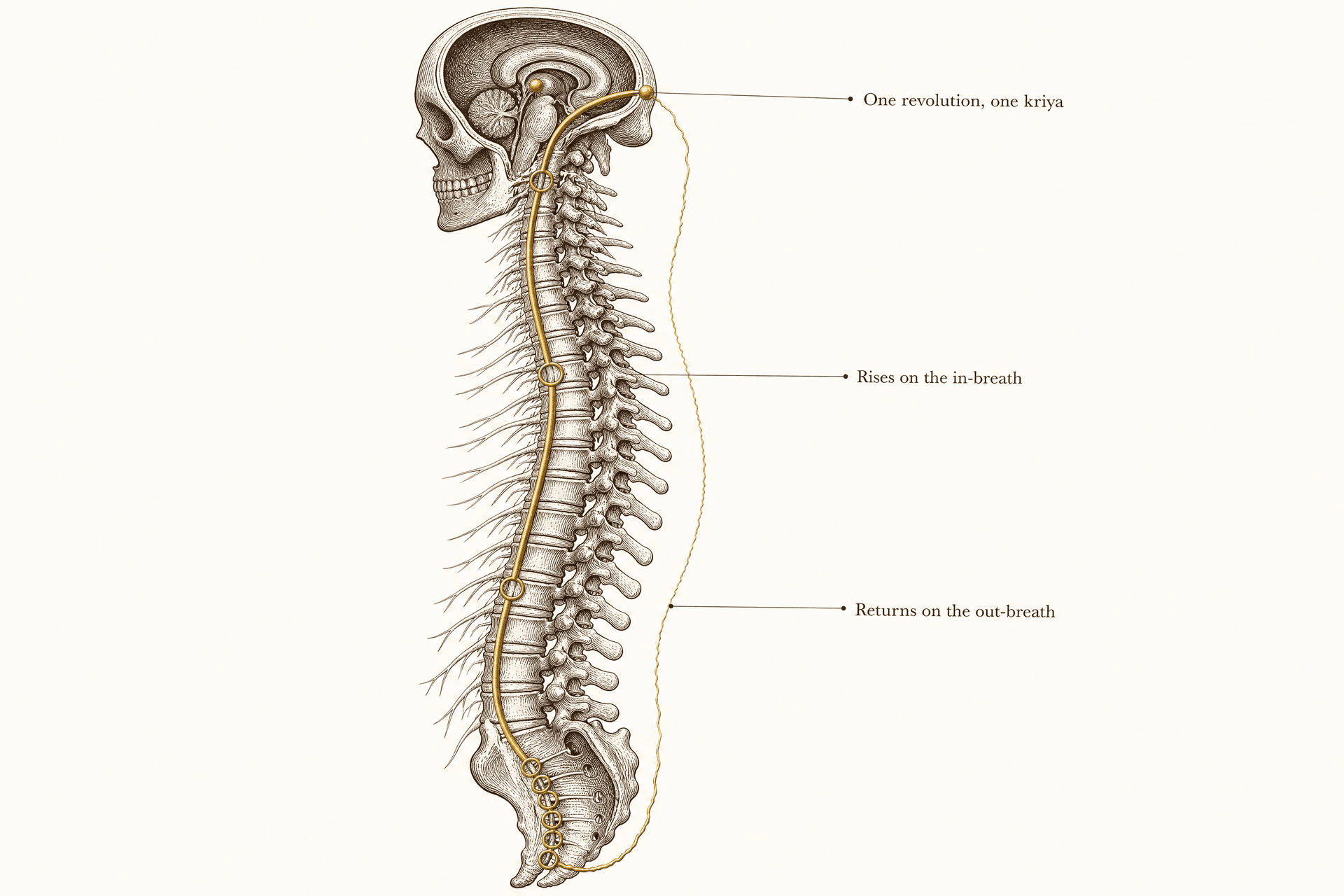
The tradition describes the effect in the language it had. Yogananda's description is startlingly physiological: the kriya decarbonises the blood and recharges it with oxygen, and the surplus is transmuted into life current that rejuvenates the brain and the spinal centres, quieting the decay the ordinary metabolism runs at.footnoteAutobiography of a Yogi, chapter 26: "Kriya Yoga is a simple, psychophysiological method by which the human blood is decarbonized and recharged with oxygen. The atoms of this extra oxygen are transmuted into life current to rejuvenate the brain and spinal centers." Written in 1946, the claim reads today as an account of profound slow-breath gas exchange and autonomic shift, described a half-century before the instrumentation existed to measure it. The modern laboratory, without ever intending to test Kriya, has confirmed the band it works in. When practitioners recite the rosary or a yogic mantra, the recitation locks the breath near six cycles a minute, and at that exact cadence the baroreflex sharpens, the blood pressure and heart rhythms synchronise into slow coherent waves, and the whole cardiovascular system settles into a resonance it reaches at no ordinary breathing rate.footnoteBernardi, L. et al. (2001). BMJ 323:1446-1449. "Effect of rosary prayer and yoga mantras on autonomic cardiovascular rhythms." Both the Ave Maria cycle and the mantra slowed breathing to almost exactly six per minute and enhanced baroreflex sensitivity and cardiorespiratory synchrony. The paced, slow, willed breath of contemplative technique tunes the autonomic system toward coherence. https://pubmed.ncbi.nlm.nih.gov/11751348/ Slow willed breathing is the strongest handle the conscious mind has on the autonomic nervous system, the one lever wired to both. Kriya is that lever, applied to the spine deliberately, thousands of times, with the current aimed.
And the aim matters, because of where it points the energy. The last chapter established the geography: the faculties of the human being are stacked up the spine and into the brain, and a life's centre of gravity sits wherever its energy pools. Kriya does not argue with the four hungers, does not moralise at the lower gates, does not fight a single appetite. It picks the current up and carries it past them, revolution by revolution, the only strategy the previous chapter left standing.
You cannot preach a river uphill. You can pump it. Kriya is the pump.
The arithmetic of evolution
Here is the claim that separates Kriya from every gentle practice sharing its name, the claim the lineage stakes its entire authority on. Nature, left alone, evolves a human consciousness slowly, on the scale of incarnate lifetimes, through experience metabolised at the ordinary rate. The technique compresses that timetable. One half-minute of kriya, the tradition states, equals one year of natural spiritual unfoldment.footnoteAutobiography of a Yogi, chapter 26: "One half-minute of Kriya equals one year of natural spiritual unfoldment," and the full arithmetic: "One thousand Kriya practiced in eight and one-half hours gives the yogi, in one day, the equivalent of one thousand years of natural evolution: 365,000 years of evolution in one year." The beginner's dose is given in the same chapter as fourteen to twenty-four kriyas, twice daily.
Run the numbers the tradition itself publishes. An hour of the practice is more than a century of ordinary becoming. The advanced yogi's day of a thousand kriyas is a millennium. And the beginner's dose, the modest fourteen to twenty-four revolutions twice a day that the lineage actually prescribes, compounds in the first month alone to roughly a thousand kriyas: by the tradition's own count, a thousand years of evolution in your first thirty days.
I state the arithmetic as the lineage states it, and then I state what I have watched. A month of honest daily practice changes a person in ways the people around them cannot file under any ordinary explanation. The face changes first, the tension architecture of it, then the voice, then the tempo of speech, because the mind behind them is running fewer processes at war with each other. Sleep deepens and shortens. The reactive machinery that used to fire before thought stops firing. Reading becomes comprehension at a depth that was not available before, and the mental faculty you bring to a problem in week five is not the faculty that met problems in week one. People who have not seen you across that month will search your face for what changed and not find a name for it. This is not a promise of comfort. Rapid evolution never is. It is growth at a rate the personality has to reorganise around, which is exactly why the rest of this chapter exists.
What the body is actually capable of
The tradition's map of the body's far capabilities sounds, on first meeting, like mythology. Then you meet the parts the laboratory has already had to concede.
Start with the breath, because Kriya works the breath toward a destination the studios never mention: its cessation. The hatha texts name it , the breathless state, breath suspended not by force but because the system has gone so still it no longer needs the tide, and they treat it as the hinge of every higher state: master it, says the Pradipika, and nothing in the three worlds is beyond reach.footnoteHatha Yoga Pradipika II.71-75, on kevala kumbhaka as retention independent of inhalation and exhalation, arising of itself in mature practice, and the text's judgment that with it accomplished there is "nothing in the three worlds that is unattainable." The mechanism claim underneath is exact: mind and breath move as one system, and the practice stills the mind by stilling its physical carrier. This is the state Kriya's slow revolutions are patiently approaching from below: a metabolism so quieted, a current so internalised, that the bellows can stop while the light stays on.
The autonomic claims went to the laboratory decades ago. When Wenger, Bagchi and Anand carried an ECG across India in the 1950s to test yogis who claimed voluntary command of the heart, the instruments returned a double verdict. The dramatic version of the claim dissolved: the men who "stopped" the heart were performing a powerful internal manoeuvre that silenced the heart's sounds and pulse while the trace ran on. What remained was, to the physiologists, nearly as arresting: practitioners demonstrating deliberate, measurable command over heart rate, circulation and the body's involuntary machinery, control the Western textbook of the day said no human being should have.footnoteWenger, M. A., Bagchi, B. K., Anand, B. K. (1961). Circulation 24:1319-1325. "Experiments in India on 'voluntary' control of the heart and pulse." The apparent full arrests were Valsalva-type manoeuvres, sounds and pulse gone while the ECG continued; alongside them the team recorded genuine voluntary autonomic control, including deliberate large swings in heart rate. The honest reading cuts both ways: the stage version failed, and the underlying capability was real and measured. https://pubmed.ncbi.nlm.nih.gov/14006121/ Sixty years later, biofeedback, tummo, and a literature of trained autonomic control have made the once-heretical direction of that finding ordinary science: the involuntary nervous system takes training. The yogis were simply centuries early, and further in.
At the far edge stand the claims the tradition refuses to soften: the master whose body does not age on the ordinary clock, Babaji holding one physical form across centuries in the lineage account. I give you that claim as the lineage gives it, a report from a tradition that has been exact about everything the laboratory later confirmed, concerning a region the laboratory has not yet reached.
And then there is the case that sits in a notarised American document rather than in scripture. When Yogananda died in Los Angeles in 1952, his body lay under observation at Forest Lawn for twenty days before the interment. The mortuary director, a man whose profession is decay, put his amazement on paper: no visible disintegration, a state of apparently perfect preservation with no indication of mould or drying, a case with nothing in the mortuary's experience to compare it to.footnoteNotarised testimony of Harry T. Rowe, Los Angeles Mortuary Director, Forest Lawn Memorial-Park, published in the Self-Realization Fellowship memorial booklet Paramahansa Yogananda: In Memoriam and reported in Time, August 4, 1952: "The absence of any visual signs of decay in the dead body of Paramhansa Yogananda offers the most extraordinary case in our experience... No physical disintegration was visible in his body even twenty days after death."
Hold that beside the title on the cover of this book. The alchemists named gold noble because nothing could corrupt it, and the whole argument of these chapters has been that the incorruptible metal was always a portrait of a possible human being. The man who spent thirty years teaching the West this exact technique left, at the end, the most literal demonstration on record: an instrument so refined that corruption could not begin its work on schedule. The gold of the philosophers is two chapters ahead. Understand, before you get there, that the flesh has already been to the summit.
The tradition was exact about everything the instruments later confirmed. Weigh what it says about the regions the instruments have not reached.
The storm the lineage warned about
Now the other half, and read it with the same seriousness you gave the promise, because it is the same mechanism wearing its other face.
The lineage that claimed a thousand years in a month also wrote the warning label. The body of the average man, Yogananda said, is like a fifty-watt lamp, and cannot accommodate the billion watts roused by an excessive practice.footnoteAutobiography of a Yogi, chapter 26: "The body of the average man is like a fifty-watt lamp, which cannot accommodate the billion watts of power roused by an excessive practice of Kriya." The sentence sits in the same chapter as the evolution arithmetic. The tradition published the hazard and the promise together, and gated the technique behind preparation because it meant both. That is not a mystic being colourful. That is an engineer stating a rating, and the whole apparatus of initiation, preparation and guarded transmission existed because the lineage had watched what happens when the rating is exceeded.
The modern record has watched it too, and given it names. The clearest case study in the literature is Gopi Krishna, a Kashmiri office worker who meditated on the crown of his head, alone, unguided, every morning for seventeen years, until one December morning in 1937 the current woke: "with a roar like that of a waterfall," he wrote, "I felt a stream of liquid light entering my brain through the spinal cord."footnoteKrishna, G. (1967). Kundalini: The Evolutionary Energy in Man. The awakening chapter records the waterfall sentence; the following years of the memoir record the cost: unbearable internal heat and burning, inability to eat or sleep, terror, and a mind he describes as hanging over an abyss, stabilising only across months and years. It remains the most detailed first-person account of an unprepared awakening in print, written by a man who continued to regard the force itself as the engine of human evolution. What followed was not bliss. It was years of burning heat along the nerves, food refused, sleep destroyed, a mind flayed open, a man hanging on to sanity by fingertips while a current his body was never prepared for ran at full amperage through wiring rated for the ordinary load. He survived it, stabilised, and spent the rest of his life telling both truths at once: that this force is the engine of human evolution, and that it had nearly killed him.
Clinical medicine, dragged to the subject by cases it could not file, has built a small honest literature around exactly this. The psychiatrist Lee Sannella catalogued the pattern and named it the : heat rising the spine, involuntary jerks and spontaneously assumed postures, inner light and sound, vibration, sleep in ruins, emotional weather of oceanic amplitude. Bruce Greyson measured the cluster with an index and found it running through meditators as a coherent syndrome of its own, distinct from the psychiatric categories it superficially resembles.footnoteSannella, L. (1987). The Kundalini Experience: Psychosis or Transcendence? and Greyson, B. (1993), "The physio-kundalini syndrome and mental illness," Journal of Transpersonal Psychology 25(1):43-58. Greyson's physio-kundalini index identified the symptom cluster as coherent and distinguishable from psychotic illness, the distinction turning on preserved insight: the person in the process knows something is happening to them, where psychosis has lost the observer. Stanislav and Christina Grof named the crisis form a spiritual emergency, and the argument Lukoff, Lu and Turner carried into psychiatry's own manual put a category into the DSM, Religious or Spiritual Problem, whose practical meaning is this: the profession that owns the word psychosis formally concedes that an awakening in crisis is not schizophrenia, and must not be reflexively medicated as if it were.footnoteGrof, S., Grof, C. (1989). Spiritual Emergency: When Personal Transformation Becomes a Crisis. Lukoff, D., Lu, F., Turner, R. (1992), "Toward a more culturally sensitive DSM-IV: psychoreligious and psychospiritual problems," Journal of Nervous and Mental Disease 180(11):673-682, the paper behind the DSM category V62.89, Religious or Spiritual Problem, carried forward in DSM-5. https://pubmed.ncbi.nlm.nih.gov/1431819/
This is what the phrase kundalini psychosis points at: the storm form, the current risen hot and fast through a system that never built the capacity to carry it. The unprepared cases share a signature. The force arrives into a body still loaded with the metals and the silt the clearing chapters exist to remove, a nervous system already inflamed, a mind with no stillness training, an ego that inflates around the voltage like a bearing seizing around heat. Sleep goes first, then the sense of scale: the crown's counterfeit from the last chapter arrives on schedule, and the person who was granted a glimpse concludes he has been granted a throne. Add a forced entry, the intensive retreat that runs techniques for ten hours a day, the psychedelic that kicks the door where a lineage would have turned a key, a heavy trauma load never metabolised, and you have assembled every documented ingredient of the crisis literature.
And every one of those ingredients reverses. The storm is a ratio: current over capacity. You are holding a book that is, cover to cover, a manual for building the capacity. Dose the current like a beginner, build the conductor like an engineer, and the same force that breaks the unprepared arrives in you as what it actually is, evolution on a compressed clock, strong coffee for a system built to drink it.
Kundalini psychosis is not a mystery and not a curse. It is current over capacity, a ratio, and you control both terms.
Chastity, conduct, and the moral foundation
Here is the part the modern seeker most wants to skip, and it is the exact part the lineages refused to let anyone skip, and they were right, for reasons that are mechanical before they are moral.
Patanjali's eight limbs are a numbered sequence, and the sequence is the safety system. Before asana, before a single breath technique, stand , the restraints and observances: non-harm, truthfulness, non-stealing, continence, non-grasping; purity, contentment, discipline, self-study, surrender.footnoteYoga Sutras II.29-45. The limbs are given in order: yama, niyama, asana, pranayama, pratyahara, dharana, dhyana, samadhi. The commentarial tradition is unanimous that the order is a curriculum, not a list. Conduct precedes energy work as insulation precedes current. Ten items of conduct, installed before the first watt is raised. The modern reader files them as ethics, a moralising preamble to the real techniques. The lineage meant them as electrical code.
Run the mechanism, because by now you own every piece of it. The last chapter showed that fear, deceit, appetite and domination are the current discharging through the lower gates. A person who lies is running a permanent leak at the throat; a person who exploits is discharging at the third gate; a person in the grip of appetite is spilling at the second. Now raise the total current tenfold through that person. Nothing about the leaks improves. Every one of them amplifies, because the technique does not manufacture character, it multiplies amplitude. Kriya makes you more of what you already are, at a rate the personality cannot outrun. Raised through a clean life, the current arrives as clarity, warmth, and force held in reserve. Raised through a dirty one, it arrives as inflation, compulsion, and the storm. That is the entire engineering content of the phrase the culture remembers as a comic-book line: with great power comes great responsibility. The lineages ran the inspection first because the current does not forgive retroactively.
And at the centre of the ten restraints sits the one this book has already armed you for: continence. The transmutation chapter established what the seed costs and what it becomes when conserved; the great lock taught the seals that hold it. Understand now why sits inside the safety code and not merely the power code. The current Kriya lifts is drawn on the same reservoir the reproductive system spends, and a practitioner who raises the voltage while draining the reservoir is running a pump on a dry well: the system cavitates, and the cavitation is the jitter, the heat, the instability the crisis literature catalogues. Chastity, in this engineering, is not a renunciation. It is keeping the fuel in the machine you are about to run at altitude. The old benchmark was blunt: the texts asked years of established continence before the serious current work began, and every documented storm I have read runs through a system that skipped it.
So the moral foundation, stated as the machine sees it. Stop lying, because a lie is a leak at the gate the current must pass. Stop taking what is not yours, because acquisition is the root gate running in fear. Guard the seed, because it is the current. Clean the vessel, feed it as Part One taught, light it as Part Three taught. Study yourself daily, because self-study is the instrument check. And surrender the summit before you climb, because the climber who ascends to enthrone himself is carrying the exact charge, pride, that detonates at altitude; the last chapter showed you that crown-counterfeit in the general population, and in a charged practitioner it is the single most dangerous object in the building. The tradition's word for protection was never caution. It was purity, and purity, read mechanically, means zero leaks under full load.
The technique multiplies amplitude, never character. Whatever you are when you raise the current is what the current will make more of.
The practice, in order
What remains is the work itself, and the order of it, because the order is where the safety and the speed both live.
The complete distilled library is open at samsinger.tech/kriya-yoga: every set laid out posture by posture, breath by breath, organised by what it works on. It was assembled the only way this book accepts, from practice and not from reading, and it is published against the tradition of secrecy for a reason I have weighed for years: the hour is late, the shared consciousness of this species is low exactly when its instruments have grown enormous, and a technology of evolution withheld in such an hour serves nobody but the dark it leaves in place. What the lineage protected with locked doors, I protect the only way an open publication can: by binding the power to its preparation, which is this book, and to its conduct, which is the section above.
Enter the library in this order.
Begin at the ground. Foundation for Infinity is the entry set for a reason: it opens and roots the pelvis, the seat the whole spinal column stands on, before its closing meditation lifts the attention to the crown. Root before sky, every time. Run it daily for your first two weeks, alongside the morning light-and-ground practice from the sun chapter, and let the body learn what a worked pelvis and an erect spine feel like.
Then wake the column. The Basic Spinal Energy Series is the workhorse of the whole library, the set that flexes, rotates and charges the spine segment by segment until the channel the current climbs is supple and awake. This is the set I would keep if I could keep only one, and it earns a permanent place in the week no matter how far you go.
Then seal and drive. Sat Kriya, the library's concentrated engine, joins the root lock you learned in the great lock chapter to sound and rhythm and drives the charge straight up the column; work it patiently, at the modest durations the set prescribes, and treat the great lock's seals as its grammar. Pair it with sex energy transformation if the second gate is where your current leaks, which, in this civilisation, is the default answer.
Then, and only then, raise. Raise Kundalini in Quick Order is the short road the title says it is, the sequence that wakes the base and walks the current up the column lock by lock, and it is the set the whole preparation was for. By the time you open it, it should feel not like a dare but like the next obvious step, because the pelvis is rooted, the spine is awake, the locks are grammatical, and the reservoir is full.
Hold the container while you climb. One set at a time, learned until it is smooth before the next is added. The beginner's dose, not the hero's: the lineage's own numbers, modest revolutions twice a day, are the numbers that produce the month I described, and doubling them does not double the result, it spends the margin the safety lives in. Practice on the morning emptiness, on bare ground when you can, with the palms and the light and the timing the sun chapter gave you. Keep eating the mineral floor of Part One; keep the clearing current of Part Two; keep the sleep. And watch the gauges: heat that stays after practice, sleep that shortens night after night, tremor, dread, the sense of the self swelling. Any of these is the instrument reporting current over capacity, and the response is the one every lineage taught: stop the technique, ground hard, feet on earth, heavier food, long walks, warm water, human company, and let the system consolidate. The storm passes when the input stops. The practitioners who came apart are, almost to a case, the ones who read the gauges as progress and pressed harder.
A last word on the teacher question, because the objection is fair: this was always taught face to face, and a book is not a master. True. I have practiced these sets for years, daily, through every state they produce, and the library is that practice written down, with the doses honest and the order load-bearing; this chapter is the initiation the open format allows, the preparation bound to the power. But the deepest answer is the one the great lock chapter already gave you: the final teacher is the work itself, and the final safeguard is the life around the practice. Build the life this book describes, run the technique inside it at the published dose, and you are held by the same structure the ashram walls were only ever there to enforce.
The ashram was never the secret. The ashram was the dose, the conduct, and the container, and you can build all three where you stand.
And the moment the current is climbing, a last question opens, the one the whole ascent has been narrowing toward. A force that evolution installed, a technique that compresses evolution, a body that at the far end of the work resists corruption itself: what is the substance all of this is refining, and what did the old sciences mean when they said the work ends in gold? They hid their answer inside a furnace and a metal that will not corrupt. It is the next thing to take apart.
Sources
- Autobiography of a Yogi (1946 First Edition), . https://www.ananda.org/support/files/2017/11/AYEbookDownload.pdf
- Practice of Brahmacharya, . https://www.dlshq.org/download2/brahmacharya.pdf
- The Yoga Sutras of Patañjali, . https://openlibrary.org/works/OL13654174W
- Hatha Yoga Pradipika, . https://openlibrary.org/works/OL9090509W
- The Bhagavad Gita, . https://openlibrary.org/works/OL518380W
- Kundalini: The Evolutionary Energy in Man, . https://openlibrary.org/works/OL44659W
- The Kundalini Experience, . https://openlibrary.org/works/OL4993820W
- Spiritual Emergency, . https://openlibrary.org/works/OL15164104W
- Toward a More Culturally Sensitive DSM-IV, . https://pubmed.ncbi.nlm.nih.gov/1431819/
- The Physio-Kundalini Syndrome and Mental Illness, . https://med.virginia.edu/perceptual-studies/wp-content/uploads/sites/360/2016/12/OTH16-Greyson.pdf
- Effect of Rosary Prayer and Yoga Mantras on Autonomic Cardiovascular Rhythms, . https://pubmed.ncbi.nlm.nih.gov/11751348/
- Experiments in India on Voluntary Control of the Heart and Pulse, . https://pubmed.ncbi.nlm.nih.gov/14006121/
- Paramahansa Yogananda: In Memoriam, . https://bookstore.yogananda-srf.org/product/paramahansa-yogananda-in-memoriam/
Next in the series
The Incorruptible Body · The GoldThe Gold of the PhilosophersThe noble metals were named for incorruptibility, not price. What the alchemists were really trying to transmute was the human being.
- Published
- Reading
- 20 min
- Sources
- 13