
The Supplement Buyer's Manual, Why Less Is More and How to Choose What Works
Most supplement tablets are 80 percent filler and a poorly absorbed remainder. The fillers to refuse on sight, why ionic and liquid beat tablet, and the minimum effective daily stack.
Open the multivitamin in your cabinet and weigh what you are actually paying for. Fifty milligrams of active sits inside four hundred milligrams of wood pulp, and the white coating that makes it look pharmaceutical is a nanoparticle banned across the European Union since August 2022. You bought a pressed disc of industrial filler carrying a trace of nutrition, in a chemical form your gut absorbs at four percent. The supplement industry is a $180 billion freight train running on one assumption, that more is better, and the consumer runs on a second, that a green leaf on the bottle means it is good for the body. Neither premise holds.
The discipline that does work is small. Choose few. Choose ionic or chelated. Choose natural over synthetic. Refuse the fillers. Most people violate every one.
A supplement the body cannot absorb is a supplement being excreted, after the body has paid the metabolic cost of trying to process the filler matrix it arrived in.
Restoring the eight essential minerals is one problem. Buying them is a second one, and the industry is built so that you lose it.
This is the buyer's manual: which forms cross the gut wall, which bottles are mostly wood pulp, and what earns a place in a cabinet that works.
The principle of fewer
The first rule of supplement discipline is that the stack should be small. The second rule is that it should be smaller than that.
Most people walk into a Whole Foods aisle and come out with fifteen bottles, each compelling at the shelf. The body cannot integrate fifteen things at once. The absorption of any one drops as it competes for the same transporter sites with the other fourteen. The cost is high, the compliance collapses inside a month.
The shape that works is the inverse: eight or nine core items running daily, dosed to the levels the literature supports.
The tenth and the eleventh are rarely additive. Usually one displaces a core item and total benefit drops.
This is the model pharmacology already runs. is now understood to produce worse outcomes than the conditions it was meant to address, and the last decade of practice has moved aggressively toward deprescribing. The same arithmetic governs your cabinet. The stack does not have to be long. It has to be right.
The fillers to refuse on sight
In a tablet, the active ingredient is usually a minority of the mass.
The rest is the manufacturing matrix: the bulk that holds the pill together, the lubricant that lets it run through high-speed presses, the coating that makes it swallow easily and look pharmaceutical. Some of it is inert and acceptable. Several items are not. The non-negotiable refusal list.
Titanium dioxide (E171)
A whitening agent in tablet coatings and capsule shells, banned as a food additive across the European Union as of August 2022 after the that genotoxicity could not be ruled out and no acceptable daily intake could be set. The US has not followed. American manufacturers still use it freely, so the label is your only protection.
The mechanism: titanium dioxide is delivered as nanoparticles. , accumulate in liver, spleen, and brain, and there is no excretion pathway for accumulated titanium. The daily dose is small. Small daily doses across forty years are not.
Refuse it. There is no nutritional justification. The manufacturer chose it to make the pill look white. Find a brand that does not.
Microcrystalline cellulose
Wood pulp, and that is not a figure of speech. Cellulose is extracted from timber or cotton linter, boiled in acid to dissolve away the soft amorphous regions, and the hard crystalline remainder is milled to a fine white powder that presses beautifully into a disc. It is routinely more than half the mass of an oral tablet and in the worst of them closer to nine tenths. The pill that holds 50 mg of active and 400 mg of cellulose is not unusual, and the label is arranged so you will not notice.
No human being makes an enzyme that can cut it. Cellulose is glucose joined by a , so every gram that goes in travels the full length of the intestine chemically untouched and comes out as what went in. A cow solves this with a four-chambered fermentation reactor and a resident microbe population that does the cutting on its behalf. We do not have one. Nor is this the soluble, fermentable fibre of vegetables that colonic bacteria break down into the short-chain fats that feed the gut lining, because the acid hydrolysis that makes microcrystalline cellulose exists precisely to strip out the fraction that would ferment. It feeds nothing. Not you, not the microbiome.
What it does instead is take up room and scrape. It sits as an inert bulk through the small intestine, physically displacing digestible material and at the very absorption sites the tablet was bought to reach. The particles are hard, insoluble, and crystalline, and against an intestinal lining one cell thick they behave more like grit than like food. A heavily supplemented adult on ten to fifteen tablets a day is pushing several grams of milled timber through that lining daily, every day, for decades. In a slow-motility gut, which is most guts past sixty, it packs rather than passes. A non-trivial subset of people develop outright hypersensitivity to it over the years.
There is no argument for swallowing this. It is in the pill because it is cheap, it flows, and it presses, and every one of those benefits belongs to the manufacturer. Buy the powder, the liquid, or a capsule filled with active and nothing else, from a maker who is on the same shelf and skips it. Capsules made of plant cellulose (vegetable capsules, the standard alternative to gelatin) are a different category and broadly fine: the shell is a small mass of a water-soluble derivative and it dissolves and gets out of the way.
Silicon dioxide (SiO2, "anti-caking agent")
Synthetic amorphous silica, used as a flow agent to stop powder clumping in high-speed bottle-filling lines. The FDA defends it as GRAS (Generally Recognised as Safe) at typical food doses. The newer concern is the same nanoparticle translocation question as titanium dioxide: modulate gut permeability through the same pathway. It is in essentially every conventional supplement, ingested across decades. Refuse the products that carry it in bulk. Nothing in it feeds you.
Polyethylene glycol (PEG) and PEG derivatives
A solubiliser and coating agent, and the adjuvant component implicated in mRNA vaccine anaphylaxis, now understood to be more allergenic than assumed. has risen sharply since PEG entered the food and pharmaceutical supply at industrial scale. Refuse it where you find it.
Synthetic colours and food dyes
FD&C Yellow 5 and 6, Red 40, Blue 1 and 2. Pure cosmetic value, derived from petroleum, banned for use in children's medications across much of Europe. There is no excuse for these in a supplement.
Hydrogenated oils
Partially-hydrogenated soybean oil, palm oil, or similar, used as a tablet binder. Same metabolic profile as the industrial trans fats banned from the food supply, inflammation-driving on a slow burn. Refuse them on the principle that no one would knowingly eat them as a food ingredient.
Maltodextrin and "natural flavour"
Maltodextrin is a corn-derived sugar polymer that spikes blood glucose more aggressively than table sugar in clinical glucose-response studies, used as a bulking agent and flavour carrier. "Natural flavour" is a regulatory category covering essentially anything the manufacturer wants to declare proprietary, routinely MSG, propylene glycol, and a basket of solvent residues. Both signal a low-quality formulation.
The acceptable exceptions
Three ingredients show up on most filler-warning lists that are, on the evidence, fine. They belong here so you do not refuse a clean product on the wrong grounds.
- Magnesium stearate. The most-feared filler on the wellness internet, and a flow agent at sub-1 percent concentration, derived from stearic acid (a saturated fatty acid in animal and plant fat). The claim that it forms a "biofilm" blocking absorption is biochemically unsupported; the studies that produced it measured isolated lymphocyte response, not gut absorption. The actual literature, Tebbey and Buttke's review and subsequent industry data, has produced not a single case of adverse effect at supplement-manufacturing doses. Refusing it narrows your supply of well-formulated products and gains you nothing. Let it through.
- Gelatin capsules. Pure protein, derived from beef or pork hide, the capsule shell, digested as protein. The plant-capsule alternative (HPMC, hydroxypropyl methylcellulose) is equally fine. Gelatin is not the worse option.
- Cellulose-based vegetable capsules (HPMC). Fine, as above. Differentiate from microcrystalline cellulose as a bulking agent inside the capsule. The capsule shell itself is a small amount and a different application.
The form principle: ionic, then chelated, then everything else
The same mineral in two chemical forms can deliver an order-of-magnitude difference in how much crosses the gut wall and reaches cells.
This is the single most-overlooked variable in supplement choice, and where the consumer routinely overpays for a product the body cannot use. Three categories, in order of bioavailability.
1. Ionic (the gold standard)
Ionic minerals are already separated into the charged atomic state the body uses. is magnesium that has already shed the carrier salt and floats in water as free Mg2+ ions. The same holds for ionic zinc (Zn2+, from the sulfate), copper (Cu2+), selenium (as selenite or selenate), iodine (I- or I2), and the trace minerals. Selenomethionine, worth naming because half the market sells it, is not in this category at all: it is selenium built into an amino acid, which the body incorporates into general protein outside any regulation, and the minerals chapter explains why the ionic drop is the better buy.
Absorption approaches the theoretical maximum because no digestive work is needed to free the mineral from its carrier. The transporters in the gut wall pick up the ion directly. Typical bioavailability runs 70 to 95 percent, against the 4 to 30 percent of a typical tablet.
The form is almost always liquid, often a dropper delivering 50 to 250 microlitres per dose. Brands that have made the ionic case well over a long horizon: Trace Minerals Research, ConcenTrace, Quinton, Eidon. The market caught up to ionic in the past decade and the cost came down with it.
2. Chelated (a strong second)
A chelate is a mineral bound to an amino acid or organic acid the body recognises as a transport vehicle. The chelating molecule shepherds the mineral past the competition at the gut wall, gets absorbed as a complex, and releases the mineral inside the body. (most popular for magnesium and zinc), , picolinates, malates, and aspartates are the workhorse chelated forms. Citrate is the weaker case: fine for zinc and calcium, but magnesium citrate is only partly retained and stays osmotic in the gut, which is why it works better as a laxative than a repletion form.
The Albion patented glycinate technology (sold as TRAACS on many labels) is the most rigorously third-party-validated chelate on the market. The studies show absorption advantages of 2 to 4 times over the basic mineral salt and substantially better gastric tolerance.
This is the form most well-formulated tablet and capsule supplements use. For minerals where the ionic form is hard to find or unstable in liquid (iron, calcium, B-complex, the fat-soluble vitamins), the chelated form is the right default.
3. Inorganic salts (the cheap, default, and worst form)
This is the supermarket multivitamin, the chain-pharmacy "calcium," the budget "magnesium." Magnesium oxide is the worst offender: roughly 4 percent of an oxide dose is absorbed, while the other 96 percent draws water into the gut osmotically and gives the user loose stools, which the user then mistakes for a "detox effect."
The oxide, carbonate, gluconate, and sulfate forms exist in the supply chain because they are the cheapest to manufacture and carry the highest milligram-per-pill density. They have the lowest absorption. They are still listed on most generic supplements in a hospital pharmacy. Refuse them.
One clarification the rule needs, because it decides a real purchase. A salt already dissolved in water is not the same object as the same salt pressed dry into a disc. Zinc sulfate is the case that matters: as a tablet it belongs in this bottom category, poorly taken up and rough on an empty stomach, while the ionic zinc drops the minerals chapter recommends are that same salt fully dissociated in solution, which puts them at the top of the ladder rather than the bottom. What is being ranked here is the dry inorganic salt in a pressed tablet, where the gut has to do the dissolving and mostly does not. The chemistry of the anion is a smaller variable than the state it arrives in.
Why liquid beats tablet, almost always
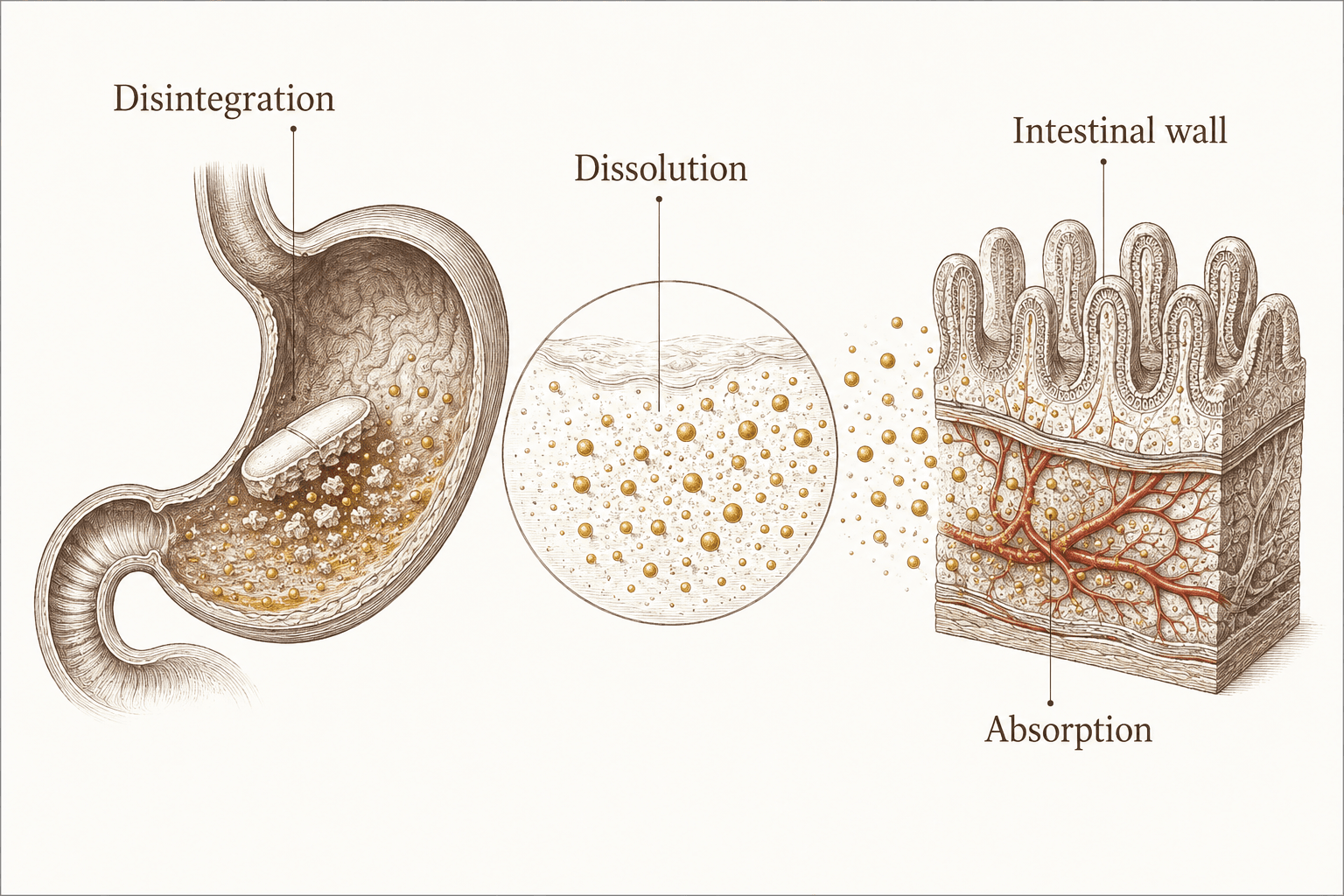
A tablet is a pressed disc of active ingredient plus binders, lubricants, disintegrants, and often a coating.
To absorb it, the body must first dissolve the binder matrix, then dissolve the active inside it, then transport it through the gut wall. Each step loses efficiency.
A liquid is already in solution. There is no disintegration step. The active is at the absorption surface the moment it leaves the stomach. , absorption begins under the tongue and bypasses the first-pass metabolism of the liver entirely.
The two specific advantages of liquid over tablet:
- No filler matrix. A 1 mL dose of a tincture is closer to 95 percent active and water than the 20 percent active and 80 percent filler of a typical tablet.
- Dose flexibility. A dropper delivers 50 to 250 microlitre increments. A tablet delivers exactly what the manufacturer fixed at the press. For minerals titrated against a lab value (iodine, zinc, copper), this matters significantly.
The cases where a tablet or capsule is the better format:
- Magnesium glycinate and other high-mass chelates. A clinical dose (200 to 400 mg of elemental magnesium) in liquid is a large daily volume; the tablet is more compact. The transdermal route covered in the minerals essay is the high-performance alternative.
- Fat-soluble vitamins (A, D, E, K). Available as liquid oil-based drops, the best format; available also as soft-gel capsules, which are fine. The dry-tablet form is the worst of the three. Take the natural forms: D3 rather than D2, natural mixed tocopherols rather than synthetic dl-alpha, and K2 as MK-7.
- Single-time-of-day, high-mass actives (creatine, taurine, glycine, MSM) are sold as bulk powder and dosed by the gram in water. That is the right format and not a tablet question at all.
Choose the methylated B vitamins
The B vitamins are sold in two grades the label treats as equal and the body does not. The cheap synthetic forms, cyanocobalamin for B12 and folic acid for folate, are not the forms the body runs on. Cyanocobalamin carries a cyanide group the liver has to cleave and discard before the vitamin is usable; folic acid has to be converted through several steps before it becomes the folate the cells actually use. Roughly four in ten people carry a common variant in the gene that throttles that conversion, so the synthetic folic acid backs up in the blood unconverted while the cells stay short, a deficiency hiding inside a full supplement.
Buy the active, methylated forms the body uses directly: methylcobalamin or hydroxocobalamin for B12, methylfolate (5-MTHF) for folate, and pyridoxal-5-phosphate (P5P) for B6.
They cost a little more and skip the conversion the cheap forms gamble on. It is the same principle as ionic over oxide, applied to the vitamins: take the form the body was built to use, not the one that was cheapest to manufacture.
The case for ascorbic acid
Vitamin C earns its own line, because it runs more jobs in the body than almost any other single molecule. The molecule itself is the one uncontroversial thing on this shelf: ascorbic acid is ascorbic acid, and the body cannot tell the laboratory-made one from the one in an orange, because atom for atom they are the same object. What you buy it inside of is where the entire decision sits, and most of the aisle fails it.
What it does, in short, is hold the body's tissue and its chemistry together. It is the non-negotiable cofactor for building , which is skin, blood vessels, gums, tendon, and bone; the scurvy of sailors was collagen failure for want of this one molecule. It is the body's primary water-soluble antioxidant, and it regenerates vitamin E and feeds the recycling of glutathione, the master antioxidant. It concentrates most heavily in the adrenal glands, spent under stress to build the stress hormones. It is required to turn dopamine into noradrenaline and to synthesise carnitine, and it sharply raises the absorption of plant iron.
It also pulls against the heavy-metal load of a contaminated century. Higher vitamin C tracks with markedly lower blood lead across the whole populationfootnoteSimon, J. A., Hudes, E. S. (1999). Journal of the American Medical Association. "Relationship of ascorbic acid to blood lead levels." In the NHANES III population, people in the highest third of serum ascorbic acid had a markedly lower prevalence of elevated blood lead than those in the lowest, independent of other factors., and it supports the excretion of lead, cadmium, and mercury, both by feeding the body's own chelation pathways and by neutralising the oxidative damage a loose metal does inside the cell while the body works it out. It is a cheap, daily, gentle partner to the heavy-metal work in the insulators essay.
Buy it as 100 percent pure L-ascorbic acid powder, with one line on the ingredients panel and nothing under it. Stir it into water, drink it, and set the dose yourself.
The reason to be rigid about this is what the alternatives carry, because almost nothing sold as "vitamin C" is vitamin C. A chewable tablet is ascorbic acid inside sucrose or sorbitol, stearic acid, an artificial orange flavour, and a synthetic dye. An effervescent tablet is mostly a fizz engine of bicarbonate and citric acid, with sorbitol, aspartame or sucralose, polyethylene glycol, and colour. A gummy is a confection with a token of vitamin C in it: glucose syrup, gelatin, palm oil, carnauba wax, dye. The "whole food" and "food-based" bottles wrap a few dozen milligrams of real ascorbate in a proprietary fruit blend padded out with rice flour, then charge several times the price for the story, and no controlled trial has ever shown the fruit matrix beats the plain molecule. Time-release and buffered tablets add coating polymers and a mineral carrier the front label is quiet about. Every one of these is the filler chapter you have just read, sold back to you with a health halo on it.
At one to three grams a day, taken daily for years, the additives are a far larger cumulative exposure than the vitamin. The pure powder is also the cheapest of them per gram, by a wide margin. Its only real drawback is that it is sour, and the answer to that is juice or a pinch of bicarbonate, which converts it in the glass to sodium ascorbate and lands the same molecule gently, not a sweetened tablet engineered to hide the taste.
The dose is generous, because the body holds only what it needs and excretes the rest: one to three grams a day, split across the day, more under illness or heavy detoxification.
The minimum effective stack
Combine the principles above and this is the minimum-effective daily stack for an adult on a Western diet, before any condition-specific layering.
- Liquid ionic magnesium, or transdermal magnesium chloride oil, taken daily. The single most-deficient mineral in the modern diet.
- Liquid Lugol's iodine 2 percent, starting at 2 to 6 drops daily and titrating toward the 6 to 10 drop (roughly 15 to 25 mg) loading range run in the minerals and pineal protocols, always paired with selenium.
- Ionic selenium drops, 100 to 200 mcg/day. Not selenomethionine, for the reason given above.
- Ionic zinc sulfate drops, 15 to 25 mg/day, with bisglycinate or picolinate as the capsule alternative, paired with copper bisglycinate 1 to 2 mg/day if running long-term high zinc.
- Vitamin D3 with K2 (MK-7), 5,000 to 10,000 IU D3 with 200 mcg MK-7. Oil-based liquid drops or soft-gel capsule.
- Boron, 3 to 10 mg/day, as borax dissolved in water or as a boron glycinate.
- Methylcobalamin B12 sublingual, 1,000 to 5,000 mcg/day if vegetarian or vegan; 500 to 1,000 mcg/day as insurance even for omnivores over 50, when stomach acid drops and absorption falls.
- EPA/DHA, 1 to 3 g/day, from a clean wild fish oil or algal oil source.
- Ascorbic acid, 100 percent pure powder, 1 to 3 g/day, split across the day, more under illness or heavy detoxification.
Nine items. Every one addresses a deficiency the food supply alone, in 2026, does not reliably cover.
The tenth, the fifteenth, the twentieth are almost always net-negative. The body cannot integrate the load, the absorption competes, the budget escalates, the compliance collapses.
Layers on top of this, for specific situations:
- For active calcification or arterial work: add IV sodium thiosulfate (physician-administered) and consider Cavadex per the minerals essay.
- For mood, sleep, or methylation work: add methyl-folate plus B12, dose-adjusted to homocysteine.
- For oxidative stress or detox work: add NAC 600 mg/day plus glutathione (liposomal sublingual or IV).
- For a vegetarian or vegan protocol: add creatine 3 to 5 g, taurine 1 to 3 g, carnitine 500 to 1500 mg, retinol from cod liver oil or a pre-formed vitamin A drop, per the companion essay on soil death and animal foods.
- For hormone substrates: add zinc, magnesium, boron (already in the core stack), plus tongkat ali or shilajit if running an androgen protocol.
The principle holds.
Each layer answers a specific lab finding or a specific protocol. None is added speculatively, none is kept after the lab moves into range.
A supplement that does nothing after 90 days is a supplement that is not working, regardless of what it costs or how good the brand story is.
What to do with the bottle you already have
Most readers arrive here with a cabinet already bought, some good, some bad. The triage:
- Read every label. Hunt for titanium dioxide, hydrogenated oil, FD&C colours. Refuse on sight.
- Look at the form of the active. Magnesium oxide? Out. Calcium carbonate without K2? Out. Multivitamin in a tablet with eight binders and the active doses below 25 percent of daily value? Out.
- Check the source and the form. Favour the natural or methylated form over the cheap synthetic, and the maker who publishes a certificate of analysis. A synthetic active in a bottle with no published testing is the one to retire first.
- Judge by results. If a supplement has run for 90 days and nothing has moved, in how you feel or in a lab value, it is not working for you. Drop it.
- Consolidate. Aim for the minimum effective list plus your specific add-ons. The twenty-bottle cabinet collapses to the core list inside a month.
The arc
Done correctly, supplementation is a tax adjustment for living in a century where the soil is depleted, the food is contaminated, and the daily detox burden is heavier than any prior generation's.
Done incorrectly, it is the wellness industry charging you for the appearance of intervention while the body absorbs almost none of what was paid for.
The correct version is small, ionic when possible, chelated when not, natural over synthetic, liquid when the format exists, disciplined enough to drop what is not working. Nine items, run consistently, will outperform a cabinet of twenty by a wide margin.
With the minerals back in and the right forms actually absorbing, the body finally has the raw material it was starving for. That is the ground restored, and it is the easier half of the work.
What a body is missing can be bought in a bottle. What has been piling up inside it for a lifetime cannot, and clearing that is the next job.
Sources
- Safety Assessment of Titanium Dioxide (E171) as a Food Additive, . https://www.efsa.europa.eu/en/efsajournal/pub/6585
- Re-Evaluation of Sodium, Potassium and Calcium Salts of Fatty Acids (E 470a) and Magnesium Salts of Fatty Acids (E 470b) as Food Additives, . https://doi.org/10.2903/j.efsa.2018.5180
- Bioavailability of Magnesium Diglycinate versus Magnesium Oxide in Patients with Ileal Resection, . https://pubmed.ncbi.nlm.nih.gov/7815675/
- Comparative Absorption of Zinc Picolinate, Zinc Citrate and Zinc Gluconate in Humans, . https://doi.org/10.1007/BF01974946
- Folate: Fact Sheet for Health Professionals, . https://ods.od.nih.gov/factsheets/Folate-HealthProfessional/
- Excipients in the Paediatric Population: A Review, . https://doi.org/10.3390/pharmaceutics13030387
- Critical Review of the Safety Assessment of Nano-Structured Silica Additives in Food, . https://pubmed.ncbi.nlm.nih.gov/27287345/
- Immediate-Type Hypersensitivity to Polyethylene Glycols: A Review, . https://pubmed.ncbi.nlm.nih.gov/27196817/
- Relationship of Ascorbic Acid to Blood Lead Levels, . https://pubmed.ncbi.nlm.nih.gov/10386552/
- Treatments and Products, . https://drsircus.com/protocol-recommendations/
- All About Ascorbic Acid, . https://www.youtube.com/watch?v=0kIGfZMrIZs
- How to Buy Vitamins (Part 1 of 2), . https://www.youtube.com/watch?v=zN_RFzYnXYI
- How to Buy Vitamins (Part 2 of 2), . https://www.youtube.com/watch?v=uF0bNTepwbQ
Next in the series
The Incorruptible Body · The ClearingThe Oxygen CureYou are not one body but a colony of thirty trillion cells, and nearly all modern disease is a failure of their working conditions. The first condition is oxygen, the one Otto Warburg traced to the root of cancer.
- Published
- Reading
- 16 min
- Sources
- 13