
The Clearing, Chapter 6
The Insulators
Mercury, lead, cadmium, aluminium, and arsenic share one crime, they jam the body's current and dim its light. Where each one actually gets into you, how to shut that door, and the mineral machinery, glutathione, selenium, and sulfur, that pulls out what already came through.
There is no safe level of lead in your blood. Not a low threshold below which it does nothing, no floor, no minimum dose that the body shrugs off, only smaller and larger amounts of damage measured all the way down to zero. The reason is mechanical and exact: lead wears calcium's face well enough to be waved through the gates built for calcium, crosses into the brain on those routes, and welds itself into circuitry that runs on charge. It is one of five metals doing the same kind of harm, and the harm has a single name.
Run a fine enough instrument over a living body and you do not find a chemical bag sloshing along. You find a circuit. You are a thing that conducts, and a thing that glows. Health is not a substance you possess. It is a quality of flow: charge moving cleanly, light moving freely, energy crossing the body with as little loss as the wiring will allow.
Into that conducting, glowing system, a modern life deposits a small set of metals that do the exact opposite of conduct. They bind. They jam. They quench. Where they lodge, the current slows and the light goes dark.
This is the simplest true thing about mercury, lead, cadmium, aluminium, and arsenic, and it is the thesis: heavy metals are insulators driven into a wire.
They are the base matter fouling a circuit built to run clean, the dark mirror of the gold of the philosophers, which is about the metals that conduct without corrupting. Here we deal with the ones that corrupt: what each does to the wiring, the specific doors each one comes in through and how to shut them, where the body hides what it cannot expel, and the machinery, much of it cheap and within reach, that pulls the rest back out.
The doors come first, because they are the only part of this you control outright. Clearing a metal is slow, expensive work that runs on energy the metal itself is stealing. Not taking it in costs nothing and works the same day.
The body is a conductor, and a light
The harm only makes sense once you see what is being harmed. The , which the oxygen essay traced in full, is literally a wire: electrons hop down a chain of metal relays and the fall is captured as the cell's fuel. Even the cell's resting state is electrical, every healthy cell holds a charge across its membrane like a tiny battery.
And the body does not only conduct. It emits. The biophysicist Fritz-Albert Popp spent his career measuring the steady stream of that living tissue gives off, and found it orderly and coherent in healthy cells and scrambled in failing ones. The full case for the body as a creature of light runs in biophotons and living food. The point here is only this: the body is wired for the clean transmission of both charge and light, and the noble metals are its image of what clean transmission looks like. Gold sits in your phone and on the mirror of a space telescope because it is the rare thing that conducts beautifully and never corrodes, the property the alchemists worshipped as incorruptibility. The body wants to be that: a conductor that does not rot.
Health is conduction. Disease, very often, is a short circuit some metal has welded shut.
What a heavy metal actually does
The sabotage, stated as a single mechanism before we break it metal by metal. The toxic heavy metals share a chemical appetite: they are, in the language of chemistry, soft, and soft binds soft. The softest, most available handle in the entire body is sulfur, specifically the , the sulfur-hydrogen pair that hangs off the amino acid cysteine and forms the working hinge of an enormous fraction of the body's proteins and enzymes. The conductive machinery in particular is strung together through sulfur and through a handful of light, well-behaved metals the body installs on purpose, zinc, magnesium, calcium, iron, selenium, each one seated in the exact spot where its charge and size do a precise job.
A heavy metal walks into that machinery and does one of two things.
Either it clamps onto a thiol and will not let go, freezing the enzyme or protein it was the working part of, or it impersonates one of the good light metals, slips into the seat reserved for zinc or calcium or iron, and sits there doing nothing useful, a dead weight in a live socket.
Either way the reaction that was supposed to happen at that spot stops. Multiply it across millions of sites and you have a measurable thing: a body whose current runs slow and whose light runs dim, its conductors studded with insulating faults.
Each of the five drives its faults into a different stretch of the circuit, and each arrives by its own road. Below, for every one of them: the fault it makes, the roads it takes to reach you, and what to do about those roads.
Mercury, and the breaking of the neuron
Mercury is the archetype, the metal whose love of sulfur is so total that it was named quicksilver for the way it flees every attempt to hold it. Its affinity for thiols is near absolute, so there is almost no sulfur-bearing protein in the body it cannot foul. Two of its acts stand out. First, it dismantles , the protein that builds the microtubule scaffolding of the cell, and in a nerve cell that scaffolding is the very architecture of the axon. Boyd Haley's group showed mercury binding the thiols on tubulin and stopping it from assembling, so the neuron's internal frame, its rails and its antennae, falls apart.footnoteDuhr, E. F., Pendergrass, J. C., Slevin, J. T., and Haley, B. E. (1993). "HgEDTA complex inhibits GTP interactions with the E-site of brain beta-tubulin." Toxicology and Applied Pharmacology 122(2):273-280. Mercury at nanomolar levels disrupts the GTP-tubulin interaction required for microtubule assembly, the structural mechanism behind the neurofibrillary disorganisation seen on mercury exposure. Second, it burns through , the body's master thiol and chief mobile detoxifier, disarming the very molecule the body would send to remove it.
The sharpest evidence is what mercury does to human neural cells in a dish, where the tissue is right there and no argument about dose reaching it survives. The form that matters here is , a preservative about half mercury by weight that releases ethylmercury once it is in the body. On cultured human neurons, at concentrations a careless intuition would call trivial, it collapses the cytoskeleton, punches open the mitochondria and spills the signals that order a cell to dismantle itself, snaps the DNA, and starts the suicide program. Below the dose that kills outright it still jams the nerve growth factor signal a developing neuron needs to extend its branches.footnoteYel, L. et al. (2005). "Thimerosal induces neuronal cell apoptosis by causing cytochrome c and apoptosis-inducing factor release from mitochondria." International Journal of Molecular Medicine 16(6):971-977. Baskin, D. S., Ngo, H., and Didenko, V. V. (2003). "Thimerosal induces DNA breaks, caspase-3 activation, membrane damage, and cell death in cultured human neurons and fibroblasts." Toxicological Sciences 74(2):361-368. Parran, D. K., Barker, A., and Ehrich, M. (2005). "Effects of thimerosal on NGF signal transduction and cell death in neuroblastoma cells." Toxicological Sciences 86(1):132-140. Sharpe, M. A., Livingston, A. D., and Baskin, D. S. (2012). "Thimerosal-derived ethylmercury is a mitochondrial toxin in human astrocytes." Journal of Toxicology 2012:373678.
The metal that loves sulfur most is the metal that breaks the neuron most completely, and it does it through the mitochondrion, the conductive heart of the cell that all of this keeps returning to.
On human neurons in a dish, ethylmercury collapses the scaffold, poisons the power plant, and starts the cell tearing itself apart. There is no dose argument left when the cell is right there under the lens.
Where your mercury comes from
Three doors carry nearly all of it, and one of them is in your head.
The mouth. A silver-coloured filling is not silver. Dental amalgam is roughly half elemental mercury by weight, and it does not sit still. The filling gives off mercury vapour continuously for as long as it is in the tooth, and chewing, grinding, brushing, and hot drinks each raise that release for a while afterwards. For someone carrying several amalgam surfaces this is usually the largest mercury exposure they have, larger than everything they eat.footnoteRichardson, G. M. et al. (2011). "Mercury exposure and risks from dental amalgam in the US population, post-2000." Science of the Total Environment 409(20):4257-4268. Daily absorbed dose scales with the number of amalgam surfaces and rises with chewing frequency and bruxism. Vapour is also the worst form to receive it in, because the lung takes up about eighty percent of what is inhaled and elemental mercury crosses into the brain freely.
The plate. Mercury that falls into water is turned into methylmercury by bacteria, and methylmercury climbs the food chain and concentrates at every step, so the load is decided almost entirely by how high up the animal fed and how long it lived. A swordfish steak carries roughly forty times the mercury of the same weight of wild salmon. The heavy end is swordfish, shark, king mackerel, tilefish, marlin, orange roughy, and the large tuna sold as steaks and sushi. The light end is sardines, anchovies, herring, wild salmon, trout, and sole, which happen to be the selenium-rich fish as well, and the selenium section below explains why that pairing matters.
The needle. Thimerosal is about fifty percent mercury by weight, and it was the standard preservative in multi-dose injectable vials for most of a century, at 25 micrograms of mercury in a 0.5 millilitre adult dose from a multi-dose influenza vial. The childhood schedules of the United States and the European Union were cleared of it between 1999 and 2001, and United States influenza vaccines followed in June 2025. Two things follow from those dates. Everyone vaccinated before them received it, which is most adults alive. And multi-dose vials are still the standard presentation across much of the rest of the world, so for a large part of the global population this is a present-tense exposure rather than a historical one. Thimerosal also remains a preservative in some allergen extracts, tuberculin preparations, and other multi-dose injectables. An injection is the most complete route on this page: it delivers the entire dose past the gut wall and the lung, the two filters that take a share of everything else you are exposed to.
And the rest. Skin-lightening creams are the most underrated mercury source in the world, many of them carrying mercury salts at percent-level concentrations and applied daily to a wide area of thin skin. Broken fluorescent tubes and compact fluorescent bulbs release vapour straight into a room. Old thermometers, thermostats, and barometers. Some traditional and Ayurvedic preparations use mercury on purpose. And coal-fired power stations put mercury into the air, where it falls into water and starts up the food chain again, which is how the power station and the plate turn out to be the same door.
How to shut them.
- If you have amalgam, the dangerous move is having it taken out badly. Drilling an amalgam without a rubber dam, high-volume suction, copious water, and a separate clean air supply for you aerosolises a large dose in a few minutes, and that one appointment can deliver more than years of quiet outgassing. Use a dentist who works to the safe-removal protocol, or leave it where it is.
- Eat down the food chain rather than rationing the top of it. Sardines, anchovies, herring, wild salmon, and drop the predators entirely.
- Ask what is in the vial. A pharmacist can read the presentation and tell you whether it is single-dose and thimerosal-free in about ten seconds, and single-dose presentations exist for almost everything.
- Throw out the skin-lightening cream. If the label does not say mercury-free and the product did not come from a regulated market, assume it is in there.
- Ventilate the room and never vacuum a broken fluorescent tube. A vacuum turns the spill into an aerosol and then blows it around the house.
Aluminium, the metal that is meant to inflame
Aluminium is the most abundant metal in the earth's crust and, in a body, one of the most out of place, because biology evolved with almost no use for it. It is technically a light metal, but it earns its seat in this gallery by behaviour. Its salts are used as for exactly one reason: the immune system reads a deposit of aluminium as a threat and inflames around it, and that inflammation is harnessed to amplify a response. The inflammatory action is the point, not an accident. The question that follows is where the metal goes afterward, and the answer is that some of it is carried off by immune cells and travels, including across the blood-brain barrier, where aluminium binds phosphate, cross-links proteins, deranges the body's handling of iron, and drives a slow neuroinflammation.
Christopher Exley's group at Keele spent years measuring aluminium directly in human brain tissue and found strikingly high loads in autism and in familial Alzheimer's, much of it sitting inside the brain's own immune cells, and injected aluminium hydroxide at adjuvant-relevant doses produces motor deficits and motor neuron degeneration in animals.footnoteMold, M., Umar, D., King, A., and Exley, C. (2018). "Aluminium in brain tissue in autism." Journal of Trace Elements in Medicine and Biology 46:76-82. The content was among the highest recorded in human brain tissue, and fluorescence microscopy located much of it inside microglia and other inflammatory cells; Exley's companion work documented comparable loads in familial Alzheimer's tissue. Shaw, C. A., and Petrik, M. S. (2009). "Aluminum hydroxide injections lead to motor deficits and motor neuron degeneration." Journal of Inorganic Biochemistry 103(11):1555-1562. It sets up a smouldering fire in the one tissue that can least afford it.
Where your aluminium comes from
The adjuvant. Start here, because it is the only aluminium exposure that is deliberate and the only one that skips the gut. Aluminium hydroxide, aluminium phosphate, and amorphous aluminium hydroxyphosphate sulfate are the adjuvants in the diphtheria, tetanus, and pertussis vaccines, in hepatitis A and hepatitis B, in HPV, in some Haemophilus influenzae type b presentations, in the pneumococcal conjugates, in meningococcal B, and in every combination shot that bundles those. United States regulation caps a single dose at 0.85 milligrams of aluminium. The live vaccines, measles, mumps, rubella, varicella, and rotavirus, carry none, and neither do most influenza vaccines.
The usual reply is that the dose is trivial next to what an antacid delivers, and on the raw milligrams that is true. It is also the wrong comparison, because the two routes are not the same event. Swallowed aluminium is mostly refused at the gut wall, on the order of a tenth of one percent of it reaching blood, so a gram of antacid contributes about a milligram and the rest leaves in the stool. An injected adjuvant is not absorbed in that sense at all. It is placed whole into muscle as a solid particle, and it has to stay there and stay intact, because slow persistence at the injection site is the entire mechanism by which it works. Gherardi's group in Paris followed what happens next: immune cells engulf the particles, leave the muscle carrying them, and deposit them over months in lymph node, spleen, and brain.footnoteKhan, Z., Combadiere, C., Authier, F.-J., Gherardi, R. K. et al. (2013). "Slow CCL2-dependent translocation of biopersistent particles from muscle to brain." BMC Medicine 11:99. Injected aluminium adjuvant particles are taken up by monocyte-lineage cells and translocate to draining lymph nodes, spleen, and brain, with the rate governed by CCL2 signalling.
The medicine cabinet. Aluminium hydroxide antacids are the largest oral aluminium dose most people will ever take, hundreds of milligrams of the salt in a single tablet and often taken by the handful for years. Buffered aspirin, sucralfate, and the aluminium-based phosphate binders sit alongside them.
The kitchen. Aluminium pans, aluminium foil, and disposable foil trays, all of which leach into the food and leach far more when the food is acidic or salty: tomato, lemon, vinegar, brine. Baking powder and self-raising flour, where sodium aluminium phosphate and sodium aluminium sulfate are the standard acidulants. Processed cheese slices, where an aluminium salt is the emulsifier. Cake and pancake mixes. The aluminium lakes used to fix food colouring. Tea leaves take aluminium up from soil and concentrate it.
The bathroom. An antiperspirant works by plugging the sweat duct, and what does the plugging is aluminium chlorohydrate or aluminium zirconium. Since sweat is one of the few genuine exit routes the body has for cadmium and lead, an antiperspirant manages two kinds of harm at once, adding a metal and closing a door.
The tap. Aluminium sulfate is the standard flocculant in municipal water treatment, so treated water carries a residue of it by design.
How to shut them.
- Aluminium-free antiperspirant, or a plain deodorant that leaves the sweating alone.
- Stainless steel or cast iron instead of aluminium pans, and no acidic food cooked in foil.
- Aluminium-free baking powder. The label states it plainly, and the one to put back on the shelf lists sodium aluminium sulfate or sodium aluminium phosphate.
- If you need an antacid, take a magnesium or calcium one. Better still, fix whatever is causing the reflux.
- Distil the drinking water, which the water essay argues on separate grounds and which removes the flocculant residue as a bonus.
- Find out which of the injections on offer are aluminium-adjuvanted and which are not. It is printed on the package insert, it is a reasonable thing to ask before consenting, and it is the difference between choosing an exposure and receiving one without being told.
Cadmium, the metal in the smoke
Cadmium is the metal of combustion. It rides out of every fossil fuel that is burned and is concentrated heavily in cigarette and wood smoke, in vehicle exhaust, in the dust of industry, so a body breathing modern air takes it in constantly and with no good way to refuse.
And cadmium is patient. Its biological half-life runs to ten or twenty years or more, so it does not pass through, it accumulates, decade upon decade, in the kidney and the bone.
Its insulating trick is impersonation. Cadmium sits one row below zinc on the periodic table and mimics it well enough to slip into zinc's seats, the zinc-finger proteins that read DNA, the enzymes that depend on a zinc atom at their core, and, most perversely, the very the body uses to detoxify metals. By knocking zinc out of its rightful places, cadmium both jams the circuits zinc was running and weakens the body's capacity to clear itself. In the kidney it scars the filtering tubules; in bone it interferes with mineralisation and drives the calcium loss that, in the cadmium-poisoned valleys of mid-century Japan, produced itai-itai disease, named for the cries of pain from bones that broke at a touch. The metal you cannot see in the air you breathe is one of the most stubborn lodgers the body ever takes in.
Where your cadmium comes from
Smoke, if you smoke. Nothing else on this list is close. One cigarette carries roughly one to two micrograms of cadmium, the lung absorbs a far larger share of what reaches it than the gut ever does, and a lifelong smoker ends up carrying about twice the body burden of someone who never smoked. Other people's smoke counts. Vaping does not solve it either: dropping the tobacco removes the plant's cadmium and then the heating coil contributes its own metals, lead, nickel, and chromium among them, straight into the aerosol.
Food, if you do not. For a non-smoker essentially all of it arrives on a plate, because plants pull cadmium out of soil readily and animals concentrate it in the organs that store it. The heavy end is kidney and liver from older animals, shellfish, particularly oyster, mussel, scallop, crab, and squid, sunflower and flax seeds, cacao and therefore dark chocolate, and the staple crops grown on cadmium-bearing soil, rice and wheat above all. Leafy greens and potatoes carry a lower load but are eaten in quantity, which for most people matters more than any single high-cadmium food.
The soil it grew in. Phosphate fertiliser carries cadmium as a contaminant of the rock it is made from, and it has been spread on farmland for a century, so agricultural soil cadmium climbs rather than falls. Sewage sludge applied to fields does the same.
Low iron, which multiplies all of the above. This is the lever almost nobody is told about. The gut takes cadmium up on the same transporter it uses for iron, and when iron runs short the body makes more of that transporter, so a person with depleted stores absorbs a far larger share of the cadmium in the identical meal.footnoteAkesson, A. et al. (2002). "Cadmium exposure in pregnancy and lactation in relation to iron status." American Journal of Public Health 92(2):284-287. Low serum ferritin was associated with markedly higher blood cadmium, consistent with upregulation of the divalent metal transporter that carries both metals across the intestinal wall. It is why women of menstruating age carry measurably more cadmium than men eating the same food. Correcting a low ferritin closes the door the whole diet is walking through.
How to shut them.
- Stop smoking, and stop sitting in other people's smoke. On this metal that one change outweighs everything else put together.
- Test ferritin and fix it if it is low. It is the cheapest cadmium intervention there is, and it works on every dietary source at once.
- Keep kidney off the menu, and treat liver as an occasional food from young animals rather than a weekly staple.
- Buy the dark chocolate, the cacao, and the protein powder that publish a heavy-metal assay. Skip the ones that do not.
- Zinc, already in the protocol below, competes with cadmium at the gut wall and again at the protein seat cadmium is trying to take.
Lead, the calcium impostor
Lead has poisoned us for as long as we have smelted, and the counterfeit named in the opening buys it two addresses. It enters the brain on the gates built for calcium, and it deposits in the skeleton, where it can sit, mimicking the calcium of bone, for decades. From those two positions it does its damage. In the nervous system it jams the calcium-triggered release of neurotransmitters and corrupts the calcium-driven signalling that underlies the laying down of memory, which is why lead is so specifically a thief of the developing mind. And it strikes the conductive pigment at its source: lead inhibits the enzymes that build , the iron-cored ring the body uses both to carry oxygen in the blood and to carry electrons along the mitochondrial wire. By blocking heme, lead degrades the body's oxygen delivery and its electrical conduction from the same blow. And there is, as the opening said, no safe blood level of lead, no threshold below which it does nothing, only smaller and larger amounts of harm.
Where your lead comes from
The house, if it is old. Lead paint was banned for residential use in the United States in 1978, and European bans followed over the next decade and a half. In any building older than that it is still on the walls, under everything painted since. The intact wall is not the danger. The dust is: window sashes and door frames grind paint to powder every time they move, and sanding or stripping during a renovation can turn a whole house into an exposure in one afternoon.
The pipe. Lead service lines, the lead solder in copper joints that the United States banned in 1986, and the lead in ordinary brass fittings. Soft and acidic water strips more of it, and hot water strips more than cold, which is why cooking water, drinking water, and infant formula should never come off the hot tap. Water that has stood in the pipe overnight carries the most.
The ground. Leaded petrol burned for most of a century, and the last country stopped selling it in 2021. That lead did not degrade. It settled, and it is still in the soil beside old roads, in the drip line of old painted buildings, and in a great many urban vegetable gardens.
Things brought in from elsewhere. Glazed ceramics and clay cookware whose glaze was never fired properly. Leaded crystal decanters, where the lead migrates into whatever has been standing in them. Turmeric and other spices adulterated with lead chromate for colour. Traditional cosmetics such as kohl and surma, and some traditional and Ayurvedic remedies. Piston aircraft still burn tetraethyl lead, so the ground around a small airfield is a live source. Indoor ranges, reloading, and game shot with lead ammunition.
Your own skeleton. This is the source nobody is warned about, and it is the reason the clearing protocol has to be built in the order it is. Bone lead has a half-life measured in decades, and it does not simply sit there. It is released back into the blood whenever the skeleton turns over, which is what pregnancy, breastfeeding, menopause, prolonged bed rest, and rapid weight loss all do.footnoteGulson, B. L. et al. (2003). "Mobilization of lead from human bone tissue during pregnancy and lactation, a summary of long-term research." Science of the Total Environment 303(1-2):79-104. Skeletal lead is released into maternal blood during periods of high bone turnover, with the contribution rising through pregnancy and lactation. A hard fast or an aggressive cleanse can raise your own blood lead from the inside. The binders and the minerals below are not optional extras to that work, they are part of it.
How to shut them.
- Test the water instead of guessing. Where the result is bad, filter at the point of use, run the tap before drinking anything that has stood, and take nothing for cooking or formula off the hot side.
- In a house built before 1978, wet-wipe sills, floors, and window wells rather than dry-dusting, and never dry-sand old paint. Renovate with proper containment or wait until nobody is living there.
- Shoes off at the door. For most households that is the whole soil route closed.
- Buy spices from brands that test, and keep acidic food and drink out of imported glazed pottery and leaded crystal.
- Keep calcium, iron, and zinc topped up. Lead crosses the gut wall on the transporters built for those three, so a well-mineralised body competes most of it away while a depleted one waves it through. The daily gram of vitamin C in the protocol lowers blood lead on top of that.
Arsenic, the gate that will not open
Arsenic is the assassin of energy itself. It reaches people mostly through contaminated groundwater and the crops, rice above all, that drink it up, and once inside it goes for the throat of metabolism. Its target is , the sulfur-bearing cofactor at the heart of pyruvate dehydrogenase, the enzyme complex that controls the gate between glucose breakdown and the Krebs cycle. Arsenic clamps the two thiols of lipoic acid together and locks the gate shut, so fuel cannot pass into the aerobic machinery. On top of that it uncouples the energy line directly, letting the proton gradient that drives the cell's turbine leak away as heat. Arsenic shuts the slow fire's intake valve, which is why arsenic poisoning presents as a body that cannot make energy no matter how well it is fed.
Where your arsenic comes from
Water, which is the whole story in some places. Naturally occurring arsenic in groundwater has poisoned tens of millions of people in Bangladesh and West Bengal, and it sits in the aquifers of parts of Chile, Argentina, Mexico, Vietnam, and the American southwest and midwest. A municipal supply is tested and treated. A private well is tested only if you test it, and nothing about the taste, the smell, or the clarity of the water will tell you a thing.
Rice, which is the whole story nearly everywhere else. Rice grows in flooded paddy, and flooding is precisely the condition that frees arsenic from soil and hands it to the roots, which is why rice takes up something like ten times the inorganic arsenic of any other cereal. Within rice the differences are large and worth knowing. Brown carries more than white, because the arsenic concentrates in the bran that milling takes off. Rice grown in the American south, on ground that was cotton land and had arsenical pesticides on it for decades, runs high; Californian rice runs lower, and basmati from India and Pakistan lower still.
Rice again, in things that do not look like rice. Brown rice syrup sweetens a great many cereal bars and has turned up in infant formula. Then rice milk, rice cereal, rice crackers, rice pasta, and the rice flour holding up a large part of the gluten-free aisle. For a small child on daily rice cereal, or an adult whose gluten-free diet is built on rice flour, this is a bigger exposure than the water is.
The garden. Chromated copper arsenate pressure-treated timber was the standard for decks, fences, and playground equipment until 2003. It leaches arsenic into the soil beneath and beside it, and onto the hands of anyone who runs a palm along the rail.
Not seafood. Most of the arsenic in fish and shellfish is arsenobetaine, an organic form that passes through largely untouched, which is why a seafood meal will spike an arsenic urine test without meaning anything at all. Hijiki seaweed is the real exception and carries genuine inorganic arsenic.
How to shut them.
- Distil the drinking water. Distillation takes arsenic out completely, where carbon filtration barely touches it, and this is already the position the water essay argues on other grounds. On a private well, test before anything else.
- Cook rice like pasta. Rinse it, boil it in six to ten parts water, and pour the water off at the end. That removes roughly half the inorganic arsenic and costs you nothing but a little starch.footnoteRaab, A., Baskaran, C., Feldmann, J., and Meharg, A. A. (2009). "Cooking rice in a high water to rice ratio reduces inorganic arsenic content." Journal of Environmental Monitoring 11(1):41-44. Boiling in excess water and discarding it removed a substantial fraction of the inorganic arsenic; the low-water absorption method retains it all. It is the easiest change on this page.
- Choose basmati and Californian rice, and rotate the grain. Buckwheat, quinoa, millet, oats, and barley all carry a fraction of the load.
- Keep rice cereal, rice milk, and brown rice syrup out of a child's daily diet, and rotate an infant's grain the way you would rotate your own.
- Do not grow food in the bed beside an old treated-timber deck, and do not let a child eat with the hands they have been climbing one with.
Where the body buries what it cannot expel
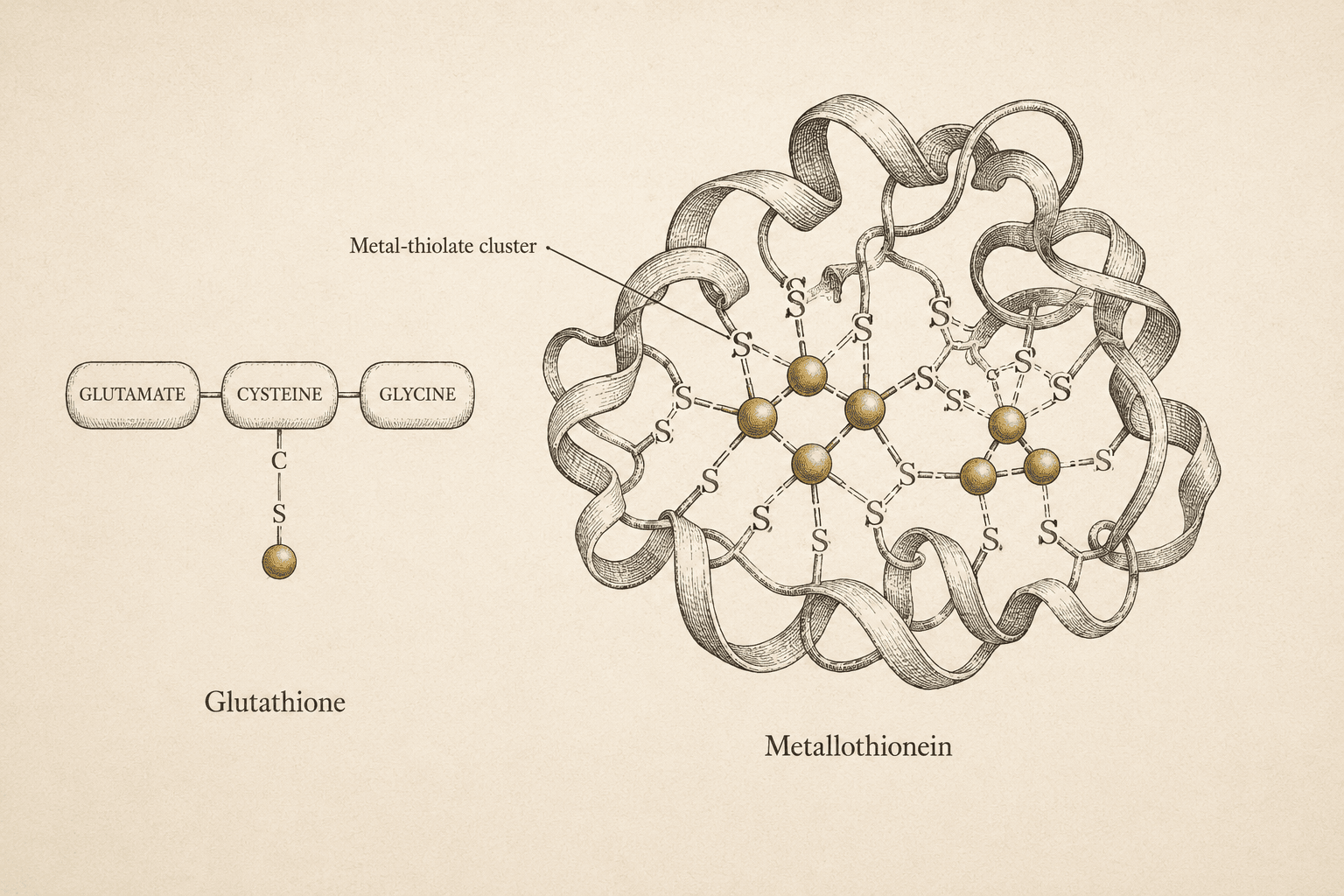
The body is not defenceless. Faced with a metal it cannot immediately throw out, it does the next best thing: it buries it. The tool is one of the most elegant proteins in physiology, , a short chain that is nearly a third cysteine, so dense with thiols that it is essentially a fistful of sulfur cages. Its day job is shuttling the good metals, zinc and copper, but when a heavy metal appears it clamps the intruder into one of those cages and holds it, inert and harmless, deep in the liver and the kidney.footnoteKlaassen, C. D., Liu, J., and Choudhuri, S. (1999). "Metallothionein: an intracellular protein to protect against cadmium toxicity." Annual Review of Pharmacology and Toxicology 39:267-294. Metallothionein induction is the body's primary intracellular defence against cadmium and a major buffer for mercury and other soft metals.
This is quarantine, not elimination, and the distinction matters. A metal locked in metallothionein is a defused metal, walled off from the live circuitry it would otherwise foul. But it is still in the body, and the magazine has a finite size.
The crucial lever is that metallothionein is induced by zinc, the body builds more of it when zinc is plentiful, so zinc status sets the ceiling on how much metal you can safely hold. This is the deeper reason zinc keeps recurring in the minerals essay as the body's heavy-metal handler.
Run low on zinc, or load the body with metal faster than it can build cages, and the quarantine overflows, the metal leaks back out of storage and onto the wire, and the slow corrosion resumes. To clear metals well, you first have to be able to hold them, and that capacity is built from zinc and sulfur.
Metallothionein is quarantine, not cure. The body walls the metal away in a cage of sulfur and waits for a path out. Give it zinc to build the cages, and sulfur to line them.
The body's own chelators: glutathione, selenium, sulfur
Quarantine buys time. Elimination needs a different tool, a molecule that can grab the metal, stay water-soluble while holding it, and carry it out of the body through bile or urine. That is , and the body runs a chelation system of real power when it is given the parts. The parts are exactly the three the proactive-medicine tradition names again and again, and they are the literal chemistry of how a body cleans itself.
Glutathione is the centre of it. The cysteine thiol at its core binds mercury, lead, arsenic, and cadmium directly, and once a metal is caught, the glutathione complex is pumped into the bile and out through the gut, the main road by which the body excretes mercury.footnoteBallatori, N., and Clarkson, T. W. (1985). "Biliary secretion of glutathione and of glutathione-metal complexes." Glutathione conjugation is the rate-limiting step in the biliary excretion of methylmercury and a primary route for several heavy metals; cellular glutathione status governs the rate of metal clearance. Glutathione is the body's primary mobile chelator, which is why depleting it, as mercury, alcohol, paracetamol, and chronic stress all do, cripples detoxification at its root. Its production is rate-limited by cysteine, which is why , the cysteine donor hospitals use to refill glutathione in a paracetamol overdose, is the most direct way to raise it.
Selenium is glutathione's partner and a chelator in its own right. It is the working atom of glutathione peroxidase and thioredoxin reductase, the enzymes that keep the antioxidant defence recharged, and it has a special relationship with mercury: selenium binds mercury even more tightly than sulfur does, forming mercury selenide, a compound so stable and inert it is effectively mineral, the body's way of turning a live poison into a dead stone.footnoteRalston, N. V. C., and Raymond, L. J. (2010). "Dietary selenium's protective effects against methylmercury toxicity." Toxicology 278(1):112-123. Mercury's extreme affinity for selenium drives the formation of inert mercury selenide; the same affinity means mercury exposure sequesters selenium and produces a functional selenium deficiency, which is one mechanism of its toxicity. The relationship runs both ways, and that is the warning inside it: because mercury grabs selenium so hard, a mercury load quietly starves the body of the selenium its own enzymes need, so chronic mercury exposure produces a hidden selenium deficiency. Pairing selenium with any mercury-clearing work is not optional.
Sulfur is the element under all of it. Glutathione is built from sulfur amino acids; metallothionein is a cage of sulfur; the thiol is a sulfur-hydrogen pair. To detoxify metals is, at the chemical level, to have enough sulfur in the right forms. The body gets it from cysteine and methionine in good protein, from the alliums, garlic and onion, whose sulfur compounds bind mercury, from in cruciferous vegetables, and from MSM. Sulforaphane is the strongest of these, because it does not merely supply sulfur, it flips the Nrf2 switch, the master regulator that ramps up the body's own production of glutathione, of metallothionein, and of the phase II detox enzymes all at once.footnoteFahey, J. W., and Talalay, P. (1999). "Sulforaphane and the induction of phase II detoxification enzymes." Sulforaphane, concentrated in broccoli sprouts, is among the most potent natural inducers of the Nrf2-ARE pathway, coordinately upregulating glutathione synthesis and the cytoprotective enzyme battery.
What builds the chelators: the B vitamins and vitamin C
There is a sleight of hand in calling glutathione the body's master chelator. Glutathione is something the body is constantly making, spending, and remaking, and it is spent fast.
Every metal it grips and carries out, every free radical it quenches, leaves it used up, and a cell clearing a real metal load runs its glutathione down faster than any careless habit ever could.
What decides the clearance is how fast you can build it back. That production line is run by the B vitamins, and almost no one clearing metals is ever told so.
Follow the chemistry and it is plain. Glutathione is assembled from three amino acids, and the one that runs out first is cysteine, the sulfur-bearing one. The body does not wait on the diet for it; it manufactures cysteine on the spot through the , and neither enzyme of that pathway will turn without vitamin B6. Feeding it from above is the , the engine that keeps the whole loop turning, and it runs on B12, folate, and riboflavin (B2). And after glutathione has done its work and come back spent and oxidised, the enzyme that recharges it needs riboflavin again and the reducing power of NADPH, which the body draws from its niacin (B3) pool when it is burning fuel with oxygen. The B vitamins are the named cofactors at every step of building and recharging the one molecule the entire clearance rests on. Pour in all the sulfur and NAC you like, and if the B vitamins are short the line stalls anyway: the cysteine is never made and the glutathione never comes.footnoteLu, S. C. (2013). "Glutathione synthesis." Biochimica et Biophysica Acta 1830(5):3143-3153. Cysteine, supplied largely by the B6-dependent transsulfuration pathway, is rate-limiting for glutathione synthesis; the methylation cycle (B12, folate, riboflavin) feeds homocysteine into that pathway, and glutathione reductase (riboflavin, NADPH) recharges the spent pool.
Then vitamin C, which works the antioxidant side of the same fight. A metal loose in a cell does most of its harm by throwing the cell into a storm of free radicals, oxidising the very structures glutathione is trying to protect. Vitamin C is the water-soluble antioxidant that stands directly beside glutathione in that storm, soaking up the radicals so glutathione is not burned merely holding the line, and then chemically handing glutathione and vitamin E their charge back after they are spent.footnoteMeister, A. (1994). "Glutathione-ascorbic acid antioxidant system in animals." Journal of Biological Chemistry 269(13):9397-9400. Ascorbate and glutathione regenerate one another; depleting either accelerates the loss of the other, so the two stand or fall together as the cell's core antioxidant defence. And it does more than shield. A daily gram of vitamin C measurably lowers the body's lead burden, both by mobilising the metal and by speeding its exit through the kidney.footnoteDawson, E. B. et al. (1999). "The effect of ascorbic acid supplementation on the blood lead levels of smokers." Journal of the American College of Nutrition 18(2):166-170. One gram of vitamin C a day produced a significant fall in blood lead, consistent with ascorbate's role in renal lead excretion.
One caution on the form, because the shelf is mostly noise. The molecule that does all of this is L-ascorbic acid, and that is the whole of it. The body cannot tell laboratory-made ascorbic acid from the ascorbic acid in an orange, because they are the identical molecule, atom for atom, and they absorb the same.footnoteMangels, A. R. et al. (1993). "The bioavailability to humans of ascorbic acid from oranges, orange juice and cooked broccoli is similar to that of synthetic ascorbic acid." Journal of Nutrition 123(6):1054-1061. Relative bioavailability from the food sources was not significantly different from 100 percent, the value for synthetic ascorbic acid. The Linus Pauling Institute states it flatly: natural and synthetic L-ascorbic acid are chemically identical, with no known difference in biological activity or bioavailability. So buy the pure powder, 100 percent L-ascorbic acid and nothing else. The whole-food and food-based products wrap a few dozen milligrams of real ascorbate inside a proprietary fruit blend and charge a premium for the story. No controlled trial has ever shown that the food-matrix packaging beats the plain molecule.footnoteCarr, A. C.; Vissers, M. C. M. (2013). "Synthetic or Food-Derived Vitamin C, Are They Equally Bioavailable?" Nutrients 5(11):4284-4304. The rigorous human evidence finds food-derived and synthetic ascorbic acid functionally equivalent; no whole-food or bioflavonoid form has demonstrated superior bioavailability or retention. What you are paying extra for is filler, and filler is the last thing that belongs in a body you are trying to clear. Take the gram a day as clean ascorbic acid and skip the rest.
Put the steps in order, because the cellular sequence is the thing worth carrying. A metal crosses into a cell, jams the sulfur hinges of its enzymes, and throws off radicals. Metallothionein cages what it can. Glutathione grips the rest in its sulfur claw, and the bound complex is pumped out of the cell, handed to the bile, and carried down to the gut, where a binder must catch it or it is reabsorbed straight back up.
Every part of that, the gripping, the pumping, the recharging, draws on a glutathione supply that the B vitamins build and vitamin C spares, and on an engine that only runs in a cell with the power to turn it.
Prying a metal loose with a strong drug while the engine behind it is starved is the classic way to get hurt: you mobilise more than the depleted system can carry, and the metal just relocates to somewhere worse. You build the engine first, then you move the metal.
Why none of it runs without oxygen
Here is the part the supplement aisle leaves out: the body's chelation system is one of the most energy-hungry things the body does, and it cannot run on an empty tank. The pumps that push a metal-glutathione complex out of a cell and into the bile burn the cell's fuel to do it. Recharging glutathione after it has dropped its load needs , which a body only makes in quantity when it is burning fuel with oxygen. The liver's two-phase detox line runs on oxygen. Even the lymph that hauls cellular waste toward the exits moves on muscular motion and the pump of the breath. A hypoxic, sedentary, congested body has chelators sitting idle for want of power.
And the metals close the trap from the other side. Mercury, arsenic, and cadmium all poison the mitochondria, the very generators whose output the body needs to expel them.
So the insulators cut their own power supply, which is the vicious circle at the centre of chronic metal toxicity: the more metal you carry, the less energy you can make, and the less energy you can make, the less metal you can clear.
The lever that breaks the circle is the one the oxygen essay is built around. Raising the oxygen reaching the tissues, by moving the body, breathing into the lower lungs, clearing the blood and the liver that feed it, is the power supply detoxification runs on. You cannot clear a metal from a cell that cannot breathe.
A chelator without oxygen behind it is a claw with no arm. And the metals poison the engine that would carry them out.
Humic and fulvic acid, the chelators from the ground
There is one more class of chelator, older than any supplement, that deserves its own section because the chemistry is so clean. When ancient plant matter is broken down over geological time, in peat bogs, in the seams of soft brown coal called leonardite, in the black resin that weeps from Himalayan rock as , what is left behind is a family of large, intricate molecules called . They are studded with carboxyl and phenolic groups, oxygen-bearing claws by the dozen on every molecule, which give them an enormous capacity to grip metal ions. This is established soil chemistry: environmental engineers use humic substances to lock up heavy metals in contaminated land and water, because the molecules bind the metals and hold them.footnoteTipping, E. (2002). Cation Binding by Humic Substances. Cambridge University Press. The carboxylic and phenolic functional groups of humic and fulvic acids give them high cation-exchange and metal-complexation capacity, the basis of their established use in remediating metal-contaminated soils and waters; the same chemistry operates in the gut.
The smaller of the two, fulvic acid, is the more interesting in a body. It is light enough to dissolve at any acidity and small enough to cross cell membranes, and it is amphoteric, able to both grip a toxic metal and ferry a beneficial one, so it works as a binder and a mineral-carrier at once.
It is also electron-rich, a genuine antioxidant that donates electrons to quench free radicals, which connects it straight back to the body-as-conductor theme, fulvic acid is, among other things, an electron donor restoring charge to a system the metals have been draining.
The same claw chemistry that pulls lead out of a poisoned field pulls it out of a gut.
The protocol: restoring the conductor
Pulled together, proactive metal management is a steady discipline of five moves, run daily, that keep the wire clean.
1. Close the tap.
You cannot out-detox an open source, and this is the half of the work that mostly costs nothing.
The doors are listed metal by metal above. Ranked by how much they usually matter and how cheaply they close, the order for most people runs like this. Stop smoking and stop standing in other people's smoke, which settles cadmium in a single move. Distil the drinking water, and test it first on a private well or in old housing with old pipes, which settles arsenic, lead, and the aluminium residue from treatment together. Change the way you cook rice, and rotate the grain. Eat down the fish chain rather than rationing the top of it. Get the ferritin up, because low iron holds the gut open to cadmium and lead alike. Take the aluminium out of the bathroom cabinet, the kitchen drawer, and the baking powder. Ask what is in any vial before it goes into you. And if there is amalgam in your mouth, never let it be drilled out by anyone who will not work behind a rubber dam, because a careless removal delivers more in twenty minutes than the filling would have in twenty years.
Most of that can be started this week, and none of it waits on a supplement arriving.
2. Build the quarantine and the chelators.
This is the minerals stack doing double duty:
- Zinc to induce metallothionein and hold the line on cadmium.
- Selenium, 100 to 200 mcg, to bind mercury and recharge the antioxidant enzymes.
- Sulfur, from cruciferous vegetables and especially broccoli-sprout sulforaphane to flip the Nrf2 switch, from garlic, and from MSM.
- NAC plus glycine to keep glutathione topped up.
- The B-complex (B6, B12, folate, and riboflavin) that actually builds and recharges that glutathione.
- Vitamin C, a gram a day, to shield the cell through the mobilisation and help carry lead out.
- Magnesium powering the enzymes that run the whole line.
3. Mobilise gently, and never without a binder.
This is the rule that protects you from your own enthusiasm.
Cilantro and chlorella, modified citrus pectin, activated charcoal, and the humic and fulvic acids above are gut-phase binders that catch metals as they come down the bile and carry them out for good, instead of letting them recirculate.
The hard line, worth repeating because breaking it is how people hurt themselves: never take an agent that pries metal loose from storage without a binder already in the gut to receive it, or you simply move the metal from a quiet store into the blood and the brain.
4. Open the exits. Sweat is a real and measurable excretion route for cadmium, lead, and even some mercury, which is the case for regular sauna and hard exercise.footnoteGenuis, S. J., Birkholz, D., Rodushkin, I., and Beesoon, S. (2011). "Blood, urine, and sweat (BUS) study: monitoring and elimination of bioaccumulated toxic elements." Archives of Environmental Contamination and Toxicology 61(2):344-357. Several toxic elements were excreted in sweat at concentrations equal to or greater than in urine, establishing induced sweating as a legitimate elimination route. Keep the bile moving, with fibre, with the alliums, and with the liver and gallbladder flush that clears the very channel metals leave by. Hydrate to keep the kidney flushing. The metal is only gone once it is out.
5. Power it with oxygen.
Everything above runs on energy. Move, breathe deep, and clear the blood and liver so the tissues are well supplied, because a well-oxygenated body is one whose chelators are fully powered and whose mitochondria can fund the work.
For a heavy, measured burden, blood, hair, and provoked-urine testing pointing to a real load, this is where the pharmaceutical chelators belong, DMSA, DMPS, EDTA, stronger versions of the same claw chemistry the body makes for itself.
They work, and they are clinician's tools, not a thing to dose yourself by feel, because aggressive chelation run without the minerals, the binders, and the timing strips the good metals along with the bad and can drive the toxic ones toward the brain.
Test first, dose under supervision, replace the minerals you move.
The clean conductor
The alchemists, in the end, wanted to turn the body into a noble metal: incorruptible, and a frictionless conductor of light. Read against that ambition, the heavy metals are the literal corruption, the base matter that rusts the circuit and dims the lamp, studding a system built for clean flow with insulating faults that slow the current and scatter the light. Nearly all chronic decline is too much of what poisons the cell and too little of what it needs, and the metals are the cleanest case of the first half there is, a small, identifiable set of poisons doing a single, mechanical, fixable kind of harm.
Which means the work is fixable too, and ordinary.
Close the tap. Build the cages from zinc and sulfur. Run the chelators the body already knows how to make, glutathione, selenium, the sulfur foods that flip the master switch, and the humic claws from the ground. Open the exits, and keep the oxygen high enough to pay for all of it.
Do that with patience and the load comes down, the faults lift off the wire one site at a time, and the body conducts again, the current returning and the light coming back up, because they were never the thing that was broken. The metal standing in their way was, and metal can be moved.
But prising a metal off the wire is only the first half of the move.
Everything you loosen still has to travel out of the tissue it was sitting in, and the network that carries it is the one system in the body with no central pump of its own. It waits on your movement, your breath, and your heat, and it will quietly recirculate the whole load if you do not give it those.
Next, the missing pump, and the second thing the clearing has to get right.
Sources
- Thimerosal Induces Neuronal Cell Apoptosis by Causing Cytochrome c and Apoptosis-Inducing Factor Release from Mitochondria, . https://pubmed.ncbi.nlm.nih.gov/16273274/
- Thimerosal Induces DNA Breaks, Caspase-3 Activation, Membrane Damage, and Cell Death in Cultured Human Neurons and Fibroblasts, . https://doi.org/10.1093/toxsci/kfg126
- Effects of Thimerosal on NGF Signal Transduction and Cell Death in Neuroblastoma Cells, . https://pubmed.ncbi.nlm.nih.gov/15843506/
- Thimerosal-Derived Ethylmercury Is a Mitochondrial Toxin in Human Astrocytes, . https://doi.org/10.1155/2012/373678
- HgEDTA Complex Inhibits GTP Interactions with the E-Site of Brain Beta-Tubulin, . https://doi.org/10.1006/taap.1993.1196
- Aluminium in Brain Tissue in Autism, . https://pubmed.ncbi.nlm.nih.gov/29413113/
- Slow CCL2-Dependent Translocation of Biopersistent Particles from Muscle to Brain, . https://doi.org/10.1186/1741-7015-11-99
- Aluminum Hydroxide Injections Lead to Motor Deficits and Motor Neuron Degeneration, . https://pmc.ncbi.nlm.nih.gov/articles/PMC2819810/
- Mercury Exposure and Risks from Dental Amalgam in the US Population, Post-2000, . https://doi.org/10.1016/j.scitotenv.2011.06.035
- Cooking Rice in a High Water to Rice Ratio Reduces Inorganic Arsenic Content, . https://doi.org/10.1039/B816906C
- Cadmium Exposure in Pregnancy and Lactation in Relation to Iron Status, . https://doi.org/10.2105/AJPH.92.2.284
- Mobilization of Lead from Human Bone Tissue during Pregnancy and Lactation, . https://doi.org/10.1016/S0048-9697(02)00355-8
- Metallothionein: An Intracellular Protein to Protect against Cadmium Toxicity, . https://doi.org/10.1146/annurev.pharmtox.39.1.267
- Dietary Selenium's Protective Effects against Methylmercury Toxicity, . https://doi.org/10.1016/j.tox.2010.06.004
- Transport of the Glutathione-Methylmercury Complex across Liver Canalicular Membranes on Reduced Glutathione Carriers, . https://doi.org/10.1016/S0021-9258(17)36946-6
- Antioxidant Functions of Sulforaphane, . https://doi.org/10.1016/S0278-6915(99)00082-4
- Blood, Urine, and Sweat (BUS) Study, . https://pubmed.ncbi.nlm.nih.gov/21057782/
- Cation Binding by Humic Substances, . https://openlibrary.org/works/OL8325495W
- Essentials of Natural Chelation Therapy at Home, . https://drsircus.com/detox/essentials-of-natural-chelation-therapy-at-home/
- All About Ascorbic Acid, . https://www.youtube.com/watch?v=0kIGfZMrIZs