
La contemplación del sol y el cuerpo eléctrico
Usted es una columna de agua salada que conduce entre un reactor de fusión y un planeta cargado, y la vida moderna lo desenchufó por ambos extremos. Cómo beber luz con seguridad, las posturas de las manos que amplían la dosis, por qué la tierra desnuda recarga el sistema, y la verdad honesta sobre vivir de luz.
En este mismo instante usted es una columna de agua salada que conduce corriente entre dos terminales, y ha sido desconectado de ambos.
Encima de usted se asienta un reactor de fusión que vierte alrededor de un kilovatio sobre cada metro cuadrado de suelo que alcanza a ver. Debajo de usted gira una esfera de trece mil kilómetros de diámetro, que sostiene una carga negativa permanente y un reservorio casi insondable de electrones libres. Entre ambos corre un campo eléctrico vertical, de cien a trescientos voltios en cada metro de aire despejado, y usted está de pie dentro de él, alto y conductivo y conectado a nada.
Durante casi toda la historia humana el cuerpo vivió enchufado a ambos polos: piel desnuda bajo el sol abierto de día, pies descalzos sobre el suelo abierto por costumbre. La vida moderna cortó ambas conexiones en el plazo de un solo siglo. Llevamos el cuerpo bajo techo, tras un cristal que filtra el sol hasta dejarlo en un rumor de sí mismo, y lo levantamos del planeta sobre suelas de goma y suelos sintéticos que no conducen nada en absoluto. El instrumento está desenchufado por ambos extremos, y se le ha dicho que esto es normal.
No es normal. Es una de las privaciones más silenciosas y de mayores consecuencias del cuerpo moderno, y el remedio no cuesta nada: un horizonte y un trozo de suelo.
La práctica es una sola cosa hecha en ambos terminales. Reciba el sol bajo con los ojos abiertos y las manos abiertas, y permanezca sobre la tierra desnuda mientras lo hace. El mecanismo es real y es ciencia asentada. También lo es la única línea que jamás debe cruzar, porque esta práctica conlleva un peligro genuino, y la versión popular de ella lo conduce directamente al peligro con una sonrisa.
Un instrumento desenchufado por ambos extremos, al que se le dice que esto es normal.
El cuerpo entre dos terminales
La física no se discute. Con buen tiempo, la superficie de la Tierra porta una carga neta negativa respecto a la atmósfera superior, y la diferencia es enorme, un potencial de aproximadamente 250.000 a 500.000 voltios sostenido a lo largo de la altura del cielo.footnoteEste es el , geofísica de manual. La Tierra es la placa negativa de un condensador planetario, mantenida cargada por el tamborileo constante de los relámpagos de todo el mundo.
El suelo bajo sus pies es, eléctricamente, la placa negativa de un condensador del tamaño de un planeta, mantenido cargado por los relámpagos del mundo entero. Permanezca descalzo sobre él y su cuerpo, conductivo porque es en su mayor parte agua rica en minerales, se equilibra hacia ese potencial. Este es el mismo principio por el cual un electricista pone un circuito a tierra por seguridad. El cuerpo en contacto con el suelo se une al mayor punto de referencia eléctrico del planeta.
Encima de usted está la fuente. El Sol entrega, en la superficie en un día despejado cerca del mediodía, casi mil vatios por metro cuadrado, y esa energía llega a través de un espectro que el cuerpo está construido para leer. Aproximadamente la mitad es infrarrojo, algo más del cuarenta por ciento visible, solo un pequeño porcentaje ultravioleta.footnoteEspectro solar en superficie, dado comúnmente como cerca del 49 al 55 por ciento de infrarrojo e infrarrojo cercano, del 42 al 43 por ciento visible, y del 3 al 8 por ciento ultravioleta, dependiendo el reparto exacto de la elevación solar, la atmósfera y dónde se trace el corte del infrarrojo. Las cifras se mueven; la forma no. La mayor parte de la energía que le alcanza es infrarroja, la parte que el ojo no puede ver y la parte que las mitocondrias pueden usar.
El sol no es una lámpara para los ojos. Es una fuente de alimentación de banda ancha, y sus distintas bandas hacen distintos trabajos sobre distintos órganos, casi ninguno de los cuales tiene nada que ver con la visión.
El ojo es un cable, no una ventana
El ojo forma imágenes, pero también opera un segundo sistema, más antiguo, que no tiene nada que ver con la visión, y ese segundo sistema es el que la luz solar gobierna.
Enterrada en la retina, aparte de los bastones y conos que construyen la imagen, hay una población escasa de células que son ellas mismas directamente sensibles a la luz. Se las llama , y solo se confirmaron en 2002.footnoteBerson, D. M., Dunn, F. A., Takao, M. (2002). Science. "Phototransduction by retinal ganglion cells that set the circadian clock." Los registros de patch-clamp mostraron que estas células ganglionares se despolarizan ante la luz con toda la entrada sináptica de bastones y conos bloqueada, lo que prueba una tercera clase de fotorreceptor en la retina de los mamíferos dedicada a la luz no formadora de imágenes.
Portan su propio pigmento, la , afinada a la luz azul en torno a los 480 nanómetros, que es precisamente la longitud de onda que inunda el cielo abierto en la primera hora de la mañana.footnoteProvencio, I. et al. (2000). Journal of Neuroscience 20(2):600-605. "A novel human opsin in the inner retina." El espectro de acción de supresión de melatonina en humanos tiene su pico en el azul, cerca de 459 a 484 nm según el método (Brainard et al. 2001, J Neurosci; Thapan, Arendt, Skene 2001, J Physiol), distinto del pico de los bastones cerca de 507 nm y del pico fotópico de los conos cerca de 555 nm. Un fotorreceptor no visual, afinado al azul. Estas células no miden lo que usted está mirando. Miden cuánta luz hay en el mundo, y comunican ese único número al reloj maestro del cerebro.
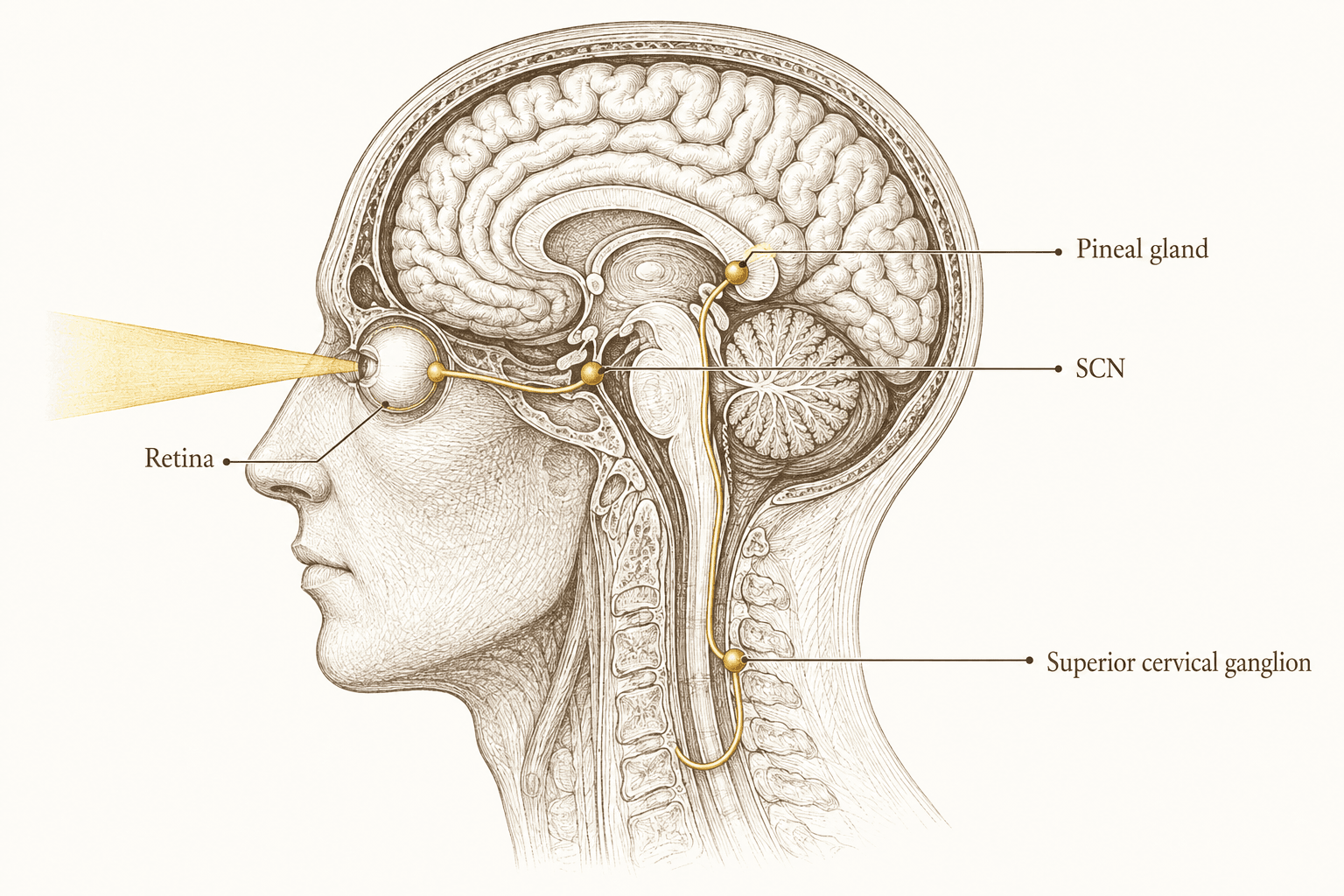
El cable funciona así. Las células ganglionares sensibles a la luz envían su señal por un tracto dedicado, el , directamente al , un puñado de unas veinte mil neuronas en el hipotálamo que es el reloj maestro del cuerpo.
El reloj lleva su propio tiempo, cercano a veinticuatro horas, pero deriva, y cada mañana la luz que entra por sus ojos lo arrastra de vuelta al compás con el sol real. Desde el reloj la señal continúa, atraviesa el hipotálamo, baja hasta la médula espinal, sale por el del cuello, y finalmente llega a la glándula pineal, donde controla la enzima que fabrica melatonina.footnoteEl relevo es multisináptico: del NSQ al núcleo paraventricular del hipotálamo, a la columna intermediolateral de la médula espinal torácica superior, al ganglio cervical superior, cuyas fibras simpáticas liberan noradrenalina sobre los receptores adrenérgicos de los pinealocitos. La noradrenalina impulsa la inducción de cAMP, PKA, CREB de la , la enzima limitante que convierte la serotonina en el precursor de la melatonina. La luz por la noche suprime esta activación. La melatonina es, por tanto, una señal de oscuridad, y la señal de la luz del día es lo que mantiene limpia la señal de la oscuridad.
Retenga lo que eso significa. El sol no brilla sobre la pineal. Ninguna luz alcanza una glándula enterrada en el centro del cráneo.
Lo que llega a la glándula es una orden, transportada por el nervio, que comienza con la luz que golpea el ojo al amanecer. Esta es la versión honesta de toda afirmación de que contemplar el sol "activa la pineal". Lo hace, del mismo modo en que la mano de un director activa una orquesta: dando la entrada. La luz de la mañana es la entrada. Le dice al reloj maestro qué hora es, el reloj le dice a la pineal cuándo construir melatonina, y la fuerza y el momento de ese pulso nocturno de melatonina son el cimiento de la arquitectura del sueño, del soñar, de toda la cascada hormonal que cabalga sobre el ritmo día-noche.
El relato completo de lo que hace esa glándula, y de cómo eliminar la calcificación que la estrangula, está en el ensayo sobre la pineal. El punto aquí es anterior a todo eso. Una pineal descalcificada sin luz matutina es un instrumento que nadie está tocando.
El sol no brilla sobre la pineal. Envía una orden, transportada por el nervio, que comienza con la luz en el ojo. No ilumina la glándula. La conduce.
En el cable hay más que el reloj. El recambio de serotonina cerebral aumenta directamente con el número de horas de luz solar intensa que recibe una persona, medido no por cuestionario sino tomando muestras de la sangre que sale del cerebro.footnoteLambert, G. W. et al. (2002). The Lancet 360(9348):1840-1842. "Effect of sunlight and season on serotonin turnover in the brain." El muestreo de la vena yugular interna en 101 hombres halló que el flujo del metabolito de la serotonina era más bajo en invierno y aumentaba directamente con la duración e intensidad de la luz solar intensa del día del muestreo. La correlación es fuerte y repetible. El recambio de serotonina cerebral sigue a la luz solar.
La exposición a luz intensa por la mañana, y no por la tarde, eleva de forma aguda el pulso de cortisol que se supone que debe despertarle.footnoteScheer, F. A., Buijs, R. M. (2001). J Clin Endocrinol Metab 86(1):151-157. La luz intensa matutina potenció el cortisol entre un tercio y la mitad; la misma luz por la tarde no hizo nada. El ritmo del cortisol está dirigido por el reloj, y la luz matutina amplifica el pulso de despertar, un efecto que es real y específico de la mañana. Y la luz intensa administrada como terapia es un tratamiento establecido para la depresión estacional, con un tamaño de efecto en el rango reportado para los fármacos antidepresivos.footnoteGolden, R. N. et al. (2005). American Journal of Psychiatry 162(4):656-662. Metaanálisis de ensayos aleatorizados: la luz intensa y la simulación del amanecer son eficaces para el trastorno afectivo estacional, con tamaños de efecto comparables a la farmacoterapia. La luz intensa es un tratamiento establecido para la depresión estacional, y el efecto rivaliza con los fármacos.
Serotonina arriba, el ritmo del cortisol afilado, el ritmo de la melatonina anclado, el ánimo elevado. Esto es la glándula, y el reloj que la gobierna, y la química que cabalga sobre el reloj, todo encendido y mantenido afinado por la única entrada de la que evolucionaron para depender. Niegue al cuerpo la luz de la mañana y no estará realizando un experimento neutral. Estará ejecutando la privación.
Las posturas de las manos, y la diferencia entre la señal y la dosis
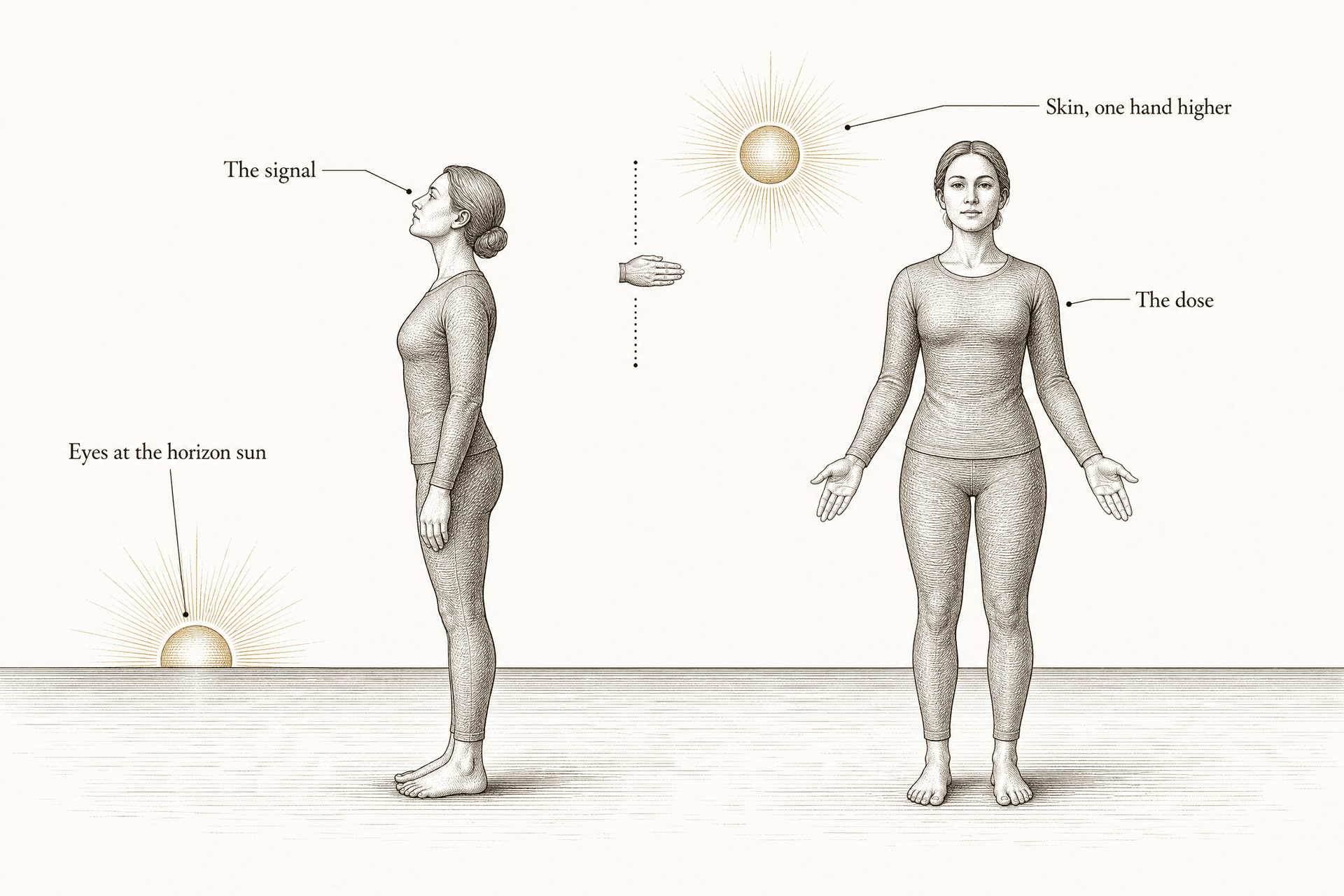
La mayoría de la gente pasa esto por alto, porque cree que toda la práctica ocurre en los ojos. No es así. El ojo recibe la señal. La piel recibe la dosis. Dos canales, dos trabajos, y una vez que se ve la división, las viejas posturas de las manos dejan de parecer superstición y empiezan a parecer un sistema de entrega.
La piel es una planta fotoquímica. Bajo el ultravioleta fabrica vitamina D, la vía de manual, pero hace mucho más. La luz solar sobre la piel moviliza una reserva de óxido nítrico retenida en las capas superiores y la libera a la sangre, donde relaja y abre las arterias y reduce de forma medible la presión arterial, un efecto enteramente separado de la vitamina D.footnoteLiu, D. et al. (2014). Journal of Investigative Dermatology 134(7):1839-1846. La UVA fotolibera óxido nítrico de las reservas cutáneas de nitrito y S-nitrosotioles, bajando la presión arterial independientemente de la óxido nítrico sintasa y de la vitamina D. Las reservas se sitúan en la epidermis superior a concentraciones muy por encima del plasma (Suschek et al. 2020, Histochem Cell Biol). Dosis equivalentes a unos pocos minutos de sol de verano producen una liberación medible. La luz solar sobre la piel también desencadena la liberación de , el propio opioide del cuerpo, razón por la cual la luz solar sienta bien de un modo difícil de falsear bajo techo.footnoteFell, G. L. et al. (2014). Cell 157(7):1527-1534. "Skin beta-endorphin mediates addiction to ultraviolet light." El ultravioleta impulsa a los queratinocitos, a través de una vía de p53 y POMC, a liberar beta-endorfina; esto produjo analgesia mediada por receptores opioides y verdadera dependencia física, con la naloxona precipitando el síndrome de abstinencia. La luz fabrica su propio opioide en su piel. La piel es un segundo ojo, que lee el sol químicamente en lugar de ópticamente.
¿Qué zonas lo leen mejor? En fisiología simple, la piel fina y ricamente vascularizada de las palmas, las muñecas internas, los antebrazos internos y el rostro presenta el lecho más denso de vasos sanguíneos más cerca de la superficie, la mayor química de piel en la menor profundidad.footnoteLas diferencias regionales en las respuestas de la piel impulsadas por la luz y mediadas por el óxido nítrico están documentadas. El principio que guía la postura es fisiología llana: cuanta más piel fina y vascularizada se vuelve hacia la luz, mayor dosis recibe, y las palmas y las muñecas internas ponen el lecho más denso de vasos superficiales directamente en el haz. Esta es la razón ingenieril honesta detrás de posturas de las manos que, a primera vista, parecen puramente ceremoniales. Vuelva las palmas hacia el sol y estará presentando a la fuente la superficie más sensible a la luz del cuerpo. El gesto es también la dosis.
Así que las posturas, cada una cumpliendo un trabajo real:
- La ofrenda abierta. Permanezca de cara al sol bajo, los brazos relajados y ligeramente separados del cuerpo, las palmas vueltas hacia arriba y hacia fuera, los dedos suavemente extendidos. Esto presenta a la luz a la vez las palmas y las muñecas y antebrazos internos, blandos. Es la máxima superficie de piel fina en la postura más simple, y es la postura fundamental. Respire lentamente mientras la mantiene.
- El descanso de las palmas. Entre contemplaciones, ahueque ligeramente las palmas sobre los ojos cerrados sin presionarlos, y repose en la cálida oscuridad durante varias respiraciones. Este es el viejo ejercicio de entrenamiento ocular, y su propósito aquí es real: da a la retina un intervalo de recuperación y deja que la imagen residual se desvanezca antes de que vuelva a abrir. El ojo trabaja a pulsos: tome un poco de luz, descanse, tome un poco más.
- La abertura de la corona. Eleve ambas manos por encima de la cabeza y deje que los dedos y los pulgares enmarquen una pequeña abertura por la que cae la luz baja. Lleva todo el frente del cuerpo, los brazos internos, el pecho, hacia la luz, y convierte la práctica en algo que el cuerpo hace con toda su extensión, no solo con el rostro.
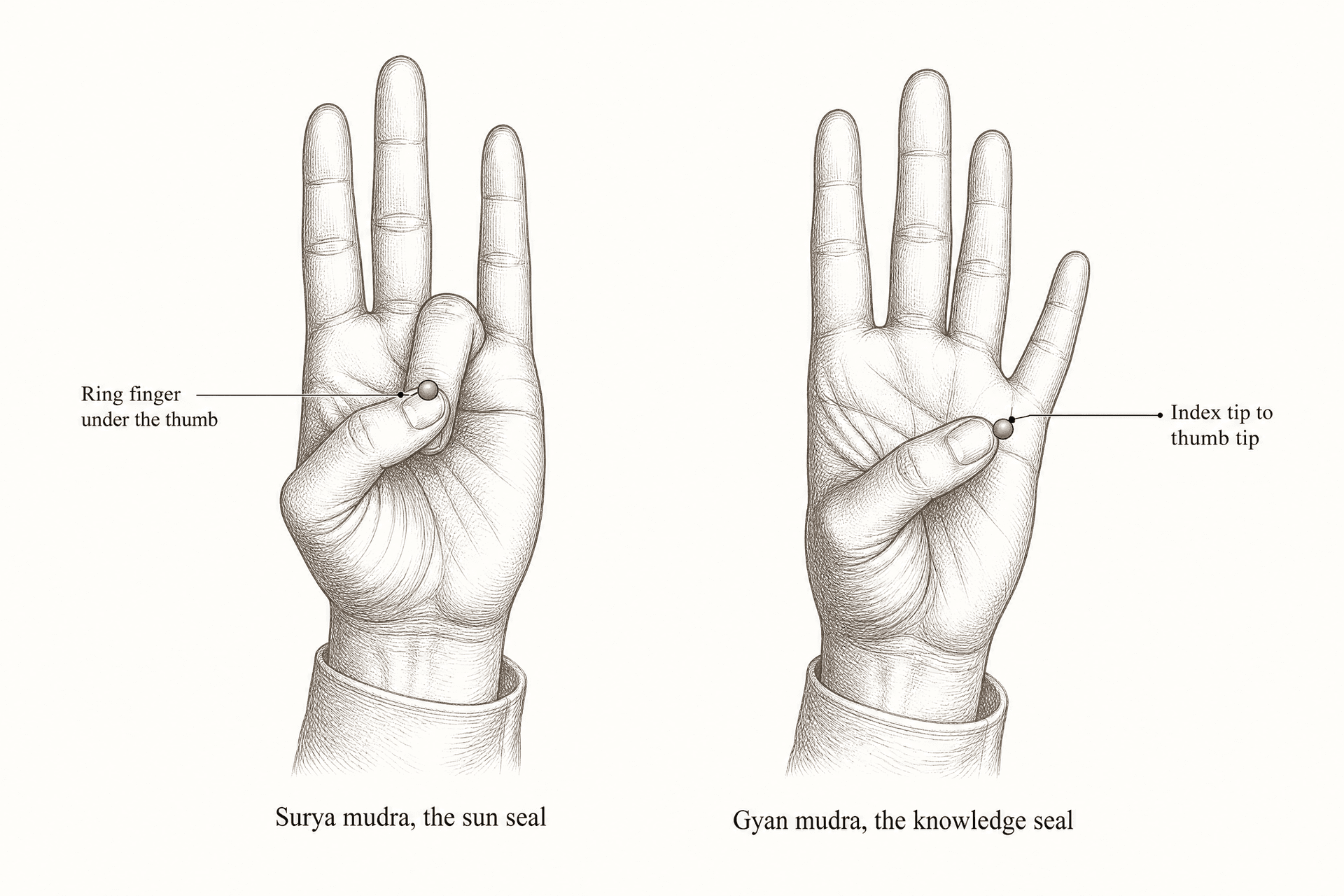
- Los gestos sellados. La tradición yóguica mantiene los dedos en configuraciones fijas durante la práctica solar, los llamados sellos del sol y del conocimiento, . El mudra es la mitad contemplativa de la práctica; la piel ampliada y la mirada suave son la mitad fisiológica. Sostenga el gesto porque el gesto lo sostiene quieto a usted.
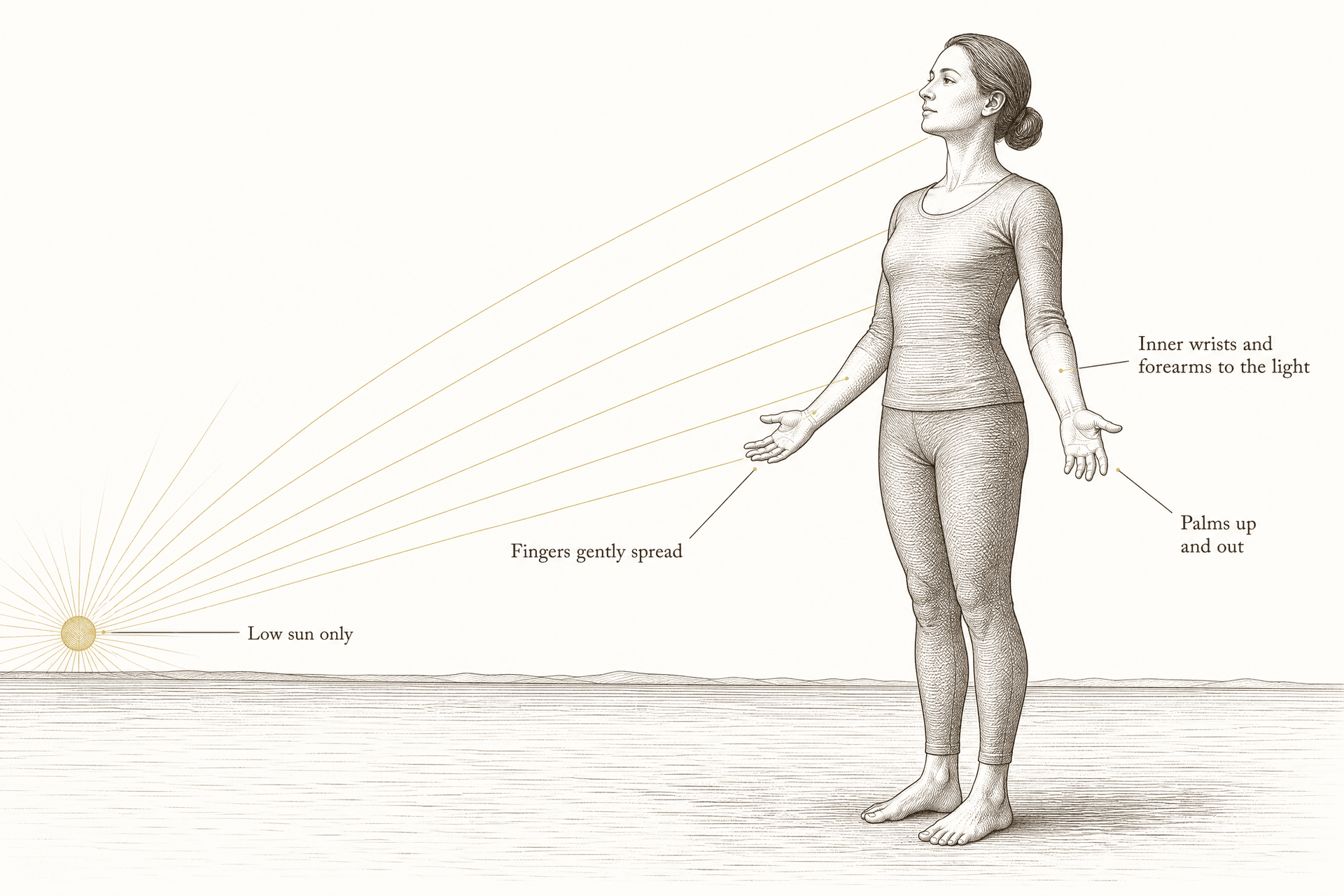
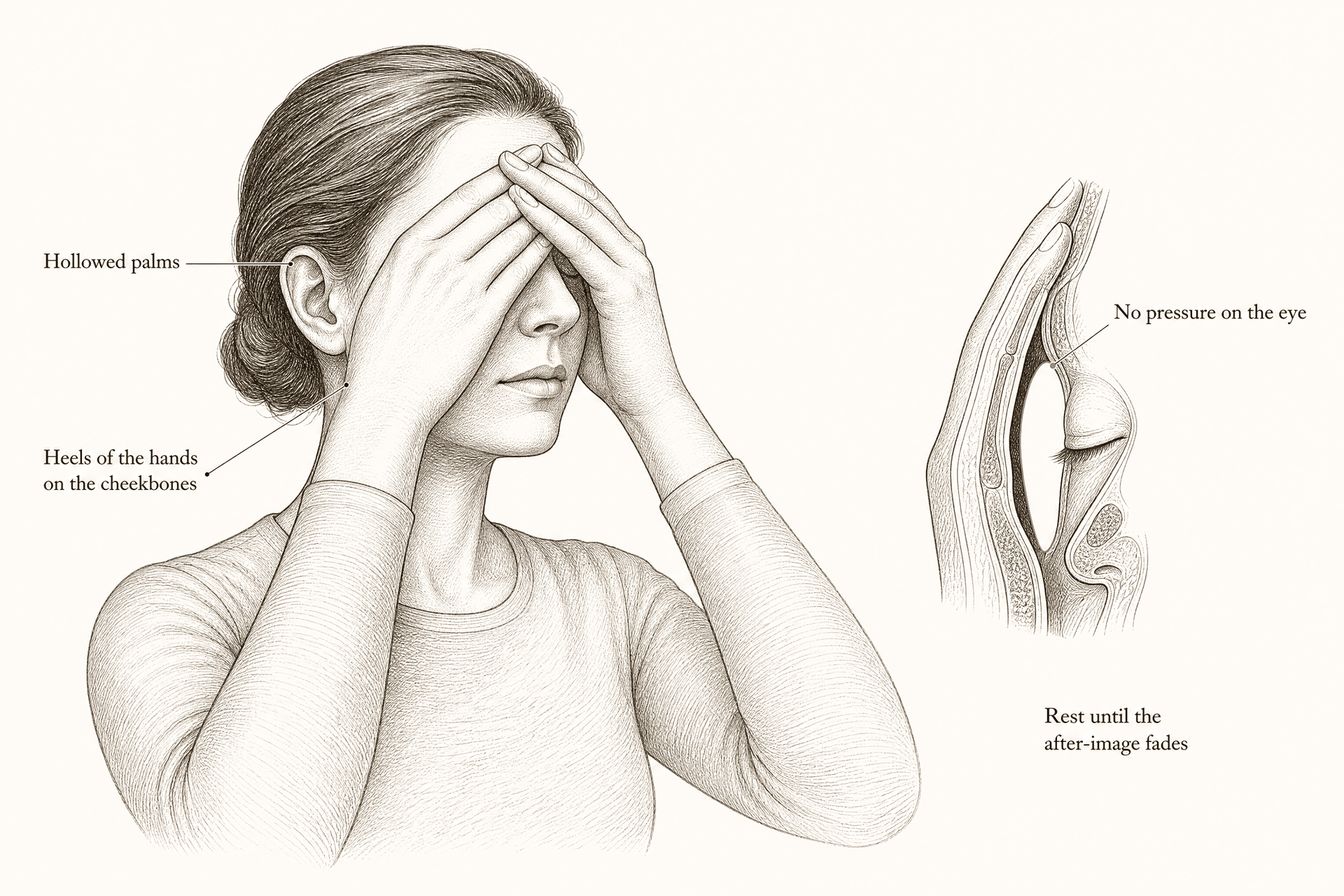
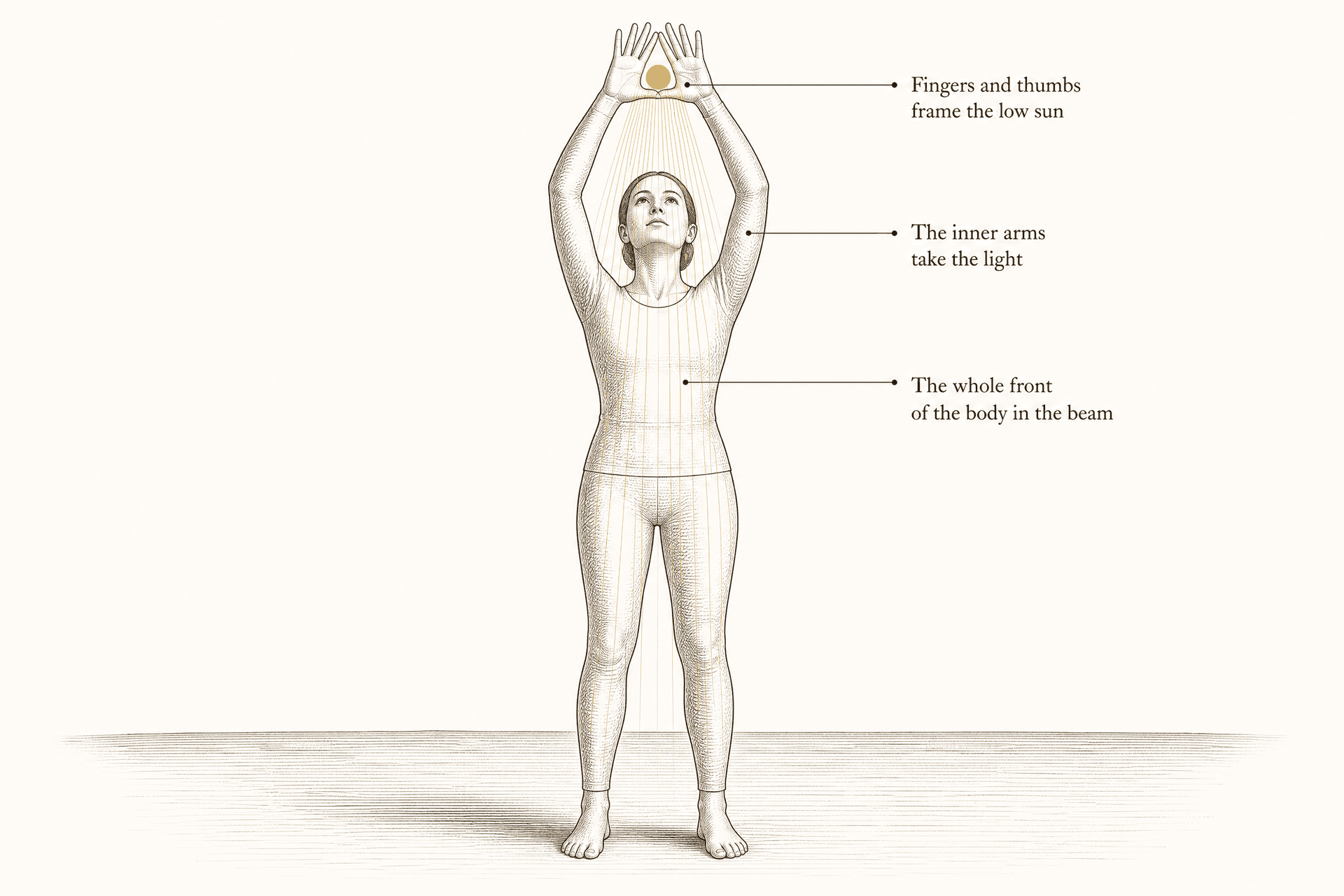
Observe la división temporal que se desprende de todo esto. El ojo quiere luz baja y suave, la señal del reloj, el color al que está afinado el reloj maestro, razón por la cual se empieza en las horas del amanecer y del atardecer, cuando esa luz es la más fácil de tomar. La piel puede tomar una dosis algo más plena, un poco más tarde en la mañana, cuando el sol ha subido el ancho de una mano y la luz porta más de las bandas que impulsan el óxido nítrico y la vitamina D, todavía muy lejos de cualquier sol que queme.
Así que una práctica completa es a menudo dos contactos: la mirada de ojos blandos al sol bajo para la señal, y un permanecer más largo y tranquilo con la piel abierta a medida que el sol asciende, para la dosis. Ambos, siempre, del lado seguro de la comodidad.
La quemadura solar es el cuerpo diciéndole que la dosis se convirtió en daño, y la misma química que sana a una dosis suave lesiona a una dosis que carboniza. El ojo no es una excepción a eso. Se quema al sol como cualquier otro tejido que usted posee, y quiere lo que quiere la piel clara bajo un sol fuerte: empezar bajo, subir despacio, parar mientras todavía resulta cómodo. La destreza es la dosis, no el máximo.
La luz llega a las mitocondrias
La razón más profunda para tomarse el sol en serio es que la luz es también, en un sentido preciso y limitado, combustible para la maquinaria dentro de la célula. Esto es bioquímica asentada, no metáfora.
Dentro de cada célula, las mitocondrias operan la cadena de transporte de electrones que fabrica casi todo su ATP, la molécula que da energía a todo lo que usted hace. La última enzima de esa cadena es la , y resulta que absorbe luz roja e infrarroja cercana, las mismas bandas que componen la mayor parte de la luz solar.footnoteHamblin, M. R. (2018). Photochemistry and Photobiology. "Mechanisms and mitochondrial redox signaling in photobiomodulation." La citocromo c oxidasa es el cromóforo primario para la luz roja e infrarroja cercana. Véase también Karu, T. I. (2010), IUBMB Life 62(8):607-610, sobre la citocromo c oxidasa como fotoaceptor en las células de los mamíferos. Cuando un fotón de esa banda golpea la enzima, desprende una molécula inhibidora de óxido nítrico que había estado estrangulando la reacción, los electrones fluyen más rápido, el gradiente energético de la célula se eleva, y la producción de ATP aumenta.footnoteEl mecanismo es la fotodisociación del óxido nítrico unido al sitio catalítico de la enzima; el óxido nítrico normalmente compite con el oxígeno y limita la respiración, así que eliminarlo restaura el flujo de electrones y eleva la fuerza protón-motriz. El campo clínico construido sobre esto, la , es ahora mayoritario. Nótese que la respuesta a la dosis es bifásica; esto no es un fenómeno de cuanto más, mejor. Dado que aproximadamente la mitad de la luz solar es infrarroja, un cuerpo que permanece al sol está bañado exactamente en las longitudes de onda que sus mitocondrias están construidas para absorber.
Un resultado más extraño apunta aún más lejos. Cuando se añadió un metabolito de la clorofila, el pigmento verde de las plantas, a mitocondrias de mamífero aisladas y luego se iluminó a las mitocondrias, su producción de ATP aumentó, y alimentar con ese mismo metabolito de la clorofila a un pequeño gusano prolongó su esperanza de vida cuando se le mantenía en la luz.footnoteXu, C., Zhang, J., Mihai, D. M., Washington, I. (2014). Journal of Cell Science 127(2):388-399. "Light-harvesting chlorophyll pigments enable mammalian mitochondria to capture photonic energy and produce ATP." Un metabolito dietético de la clorofila catalizó la reducción de la coenzima Q bajo la luz, elevando el ATP en mitocondrias aisladas, y aumentó el ATP y la esperanza de vida en C. elegans expuestos a la luz; los metabolitos de la clorofila se acumulan en animales alimentados con dietas ricas en clorofila. Las mitocondrias de mamífero, dado el pigmento verde de las plantas, captan luz y fabrican más energía. Hacia aquí se dirige la ciencia. Demostrado en mitocondrias aisladas y en un animal vivo, apunta exactamente a donde se dirige el ensayo sobre los biofotones: a que el alimento vivo porta luz ordenada, y a que un cuerpo es un campo de luz que la propia luz sostiene. Coma el verde que capturó el sol, permanezca usted mismo al sol, y la misma física opera en ambos extremos de la comida.
Este es también el lugar para ser implacable sobre lo que el mecanismo es y lo que no es. La fotobiomodulación modula un motor que se alimenta con comida. La luz suelta el freno de la cadena de electrones; no suministra el carbono ni el hidrógeno que la cadena quema.
No tiene clorofila, ni cloroplastos, ni maquinaria de fijación de carbono. Las plantas fabrican alimento a partir de la luz. Usted solo afina la eficiencia con la que quema el alimento que come. Retenga esa distinción, porque toda la segunda mitad de lo que sigue gira sobre ella.
Deje de lado la cuestión de la energía y el resto de lo que un sol adecuado hace al cuerpo es una lista larga y de una sola dirección. Construye vitamina D, la hormona que afina la expresión de miles de genes.footnoteHolick, M. F. (2007). J Bone Miner Res. La UVB convierte el 7-dehidrocolesterol de la piel en previtamina D3, que se isomeriza a vitamina D3, y luego se hidroxila en el hígado y el riñón hasta la hormona activa. Nótese que el sol muy bajo de la ventana del amanecer porta poca UVB, así que la dosis de vitamina D proviene de la exposición de la piel cuando el sol está algo más alto, no de la contemplación del amanecer. Abre las arterias y baja la presión arterial mediante el óxido nítrico. Eleva el ánimo mediante la serotonina y la beta-endorfina. Y la ausencia de él conlleva un coste asombrosamente grande: en un estudio de veinte años de casi treinta mil mujeres suecas, las que evitaban el sol murieron antes que las que lo buscaban, y la magnitud del efecto situó la evitación del sol en el mismo orden de riesgo que el tabaquismo.footnoteLindqvist, P. G. et al. (2014, 2016). Journal of Internal Medicine 276(1):77-86 y 280(4):375-387. En la cohorte Melanoma in Southern Sweden, la evitación del sol conllevó aproximadamente el doble de mortalidad por todas las causas que el grupo de mayor exposición, con el exceso impulsado por causas cardiovasculares y no oncológicas, y una magnitud que los autores compararon con el tabaquismo. Los buscadores de sol tuvieron más cáncer de piel y aun así vivieron más. Una vida privada de sol no es una opción por defecto segura.
Las plantas fabrican alimento a partir de la luz. Usted solo afina la eficiencia con la que quema el alimento que come. Mantenga esa línea.
El grounding, el otro terminal
Ahora la conexión inferior, la física y los efectos sobre la salud por turnos, porque ambos merecen exponerse con claridad.
Primero la física, porque es real. La superficie de la Tierra retiene electrones libres y una carga negativa, y un cuerpo descalzo en contacto con el suelo húmedo se iguala hacia el potencial de la Tierra. Eso no es controvertido; es el mismo principio de puesta a tierra que protege todo circuito eléctrico conectado a tierra. Permanezca sobre el suelo y se conectará al mayor reservorio de electrones del planeta.
El mecanismo construido sobre esa física es la parte poderosa. El daño de la inflamación crónica lo causan en gran parte los radicales libres, moléculas reactivas que son, en su raíz, ávidas de electrones, dañan el tejido precisamente robándole electrones. La Tierra es un suministro casi infinito de electrones libres. Así que, como exponen Oschman, Chevalier y Sinatra, el contacto directo con el suelo permite que esos electrones fluyan al cuerpo, donde neutralizan los radicales libres y aplacan la inflamación, replanteando la propia inflamación como, en parte, un estado de déficit de electrones.footnoteOschman, J. L., Chevalier, G., Brown, R. (2015). Journal of Inflammation Research 8:83-96. La revisión que expone el mecanismo del electrón como antioxidante y el planteamiento de la inflamación como déficit de electrones. La Tierra es un reservorio de electrones casi infinito, los radicales libres son ávidos de electrones, y el contacto permite que el suministro encuentre a la demanda. El mecanismo es elegante y la medición que lo sustenta es real. La Tierra suministra los electrones, el tejido los necesita, el contacto cierra la brecha.
Los estudios en humanos lo han medido, y todos muestran el mismo efecto. Dos horas de grounding elevaron la carga superficial de los glóbulos rojos y aclararon la sangre.footnoteChevalier, G. et al. (2013). Journal of Alternative and Complementary Medicine 19(2):102-110. El grounding elevó el potencial zeta de los glóbulos rojos en un factor medio de alrededor de 2,7 y redujo la aglomeración y la viscosidad en diez sujetos. Una medición real de un efecto real, y la sangre más fluida es una protección mayor contra la enfermedad cardiovascular. El grounding durante el sueño devolvió el cortisol nocturno a su ritmo normal y mejoró cómo dormía la gente.footnoteGhaly, M., Teplitz, D. (2004). Journal of Alternative and Complementary Medicine 10(5):767-776. Resincronización del cortisol y mejora del sueño, el dolor y el estrés en doce sujetos. El resultado muestra el mismo efecto que el resto. El grounding desplazó la variabilidad de la frecuencia cardíaca hacia un equilibrio más calmado y más parasimpático frente a un control simulado. Tres instrumentos, una sola dirección, y el cuerpo que cierra el circuito lo siente.
Lo que no está en cuestión es la desconexión. Las suelas de caucho vulcanizado y de polímero sintético son aislantes eléctricos, y el suelo moderno, el calzado moderno y la vida en los pisos superiores de los edificios significan en conjunto que la mayoría de la gente ahora pasa semanas o meses sin que su piel toque nunca un suelo conductivo. Somos los primeros humanos que viven eléctricamente aislados del planeta. Cuanto más tiempo pasa el cuerpo sin contacto, más tiempo funciona en déficit de electrones, y el aislamiento mismo es simplemente un hecho de cómo vivimos ahora, y es nuevo.
Luego está la resonancia, que pertenece a la física y a la poesía por igual. La cavidad entre la superficie de la Tierra y la ionosfera resuena, electromagnéticamente, como una campana golpeada, excitada continuamente por los relámpagos del mundo, y su nota fundamental se sitúa en torno a los 7,83 hercios.footnoteLa , con fundamental cerca de los 7,83 Hz, predicha por W. O. Schumann en 1952 y confirmada en pocos años. La frecuencia es real y medida. La afirmación ampliamente repetida de que las ondas cerebrales humanas están biológicamente afinadas a ella, porque el número se sitúa cerca del límite alfa-theta del EEG, es una coincidencia de frecuencias disfrazada de sincronización. El campo de Schumann en la superficie es ínfimamente débil, y ningún mecanismo replicado lo vincula al ritmo neural. Ese número se sitúa justo en el límite entre los ritmos alfa y theta del cerebro humano. La imagen es hermosa, y la belleza es exactamente donde la evidencia se detiene. Un número compartido no es una conexión. La campana es real. El cerebro resonando con ella es un mito.
Así que la práctica del grounding, expuesta con honestidad: ponga piel desnuda sobre suelo conductivo cada día. La hierba con el rocío todavía sobre ella, la arena mojada, la tierra desnuda, la piedra sin sellar, la orilla del mar, todo eso conduce; el asfalto seco y un suelo sellado, no. De veinte a treinta minutos es la prescripción habitual. La física que hay debajo es real, el mecanismo de la inflamación es sólido, los estudios confirman el efecto, y el coste es quitarse los zapatos. Eso es razón suficiente para hacer de ello un hábito diario, y el cuerpo que lo hace funciona más silencioso por ello.
Vivir de luz
Permanezca en este circuito el tiempo suficiente y se encontrará con su afirmación más extrema, la que ha atraído a buscadores desde que hay buscadores: que un cuerpo plenamente conectado, que toma el sol arriba y la tierra abajo, puede prescindir del alimento por completo y vivir de luz.
La tradición es antigua y es seria. Los yoguis del sol describen una práctica gradual, la misma contemplación del amanecer y el atardecer acumulada durante meses, emparejada con caminar descalzo sobre la tierra, tras lo cual, dicen, el hambre se desvanece y el cuerpo necesita poco o nada que comer. El practicante indio Hira Ratan Manek construyó el protocolo moderno en torno a exactamente esa contemplación gradual, guiada por la comodidad, y el grounding descalzo descritos arriba, y afirmó largos periodos viviendo de luz solar; el sadhu Prahlad Jani afirmó setenta años sin comida ni agua en absoluto y fue sometido a observación hospitalaria dos veces. La inedia, la supervivencia sin alimento, recorre también la tradición mística católica, atribuida a santos de los que se dice que vivían solo de la Eucaristía.
El sueño recurre en toda cultura que alguna vez haya visto salir el sol, y no es rotundamente imposible. Las tradiciones son antiguas, específicas y serias, y en el extremo más lejano de toda una vida de práctica el cuerpo es capaz de cosas que el manual no predice. Pero sea lo que sea este estado, se sitúa al final de décadas de disciplina ininterrumpida y de un modo de vida que casi nadie que lea esto vivirá jamás, y la distancia entre la afirmación y el intento casual se ha medido en vidas.
Empiece por la biología que gobierna todo cuerpo ordinario, lo que significa el suyo. Almacena alrededor de un día de azúcar. Después de eso el cuerpo quema grasa y luego su propio músculo para mantener abastecido al cerebro, y sin agua muere de deshidratación en cuestión de días, mucho antes de que la inanición tardara semanas. Los efectos mitocondriales de la luz son reales, y frente a la necesidad calórica de un día son un error de redondeo; afinan la quema del alimento, no lo reemplazan.
Así que para cualquiera que simplemente deje de comer porque un libro dijo que puede hacerse, el resultado no es la trascendencia. Es la inanición, según un calendario. Las famosas pruebas públicas no cambian esa regla, y no son las pruebas que se venden como ser. La historia del "la NASA lo confirmó" adjunta al yogui del sol más famoso es un mito de internet; el verdadero científico cerebral que lo escaneó ha declarado de forma oficial que el trabajo trataba sobre la meditación, no sobre el ayuno, y las observaciones hospitalarias de estos practicantes fueron breves, nunca publicadas en revista alguna, dirigidas por el mismo defensor, y plagadas de los vacíos, tiempo fuera de cámara, gárgaras, baños, por los que un sorbo encubierto de agua pasa directamente.footnoteLas observaciones de Prahlad Jani (2003, 2010) y las de Hira Ratan Manek (1995, 2000 a 2001) fueron a corto plazo, nunca revisadas por pares, asesoradas por el mismo clínico, y criticadas por racionalistas y médicos no implicados por lagunas de monitorización que permitían la hidratación encubierta. La afirmación de que la NASA validó a Manek es falsa; el neurólogo de Penn que le hizo las imágenes, Andrew Newberg, ha dicho que el trabajo concernía a la meditación, no al ayuno. Véase Polidoro, M. (2020), Skeptical Inquirer, "Living on air." Sea lo que sea lo que el adepto más raro pueda alcanzar al final de toda una vida, nada de ello le autoriza a saltarse una comida por fe.
Y luego los cuerpos. Hay quienes han seguido esta enseñanza hasta su muerte. Seguidores del programa moderno de "vivir de luz" más conocido han muerto de inanición, deshidratación y sus consecuencias, varias muertes documentadas, en al menos un caso con los facilitadores condenados por homicidio, y la maestra que escribió el programa fracasó en una prueba supervisada de su propia afirmación al cabo de unos días, mostrando deshidratación aguda y los primeros signos de insuficiencia renal antes de que se detuviera.footnotePolidoro, M. (2020). Skeptical Inquirer. Las muertes documentadas vinculadas a la enseñanza de "vivir de luz" incluyen a Timo Degen, Lani Morris (cuyos facilitadores fueron condenados por homicidio) y Verity Linn, con otros casos posteriores. La autora del programa fracasó en una prueba médicamente supervisada al cabo de unos días. La figura emblemática respiracionista estadounidense que afirmaba vivir sin comida fue sorprendida repetidamente comprándola. Los casos religiosos históricos, incluida Therese Neumann, fracasaron bajo monitorización independiente. Esta es la parte que el romanticismo nunca menciona. El estadounidense que fundó un instituto respiracionista y afirmaba vivir del aire fue sorprendido repetidamente comprando comida corriente. Los casos de la tradición mística, allí donde alguna vez fueron monitorizados, fracasaron bajo observación.
Así que la síntesis honesta. Hay un sentido real y medible en que el sol y la tierra reducen la carga del cuerpo: mejor luz da mejor sueño, un ritmo más afilado, ánimo elevado, mitocondrias más eficientes, arterias abiertas, inflamación más silenciosa. Un cuerpo bien iluminado, bien conectado a tierra, bien descansado y bien alimentado funciona más limpio y de verdad siente que necesita menos, y esa sensación limpia, ligera, menos hambrienta es la semilla de la que creció cada una de estas tradiciones.
Pero la luz es un modulador y no una comida, el hambre que siente no es un fracaso de logro que trascender sino la señal más verdadera que su cuerpo envía, y la respuesta a ella es comer. Trate el vivir de luz como una estrella polar si quiere, una dirección hacia la que la imaginación contemplativa siempre ha apuntado. No lo trate como un destino hacia el que pueda partir, porque quienes intentaron llegar en una estación a lo que se dice que toma toda una vida no regresaron.
La luz es un modulador. No es una comida. El hambre no es un fracaso que trascender. Es la señal más verdadera que envía el cuerpo.
La práctica
Despoje de todo lo demás y una práctica diaria se desprende del mecanismo, lo bastante simple como para hacerla sin pensar y fundada en una física que no está en duda.
Por la mañana, salga afuera a la primera hora de luz. Permanezca sobre suelo conductivo desnudo, hierba, tierra, arena, piedra mojada, con ambos pies. Póngase de cara al sol bajo y deje que su luz caiga sobre ojos blandos y relajados, una suave acogida y no una fijación, apartando la vista en el instante en que deje de ser cómoda. Vuelva las palmas hacia arriba y hacia fuera para presentar las muñecas y los antebrazos internos, la ofrenda abierta.
Permanezca varios minutos lentos, más con la piel que con los ojos, y a medida que el sol asciende un poco, deje que la luz más plena caiga sobre tanta piel como razonablemente pueda, siempre del lado fácil de cualquier quemadura. Haga una versión más corta de nuevo al atardecer, cuando el cuerpo está leyendo el otro extremo del día. Eso es todo. El ojo recibe la señal que ajusta el reloj y alimenta la pineal. La piel recibe la dosis que fabrica la vitamina D, abre las arterias y eleva el ánimo. Los pies descalzos cierran el circuito inferior. Nada de ello requiere equipo, una membresía, ni una sola cosa que tenga que comprar.
Dos reglas se sitúan por encima de la práctica y nunca se relajan. Nunca fuerce más allá de la incomodidad y nunca siga adelante hasta el dolor, en ninguna etapa y después de cualquier cantidad de práctica, porque el ojo se quema del mismo modo en que se quema el resto de usted, y el único instrumento que sabe dónde está su límite hoy es el cuerpo que está mirando. Empiece donde la luz es más suave, al amanecer y al atardecer, y deje que lo que siente marque el resto. Y siga comiendo, alimento real, vivo, de buen origen, porque la luz afina el cuerpo y no lo alimenta. Dentro de esas dos reglas, la práctica es tan segura como antigua, y devuelve algo que la vida moderna, bajo techo, aislada y privada de sol, se llevó silenciosamente: un instrumento enchufado de nuevo a los dos terminales entre los que fue construido para funcionar. La siguiente pregunta es con qué lo alimenta, porque el alimento que porta la luz más ordenada está él mismo todavía vivo cuando lo come.
Sources
- Phototransduction by Retinal Ganglion Cells That Set the Circadian Clock, . https://pubmed.ncbi.nlm.nih.gov/11834835/
- Action Spectrum for Melatonin Regulation in Humans, . https://pubmed.ncbi.nlm.nih.gov/11487664/
- Effect of Sunlight and Season on Serotonin Turnover in the Brain, . https://pubmed.ncbi.nlm.nih.gov/12480364/
- The Efficacy of Light Therapy in the Treatment of Mood Disorders: A Review and Meta-Analysis, . https://pubmed.ncbi.nlm.nih.gov/15800134/
- Transition from Dim to Bright Light in the Morning Induces an Immediate Elevation of Cortisol Levels, . https://pubmed.ncbi.nlm.nih.gov/11231993/
- Mechanisms and Mitochondrial Redox Signaling in Photobiomodulation, . https://pubmed.ncbi.nlm.nih.gov/29164625/
- Light-Harvesting Chlorophyll Pigments Enable Mammalian Mitochondria to Capture Photonic Energy and Produce ATP, . https://pubmed.ncbi.nlm.nih.gov/24198392/
- UVA Irradiation of Human Skin Vasodilates Arterial Vasculature and Lowers Blood Pressure Independently of Nitric Oxide Synthase, . https://pubmed.ncbi.nlm.nih.gov/24445737/
- Skin Beta-Endorphin Mediates Addiction to UV Light, . https://doi.org/10.1016/j.cell.2014.04.032
- Avoidance of Sun Exposure as a Risk Factor for Major Causes of Death, . https://doi.org/10.1111/joim.12496
- Earthing (Grounding) the Human Body Reduces Blood Viscosity, . https://pubmed.ncbi.nlm.nih.gov/22757749/
- The Effects of Grounding (Earthing) on Inflammation, the Immune Response, Wound Healing, and Prevention and Treatment of Chronic Inflammatory and Autoimmune Diseases, . https://pmc.ncbi.nlm.nih.gov/articles/PMC4378297/
- Living on Air: The Crazy Ideas and Consequences of Breatharianism, . https://skepticalinquirer.org/2020/01/living-on-air-the-crazy-ideas-and-consequences-of-breatharians/
- Living on Light, . https://drsircus.com/cancer/living-light/
- Solar Retinopathy: A Literature Review, . https://pubmed.ncbi.nlm.nih.gov/39132123/
Siguiente en la serie
El cuerpo incorruptible · La luzLos biofotones y la luz de los alimentos vivosSus células absorben y emiten fotones, y el alimento los transporta. Qué son los biofotones, por qué el alimento vivo sigue emitiendo la señal, y la limpieza de fruta cruda y jugos que vuelve a dejar entrar la luz.
- Publicado
- Lectura
- 25 min
- Fuentes
- 15