
El Suelo, Capítulo 4
El manual del comprador de suplementos: por qué menos es más y cómo elegir lo que funciona
La mayoría de los comprimidos de suplementos son 80 por ciento de relleno y un remanente que se absorbe mal. Los rellenos que hay que rechazar de inmediato, por qué lo iónico y lo líquido superan al comprimido, y el stack diario mínimo eficaz.
Abra el multivitamínico de su botiquín y pese lo que en realidad está pagando. Cincuenta miligramos de principio activo se alojan dentro de cuatrocientos miligramos de pulpa de madera, y el recubrimiento blanco que le da aspecto farmacéutico es una nanopartícula prohibida en toda la Unión Europea desde agosto de 2022. Ha comprado un disco prensado de relleno industrial que lleva dentro una traza de nutrición, en una forma química que su intestino absorbe al cuatro por ciento. La industria de los suplementos es un tren de carga de 180.000 millones de dólares que avanza sobre una sola premisa, que más es mejor, y el consumidor avanza sobre una segunda, que una hoja verde en el frasco significa que es bueno para el cuerpo. Ninguna de las dos premisas se sostiene.
La disciplina que sí funciona es pequeña. Elija pocos. Elija iónico o quelado. Elija natural antes que sintético. Rechace los rellenos. La mayoría de la gente incumple todos y cada uno de estos puntos.
Un suplemento que el cuerpo no puede absorber es un suplemento que se excreta, después de que el cuerpo ha pagado el coste metabólico de intentar procesar la matriz de relleno en la que llegó.
Reponer los ocho minerales esenciales es un problema. Comprarlos es un segundo problema, y la industria está construida para que usted lo pierda.
Este es el manual del comprador: qué formas cruzan la pared del intestino, qué frascos son sobre todo pulpa de madera, y qué se gana un sitio en un botiquín que funciona.
El principio de tomar menos
La primera regla de la disciplina en suplementación es que el stack debe ser pequeño. La segunda regla es que debe ser más pequeño todavía.
La mayoría de la gente entra en un pasillo de Whole Foods y sale con quince frascos, cada uno convincente delante del estante. El cuerpo no puede integrar quince cosas a la vez. La absorción de cualquiera de ellas cae mientras compite por los mismos sitios transportadores con las otras catorce. El coste es alto, y el cumplimiento se derrumba antes de un mes.
La forma que funciona es la inversa: ocho o nueve elementos centrales tomados a diario, dosificados a los niveles que la literatura respalda.
El décimo y el undécimo rara vez suman. Lo habitual es que uno desplace a un elemento central y el beneficio total baje.
Este es el modelo que la farmacología ya aplica. Hoy se entiende que la produce peores resultados que las propias condiciones que pretendía atender, y la última década de práctica se ha movido con decisión hacia la desprescripción. La misma aritmética gobierna su botiquín. El stack no tiene que ser largo. Tiene que ser el correcto.
Los rellenos que hay que rechazar de inmediato
En un comprimido, el ingrediente activo suele ser una minoría de la masa.
El resto es la matriz de fabricación: el volumen que mantiene unida la pastilla, el lubricante que le permite pasar por prensas de alta velocidad, el recubrimiento que la hace fácil de tragar y le da aspecto farmacéutico. Parte de ello es inerte y aceptable. Varios elementos no lo son. La lista de rechazo innegociable.
Dióxido de titanio (E171)
Un agente blanqueante presente en recubrimientos de comprimidos y en carcasas de cápsulas, prohibido como aditivo alimentario en toda la Unión Europea desde agosto de 2022, después de que la que no podía descartarse la genotoxicidad y que no podía fijarse una ingesta diaria admisible. Estados Unidos no ha seguido ese paso. Los fabricantes estadounidenses lo siguen usando con total libertad, así que la etiqueta es su única protección.
El mecanismo: el dióxido de titanio se administra en forma de nanopartículas. , se acumulan en el hígado, el bazo y el cerebro, y no existe vía de excreción para el titanio acumulado. La dosis diaria es pequeña. Las dosis diarias pequeñas a lo largo de cuarenta años no lo son.
Rechácelo. No hay justificación nutricional alguna. El fabricante lo eligió para que la pastilla se viera blanca. Encuentre una marca que no lo use.
Celulosa microcristalina
Pulpa de madera, y no es una manera de hablar. La celulosa se extrae de la madera o del línter de algodón, se hierve en ácido para disolver las regiones amorfas blandas, y el resto cristalino y duro se muele hasta un polvo blanco y fino que se prensa maravillosamente en un disco. Suele ser más de la mitad de la masa de un comprimido oral y, en los peores, más cerca de nueve décimas. La pastilla que lleva 50 mg de activo y 400 mg de celulosa no tiene nada de rara, y la etiqueta está dispuesta para que usted no lo note.
Ningún ser humano fabrica una enzima capaz de cortarla. La celulosa es glucosa unida por un , de modo que cada gramo que entra recorre el intestino entero químicamente intacto y sale como lo que entró. Una vaca resuelve esto con un reactor de fermentación de cuatro cámaras y una población microbiana residente que hace el corte en su nombre. Nosotros no tenemos uno. Tampoco es la fibra soluble y fermentable de las verduras que las bacterias del colon descomponen en las grasas de cadena corta que alimentan el revestimiento intestinal, porque la hidrólisis ácida que fabrica la celulosa microcristalina existe precisamente para retirar la fracción que fermentaría. No alimenta nada. Ni a usted, ni al microbioma.
Lo que hace en cambio es ocupar sitio y raspar. Se queda como bulto inerte a lo largo del intestino delgado, desplazando físicamente material digerible y justo en los sitios de absorción a los que el comprimido se compró para llegar. Las partículas son duras, insolubles y cristalinas, y contra un revestimiento intestinal de una célula de grosor se comportan más como grava que como comida. Un adulto muy suplementado, con diez o quince comprimidos al día, empuja varios gramos de madera molida por ese revestimiento a diario, todos los días, durante décadas. En un intestino de motilidad lenta, que es la mayoría de los intestinos pasados los sesenta, se apelmaza en vez de pasar. Un subconjunto nada despreciable de personas desarrolla con los años una hipersensibilidad declarada.
No hay argumento para tragarse esto. Está en la pastilla porque es barata, porque fluye y porque se prensa, y cada uno de esos beneficios es del fabricante. Compre el polvo, el líquido o una cápsula llena de activo y nada más, a un fabricante que está en el mismo estante y se la ahorra. Las cápsulas hechas de celulosa vegetal (las cápsulas vegetales, la alternativa estándar a la gelatina) son otra categoría y en general están bien: la cubierta es una masa pequeña de un derivado soluble en agua, se disuelve y se quita de en medio.
Dióxido de silicio (SiO2, "agente antiapelmazante")
Sílice amorfa sintética, usada como agente de fluidez para evitar que el polvo se apelmace en las líneas de envasado de alta velocidad. La FDA la defiende como GRAS (generalmente reconocida como segura) a las dosis alimentarias habituales. La preocupación más reciente es la misma cuestión de translocación de nanopartículas que con el dióxido de titanio: modulan la permeabilidad intestinal por la misma vía. Está en prácticamente todos los suplementos convencionales, ingerida a lo largo de décadas. Rechace los productos que la llevan en cantidad. Nada de ella le alimenta.
Polietilenglicol (PEG) y derivados del PEG
Un solubilizante y agente de recubrimiento, y el componente adyuvante implicado en la anafilaxia por vacunas de ARNm, hoy entendido como más alergénico de lo que se suponía. ha subido con fuerza desde que el PEG entró a escala industrial en el suministro alimentario y farmacéutico. Rechácelo donde lo encuentre.
Colorantes sintéticos y tintes alimentarios
FD&C Amarillo 5 y 6, Rojo 40, Azul 1 y 2. Valor puramente cosmético, derivados del petróleo, prohibidos en medicamentos infantiles en buena parte de Europa. No hay excusa para que estén en un suplemento.
Aceites hidrogenados
Aceite de soja parcialmente hidrogenado, aceite de palma o similares, usados como aglutinante del comprimido. El mismo perfil metabólico que las grasas trans industriales expulsadas del suministro alimentario, promotoras de inflamación a fuego lento. Rechácelos por el principio de que nadie se los comería a sabiendas como ingrediente alimentario.
Maltodextrina y "aroma natural"
La maltodextrina es un polímero de azúcar derivado del maíz que dispara la glucosa en sangre con más fuerza que el azúcar de mesa en los estudios clínicos de respuesta glucémica, y se usa como agente de volumen y portador de aroma. "Aroma natural" es una categoría regulatoria que cubre prácticamente cualquier cosa que el fabricante quiera declarar secreto industrial, de forma rutinaria glutamato monosódico, propilenglicol y una cesta de residuos de disolventes. Ambos señalan una formulación de baja calidad.
Las excepciones aceptables
Hay tres ingredientes que aparecen en casi todas las listas de rellenos temibles y que, a la vista de la evidencia, están bien. Están aquí para que no rechace un producto limpio por el motivo equivocado.
- Estearato de magnesio. El relleno más temido de la internet del bienestar, y un agente de fluidez a concentración inferior al 1 por ciento, derivado del ácido esteárico (un ácido graso saturado presente en la grasa animal y vegetal). La afirmación de que forma una "biopelícula" que bloquea la absorción carece de apoyo bioquímico; los estudios que la produjeron midieron la respuesta de linfocitos aislados, no la absorción intestinal. La literatura real, la revisión de Tebbey y Buttke y los datos posteriores de la industria, no ha producido un solo caso de efecto adverso a las dosis de fabricación de suplementos. Rechazarlo estrecha su acceso a productos bien formulados y no le aporta nada. Déjelo pasar.
- Cápsulas de gelatina. Proteína pura, derivada de piel de vacuno o de cerdo, la carcasa de la cápsula, digerida como proteína. La alternativa vegetal (HPMC, hidroxipropilmetilcelulosa) está igual de bien. La gelatina no es la peor opción.
- Cápsulas vegetales a base de celulosa (HPMC). Bien, como arriba. Distíngalas de la celulosa microcristalina usada como agente de volumen dentro de la cápsula. La carcasa de la cápsula en sí es una cantidad pequeña y una aplicación distinta.
El principio de la forma: iónico, luego quelado, luego todo lo demás
El mismo mineral en dos formas químicas puede dar una diferencia de un orden de magnitud en cuánto cruza la pared del intestino y llega a las células.
Es la variable más pasada por alto al elegir un suplemento, y donde el consumidor paga de más de forma rutinaria por un producto que el cuerpo no puede usar. Tres categorías, en orden de biodisponibilidad.
1. Iónico (el patrón oro)
Los minerales iónicos ya están separados en el estado atómico cargado que el cuerpo usa. es magnesio que ya se ha desprendido de la sal portadora y flota en el agua como iones Mg2+ libres. Lo mismo vale para el zinc iónico (Zn2+), el cobre (Cu2+), el selenio (selenito o selenometionina), el yodo (I- o I2) y los oligoelementos.
La absorción se acerca al máximo teórico porque no hace falta trabajo digestivo para liberar el mineral de su portador. Los transportadores de la pared del intestino recogen el ion directamente. La biodisponibilidad típica va del 70 al 95 por ciento, frente al 4 a 30 por ciento de un comprimido corriente.
La forma es casi siempre líquida, a menudo un cuentagotas que entrega de 50 a 250 microlitros por dosis. Marcas que han defendido bien lo iónico durante mucho tiempo: Trace Minerals Research, ConcenTrace, Quinton, Eidon. El mercado alcanzó a lo iónico en la última década y el coste bajó con él.
2. Quelado (un segundo puesto sólido)
Un quelato es un mineral ligado a un aminoácido o a un ácido orgánico que el cuerpo reconoce como vehículo de transporte. La molécula quelante escolta al mineral por delante de la competencia en la pared del intestino, se absorbe como complejo y libera el mineral dentro del cuerpo. Los (los más populares para el magnesio y el zinc), los , los picolinatos, los malatos y los aspartatos son las formas queladas de uso corriente. El citrato es el caso más débil: bien para el zinc y el calcio, pero el citrato de magnesio solo se retiene en parte y se mantiene osmótico en el intestino, que es la razón por la que funciona mejor como laxante que como forma de reposición.
La tecnología patentada de glicinatos de Albion (vendida como TRAACS en muchas etiquetas) es el quelato validado por terceros con más rigor del mercado. Los estudios muestran ventajas de absorción de 2 a 4 veces sobre la sal mineral básica y una tolerancia gástrica sustancialmente mejor.
Es la forma que usan la mayoría de los suplementos bien formulados en comprimido y en cápsula. Para los minerales cuya forma iónica es difícil de encontrar o inestable en líquido (el hierro, el calcio, el complejo B, las vitaminas liposolubles), la forma quelada es la opción por defecto correcta.
3. Sales inorgánicas (la forma barata, la de siempre y la peor)
Es el multivitamínico de supermercado, el "calcio" de la farmacia de cadena, el "magnesio" barato. El óxido de magnesio es el peor infractor: se absorbe alrededor del 4 por ciento de una dosis de óxido, mientras que el otro 96 por ciento atrae agua al intestino por ósmosis y le produce al usuario heces sueltas, que el usuario confunde entonces con un "efecto detox".
Las formas de óxido, carbonato, gluconato y sulfato existen en la cadena de suministro porque son las más baratas de fabricar y llevan la mayor densidad de miligramos por pastilla. Tienen la absorción más baja. Siguen figurando en la mayoría de los suplementos genéricos de una farmacia hospitalaria. Rechácelas. La regla necesita una aclaración, porque decide una compra real. Una sal ya disuelta en agua no es el mismo objeto que esa misma sal prensada en seco en un disco. El sulfato de zinc es el caso que importa: como comprimido pertenece a esta categoría de abajo, mal absorbido y áspero con el estómago vacío, mientras que las gotas de zinc iónico que recomienda el capítulo de los minerales son esa misma sal plenamente disociada en solución, lo que las coloca en lo alto de la escalera y no en su fondo. Lo que se está clasificando aquí es la sal inorgánica seca en un comprimido prensado, donde el intestino tiene que hacer la disolución y casi nunca la hace. La química del anión es una variable menor que el estado en el que llega.
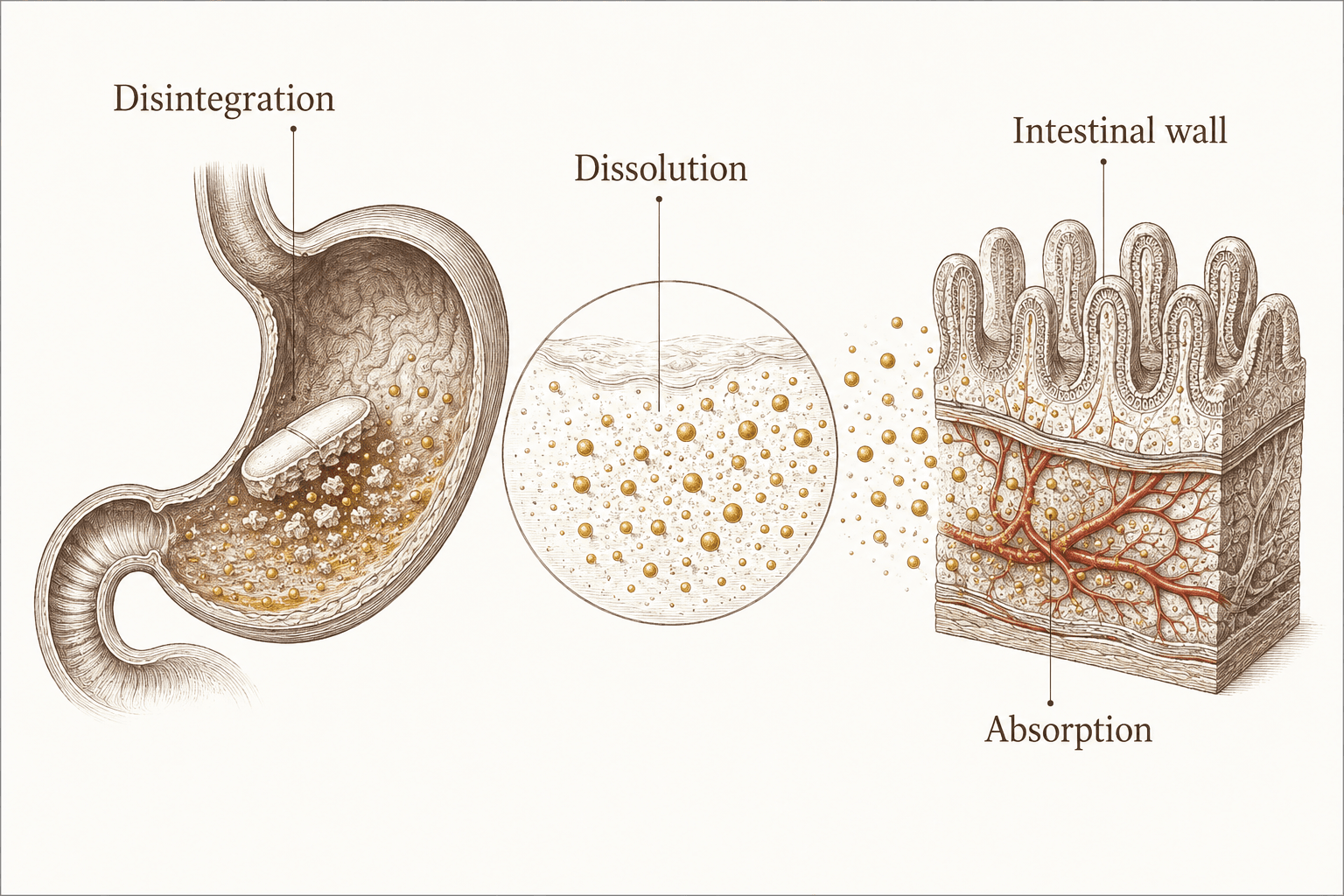
Por qué el líquido gana al comprimido, casi siempre
Un comprimido es un disco prensado de ingrediente activo más aglutinantes, lubricantes, disgregantes y a menudo un recubrimiento.
Para absorberlo, el cuerpo tiene que disolver primero la matriz de aglutinantes, luego disolver el activo que hay dentro y luego transportarlo a través de la pared del intestino. Cada paso pierde eficiencia.
Un líquido ya está en disolución. No hay paso de disgregación. El activo está en la superficie de absorción en el momento en que sale del estómago. , la absorción empieza debajo de la lengua y esquiva por completo el metabolismo de primer paso del hígado.
Las dos ventajas concretas del líquido sobre el comprimido:
- Sin matriz de relleno. Una dosis de 1 mL de una tintura está más cerca del 95 por ciento de activo y agua que del 20 por ciento de activo y 80 por ciento de relleno de un comprimido típico.
- Flexibilidad de dosis. Un cuentagotas entrega incrementos de 50 a 250 microlitros. Un comprimido entrega exactamente lo que el fabricante fijó en la prensa. Para los minerales que se titulan contra un valor de laboratorio (el yodo, el zinc, el cobre), esto importa mucho.
Los casos en que un comprimido o una cápsula son el mejor formato:
- El glicinato de magnesio y otros quelatos de masa alta. Una dosis clínica (de 200 a 400 mg de magnesio elemental) en líquido supone un volumen diario grande; el comprimido es más compacto. La vía transdérmica que cubre el ensayo sobre los minerales es la alternativa de alto rendimiento.
- Las vitaminas liposolubles (A, D, E, K). Disponibles en gotas líquidas con base oleosa, el mejor formato; disponibles también en cápsulas blandas, que están bien. La forma de comprimido seco es la peor de las tres. Tome las formas naturales: D3 en vez de D2, tocoferoles mixtos naturales en vez de dl-alfa sintético, y K2 como MK-7.
- Los activos de masa alta que se toman una vez al día (creatina, taurina, glicina, MSM) se venden como polvo a granel y se dosifican por gramos en agua. Ese es el formato correcto y no es en absoluto una cuestión de comprimidos.
Elija las vitaminas B metiladas
Las vitaminas del grupo B se venden en dos grados que la etiqueta trata como iguales y el cuerpo no. Las formas sintéticas baratas, la cianocobalamina para la B12 y el ácido fólico para el folato, no son las formas con las que el cuerpo funciona. La cianocobalamina lleva un grupo cianuro que el hígado tiene que escindir y desechar antes de que la vitamina sea utilizable; el ácido fólico tiene que atravesar varios pasos de conversión antes de llegar a ser el folato que las células usan de verdad. Cerca de cuatro de cada diez personas llevan una variante común del gen que estrangula esa conversión, de modo que el ácido fólico sintético se acumula sin convertir en la sangre mientras las células siguen escasas, una deficiencia escondida dentro de un suplemento completo.
Compre las formas activas y metiladas que el cuerpo usa directamente: metilcobalamina o hidroxocobalamina para la B12, metilfolato (5-MTHF) para el folato y piridoxal-5-fosfato (P5P) para la B6.
Cuestan un poco más y se saltan la conversión con la que las formas baratas apuestan. Es el mismo principio que lo iónico frente al óxido, aplicado a las vitaminas: tome la forma que el cuerpo fue construido para usar, no la que era más barata de fabricar.
El argumento a favor del ácido ascórbico
La vitamina C se gana su propia línea, porque desempeña más trabajos en el cuerpo que casi ninguna otra molécula. La molécula en sí es lo único indiscutible de este estante: el ácido ascórbico es ácido ascórbico, y el cuerpo no distingue el hecho en el laboratorio del que está en una naranja, porque átomo por átomo son el mismo objeto. Dentro de qué lo compra usted es donde se juega la decisión entera, y casi todo el pasillo suspende.
Lo que hace, en pocas palabras, es mantener unidos el tejido del cuerpo y su química. Es el cofactor innegociable para construir , que es la piel, los vasos sanguíneos, las encías, el tendón y el hueso; el escorbuto de los marineros era un fallo del colágeno por falta de esta sola molécula. Es el principal antioxidante hidrosoluble del cuerpo, regenera la vitamina E y alimenta el reciclaje del glutatión, el antioxidante maestro. Se concentra sobre todo en las glándulas suprarrenales, y se gasta bajo estrés para construir las hormonas del estrés. Hace falta para convertir la dopamina en noradrenalina y para sintetizar carnitina, y eleva marcadamente la absorción del hierro vegetal.
También tira en contra de la carga de metales pesados de un siglo contaminado. Una vitamina C más alta va de la mano de un plomo en sangre marcadamente más bajo en el conjunto de la poblaciónfootnoteSimon, J. A., Hudes, E. S. (1999). Journal of the American Medical Association. "Relationship of ascorbic acid to blood lead levels." En la población de NHANES III, las personas del tercio superior de ácido ascórbico sérico tenían una prevalencia marcadamente menor de plomo elevado en sangre que las del tercio inferior, con independencia de otros factores., y apoya la excreción de plomo, cadmio y mercurio, tanto alimentando las propias vías de quelación del cuerpo como neutralizando el daño oxidativo que un metal suelto causa dentro de la célula mientras el cuerpo lo va sacando. Es un socio barato, diario y suave del trabajo con metales pesados del ensayo sobre los aislantes.
La dosis es generosa, porque el cuerpo retiene solo lo que necesita y excreta el resto: de uno a tres gramos al día, repartidos a lo largo del día, y más durante una enfermedad o una desintoxicación intensa.
Cómprelo como ácido L-ascórbico en polvo 100 por cien puro, con una línea en el panel de ingredientes y nada debajo. Remuévalo en agua, bébalo y fije usted mismo la dosis.
La razón para ser rígido en esto es lo que llevan las alternativas, porque casi nada de lo que se vende como "vitamina C" es vitamina C. Un comprimido masticable es ácido ascórbico dentro de sacarosa o sorbitol, ácido esteárico, un aroma artificial de naranja y un colorante sintético. Un comprimido efervescente es sobre todo un motor de burbujas de bicarbonato y ácido cítrico, con sorbitol, aspartamo o sucralosa, polietilenglicol y color. Una gominola es una golosina con una muestra simbólica de vitamina C dentro: jarabe de glucosa, gelatina, aceite de palma, cera de carnauba, colorante. Los frascos de "alimento entero" y "a base de alimentos" envuelven unas decenas de miligramos de ascorbato real en una mezcla de frutas patentada rellenada con harina de arroz, y luego cobran varias veces el precio por el relato, y ningún ensayo controlado ha demostrado nunca que la matriz de fruta supere a la molécula desnuda. Los comprimidos de liberación prolongada y los tamponados añaden polímeros de recubrimiento y un portador mineral sobre el que la etiqueta frontal calla. Cada uno de ellos es el capítulo de los excipientes que acaba de leer, revendido con un halo de salud.
A uno o tres gramos al día, tomados a diario durante años, los aditivos son una exposición acumulada mucho mayor que la vitamina. El polvo puro es además el más barato por gramo, y con diferencia. Su único inconveniente real es que es ácido, y la respuesta a eso es zumo o una pizca de bicarbonato, que lo convierte en el vaso en ascorbato de sodio y deja caer la misma molécula con suavidad, no un comprimido azucarado diseñado para esconder el sabor.
El stack mínimo eficaz
Combine los principios anteriores y este es el stack diario mínimo eficaz para un adulto con dieta occidental, antes de cualquier capa específica para una condición concreta.
- Magnesio iónico líquido, o aceite transdérmico de cloruro de magnesio, tomado a diario. El mineral más deficitario de la dieta moderna.
- Yodo de Lugol líquido al 2 por ciento, empezando por 2 a 6 gotas diarias y titulando hacia el rango de carga de 6 a 10 gotas (unos 15 a 25 mg) que usan los protocolos de minerales y de la pineal, siempre acompañado de selenio.
- Gotas de selenio iónico, de 100 a 200 mcg al día. No selenometionina, por la razón dada más arriba.
- Gotas de sulfato de zinc iónico, de 15 a 25 mg al día, con bisglicinato o picolinato como alternativa en cápsula, acompañado de bisglicinato de cobre de 1 a 2 mg al día si mantiene zinc alto a largo plazo.
- Vitamina D3 con K2 (MK-7), de 5.000 a 10.000 UI de D3 con 200 mcg de MK-7. En gotas líquidas con base oleosa o en cápsula blanda.
- Boro, de 3 a 10 mg al día, como bórax disuelto en agua o como glicinato de boro.
- Metilcobalamina B12 sublingual, de 1.000 a 5.000 mcg al día si es vegetariano o vegano; de 500 a 1.000 mcg al día como seguro incluso para omnívoros de más de 50, cuando el ácido del estómago baja y la absorción cae.
- EPA/DHA, de 1 a 3 g al día, de un aceite de pescado salvaje limpio o de un aceite de algas.
- Ácido ascórbico, en polvo 100 por cien puro, de 1 a 3 g al día, repartidos a lo largo del día, y más durante una enfermedad o una desintoxicación intensa.
Nueve elementos. Cada uno responde a una carencia que el suministro de alimentos por sí solo, en 2026, no cubre de forma fiable.
El décimo, el decimoquinto, el vigésimo son casi siempre netamente negativos. El cuerpo no puede integrar la carga, la absorción compite, el presupuesto se dispara, el cumplimiento se derrumba.
Capas por encima de esto, para situaciones concretas:
- Para calcificación activa o trabajo arterial: añada tiosulfato de sodio intravenoso (administrado por un médico) y considere Cavadex según el ensayo sobre los minerales.
- Para el ánimo, el sueño o el trabajo de metilación: añada metilfolato más B12, con la dosis ajustada a la homocisteína.
- Para el estrés oxidativo o el trabajo de desintoxicación: añada NAC 600 mg al día más glutatión (liposomal sublingual o intravenoso).
- Para un protocolo vegetariano o vegano: añada creatina de 3 a 5 g, taurina de 1 a 3 g, carnitina de 500 a 1500 mg, y retinol de aceite de hígado de bacalao o una gota de vitamina A preformada, según el ensayo complementario sobre la muerte del suelo y los alimentos animales.
- Para los sustratos hormonales: añada zinc, magnesio, boro (ya en el stack central), más tongkat ali o shilajit si sigue un protocolo androgénico.
El principio se sostiene.
Cada capa responde a un hallazgo de laboratorio concreto o a un protocolo concreto. Ninguna se añade de forma especulativa, ninguna se conserva una vez que el laboratorio entra en rango.
Un suplemento que no hace nada después de 90 días es un suplemento que no está funcionando, cueste lo que cueste y por buena que sea la historia de la marca.
Qué hacer con el frasco que ya tiene
La mayoría de los lectores llegan aquí con un botiquín ya comprado, una parte bueno, otra parte malo. El triaje:
- Lea todas las etiquetas. Busque dióxido de titanio, aceite hidrogenado, colorantes FD&C. Rechácelos de inmediato.
- Mire la forma del activo. ¿Óxido de magnesio? Fuera. ¿Carbonato de calcio sin K2? Fuera. ¿Multivitamínico en comprimido con ocho aglutinantes y las dosis de activo por debajo del 25 por ciento del valor diario? Fuera.
- Compruebe el origen y la forma. Prefiera la forma natural o metilada a la sintética barata, y al fabricante que publica un certificado de análisis. Un activo sintético en un frasco sin análisis publicados es el primero que hay que retirar.
- Juzgue por resultados. Si un suplemento lleva 90 días y no se ha movido nada, ni en cómo se siente ni en un valor de laboratorio, no le está funcionando. Déjelo.
- Consolide. Apunte a la lista mínima eficaz más sus añadidos concretos. El botiquín de veinte frascos se reduce a la lista central en menos de un mes.
El arco
Bien hecha, la suplementación es un ajuste fiscal por vivir en un siglo en el que el suelo está agotado, la comida está contaminada y la carga diaria de desintoxicación es más pesada que la de cualquier generación anterior.
Mal hecha, es la industria del bienestar cobrándole por la apariencia de una intervención mientras el cuerpo casi no absorbe nada de lo que se pagó.
La versión correcta es pequeña, iónica cuando se puede, quelada cuando no, natural antes que sintética, líquida cuando el formato existe, y lo bastante disciplinada como para dejar lo que no funciona. Nueve elementos, tomados con constancia, superarán por mucho a un botiquín de veinte.
Con los minerales repuestos y las formas correctas absorbiéndose de verdad, el cuerpo tiene por fin la materia prima que le faltaba. Ese es el terreno restaurado, y es la mitad fácil del trabajo.
Lo que a un cuerpo le falta puede comprarse en un frasco. Lo que lleva toda una vida acumulándose dentro, no, y despejar eso es el siguiente trabajo.
Sources
- Safety Assessment of Titanium Dioxide (E171) as a Food Additive, . https://www.efsa.europa.eu/en/efsajournal/pub/6585
- Re-Evaluation of Sodium, Potassium and Calcium Salts of Fatty Acids (E 470a) and Magnesium Salts of Fatty Acids (E 470b) as Food Additives, . https://doi.org/10.2903/j.efsa.2018.5180
- Bioavailability of Magnesium Diglycinate versus Magnesium Oxide in Patients with Ileal Resection, . https://pubmed.ncbi.nlm.nih.gov/7815675/
- Comparative Absorption of Zinc Picolinate, Zinc Citrate and Zinc Gluconate in Humans, . https://doi.org/10.1007/BF01974946
- Folate: Fact Sheet for Health Professionals, . https://ods.od.nih.gov/factsheets/Folate-HealthProfessional/
- Excipients in the Paediatric Population: A Review, . https://doi.org/10.3390/pharmaceutics13030387
- Critical Review of the Safety Assessment of Nano-Structured Silica Additives in Food, . https://pubmed.ncbi.nlm.nih.gov/27287345/
- Immediate-Type Hypersensitivity to Polyethylene Glycols: A Review, . https://pubmed.ncbi.nlm.nih.gov/27196817/
- Relationship of Ascorbic Acid to Blood Lead Levels, . https://pubmed.ncbi.nlm.nih.gov/10386552/
- Treatments and Products, . https://drsircus.com/protocol-recommendations/
- All About Ascorbic Acid, . https://www.youtube.com/watch?v=0kIGfZMrIZs
- How to Buy Vitamins (Part 1 of 2), . https://www.youtube.com/watch?v=zN_RFzYnXYI
- How to Buy Vitamins (Part 2 of 2), . https://www.youtube.com/watch?v=uF0bNTepwbQ